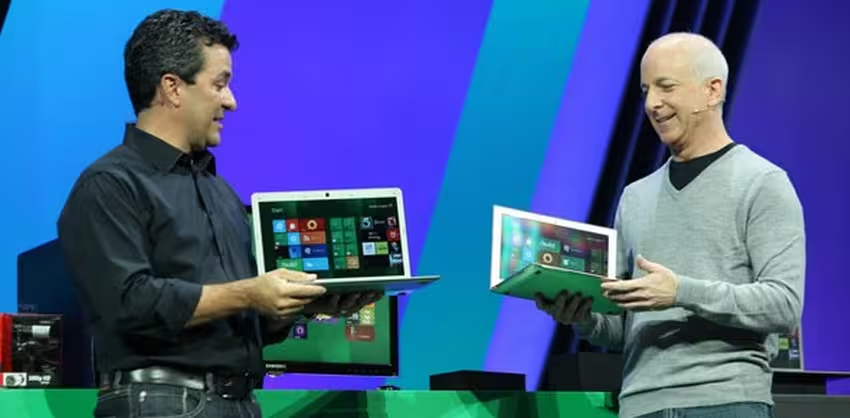
One of the more interesting aspects of Windows 8 is that its minimum hardware specifications are quite low, compared to current market hardware norms, and that it is designed to employ less total RAM than its predecessor, Windows 7.
The reason for this, it appears, is that Windows 8 is built for form factors that are new to the Windows platform, such as tablets, that usually sport lower-power components than traditional desktop and laptop computers. Microsoft’s plan appears to be, ‘keep the requirements low, and the OS can be sold on cheap, battery-sipping slates.’ As far as ideas go, it’s a good one.
Here is an example of this. The Kindle Fire, now shipping, has been received with reviews that contain mixed elements, but are generally positive. There is one feature of these early notices that we want to focus on: the guts of the machine, and how they translate into normal use. This is The Verge on the Fire’s browser: “it seems a little sluggish.” And on the firmware that is included: “the overall OS performance feels stuttery and sluggish.” And on the Fire’s speed compared to other Android-based tablets: “a little more bogged down than what you’d get with a raw Android experience.”
In short, the Fire is a slow on a number of fronts. Now, keep in mind that we are talking about a device that retails for $200. Here is a fact: The Fire can very nearly run Windows 8. All it needs is another 8 gb of internal storage, and an extra half gigabyte of RAM. In short, not much. And this device is struggling a bit to run Android. It makes you think.
That oddness, when combined with today’s news that quad-core Android tablets are due in the market before Windows 8 will land, only compounds our head scratching. Why does it appear that Windows 8 may actually be lighter-weight than Android? That simply doesn’t make sense. And yet at BUILD Microsoft hit on the idea again and again that you can run Windows 8 on an older netbook, which would certainly have its lunch eaten by the Fire’s specs (in general), and definitely by this four-core HTC tablet that we will see in 2012.
Why are Android OEMs pushing such high-end hardware to run Android, when Windows 8 is moving the goalposts in the other direction? This is my guess: Android manufactures are stuck in a never-ending updraft war with each other to build hardware that sells on its specs, which explains the coming overpowered tablets that are likely to be battery draining (this excepts the Fire, of course). At the same time, Microsoft is perhaps cognizant of the battery life numbers that the iPad 2 has posted, and wants to match them. If that is possible remains an open question; thus far the iPad remains in a class of its own in several aspects.
But the future is set: Windows 8 can almost run on a Kindle Fire, a device that costs $200. The OS is not set to land for a year. That means that when it is released, a new generation of the Kindle Fire will likely be in the market. For $200. And it will sport an improved spec list, while Windows 8’s requirements will not have budged. That means that Windows 8, when it comes, will run on $200 hardware. And that is damn impressive.
Get the TNW newsletter
Get the most important tech news in your inbox each week.
Also tagged with


