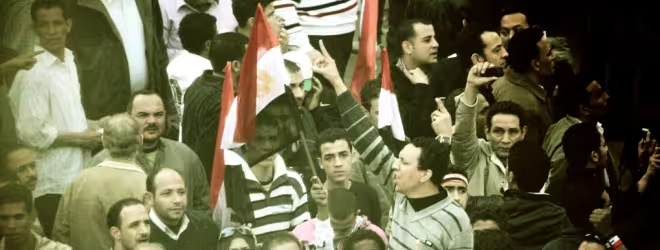
Ask any Egyptian how much of an influence the Internet was in the nation’s uprising, the first thing they’ll probably do is roll their eyes at you. I’ve certainly mentioned it countless times – International media found the perfectly convenient package of the Facebook revolution fueled by a Google executive. A better lede couldn’t have been written if they had made it up themselves.
But the thing is, there is as much fiction in that phrase as there is fact. Yes the Facebook page We Are All Khaled Said, created by the Google executive Wael Ghonim, was instrumental in mobilizing a certain demographic in Egypt. But long after Hosny Mubarak was toppled, figures have emerged to prove that calling the uprising in Egypt in any way, shape or form, a Facebook Revolution, is almost as ridiculous as the short-lived name, the Lotus Revolution, a name which had absolutely nothing to do with the movement.
In case you’re curious, the Lotus Revolution was a name that followed the just as ill-thought out name for the Tunisian uprising, the Jasmine Revolution. Both names were no doubt dreamed up by journalists who had visited the countries once upon a time, and were enamoured with the exotic, oriental, incense-filled alleyways of Cairo and Tunis. The reality of these uprisings couldn’t be further from the Orientalist postcard snapshot that is continually forced down our throats.
The reality of the uprising in Tunisia is that it was sparked by a young man, Mohamed Bouazizi, who lit himself on fire, because that was the only form of protest he had left to use. The reality of the uprising in Egypt is that it was sparked by a young man, Khaled Said, who was brutally beaten to death in an alleyway, while people watched, helpless as he begged for his life.
So with that in mind, it’s no surprise that the Wikileaks parody ad that seemed to be taking a bit of credit for the Egyptian revolution has sparked outrage among Egyptian activists.
Mosa’ab El Shamy, an Egyptian activist and photographer who spent the 18 days of the uprising in Tahrir, told The Next Web, “I thought we would only have to counter all the local corporates here, which were trying to claim credit for the revolution and share a ride on the bandwagon, but Wikileaks, is to me, the worst of them all.”
Many local companies have been accused of playing both sides in Egypt, bowing to the regime before the uprising, and in a lightening quick chameleon change, their colours were suddenly an entirely red, white and black display of supposed patriotism and pride in Egypt’s revolution.
El Shamy goes on to explain his views on Wikileaks conceding, “I believe it’s changing the world in its own way and their effort is a prime and noble one, but it’s ludicrous to hear Mr. Assange in the ad declare with a cheeky grin as he watches the imagery of protesters pushing police forces back from Kasr el Nil Bridge that ‘the world changing as a result of his work is priceless.’”
In fact, as Egyptian blogger Zeinobia pointed out in her response to the parody ad, most of the Wikileaks cables relating to Egypt were never translated or published in local media for a variety of reasons, ranging from a fear of retribution to simply a matter of bad timing, with more important issues taking the attention of the Egyptian media and its audience.
Ironically, much of the information that the Wikileaks cables revealed about the Egyptian authorities was already common knowledge. Egypt is a country that saw bloggers and journalists imprisoned for voicing their opinion. Egypt is a country where questioning the president’s health was punishable with imprisonment. It is not a country which was waiting for Wikileaks cables to spark a movement that was years in the making.
El Shamy points to another ad that saw an even bigger backlash from Egyptian activists, bloggers and tweeters. A Vodafone ad which had originally been released a few weeks before the January 25 protests, was re-released online, with a newly added introduction, in which the telecom company seemed to be attempting to take a bit of the credit for mobilizing the masses.
Comparing the two, El Shamy says of the Wikieaks ad, “I find it more dangerous, and ‘under-attacked.’ Assange is an international, popular figure and millions are ready to follow his steps and take his word; and here lies the danger of ‘brainwashing’ more masses than the ones who believe that it was all his work.”
Wikileaks parody ads aside, no matter how many times the theory is debunked with statistics and personal stories, the Internet revolution keeps rearing its ugly head. El Shamy comments, “It’s always entertaining to see the media to rinse and repeat stories about how tech savvy our revolution was, how Facebooked, YouTubed and Twittereized it is, but I believe it is taken out of context this way, and is an insistence on showing a small, rather unrepresentative aspect of the Egyptian revolution. The huge majority of Egyptians who took to the streets weren’t on Facebook or didn’t mind on missing on the Twitter fad, the impoverished and underfed and ragged clothed certainly weren’t motivated by a Facebook event or some videos they saw on YouTube. That should be acknowledged sooner or later or else I think it’s a huge injustice to them, and an elitist perspective.”
The Egyptian revolution was an incredible coming together of men and women, from different backgrounds, different religions, different cities, and throughout the country, they stood side by side and called for one thing. To even attempt to credit that to the Internet, to Wikileaks, or to anything else other than the perseverance of the Egyptian people is to ignore the facts.
The role that the Internet did play was to get the story out. El Shamy was one of many who tweeted his way through the revolution. Asking him how he personally used the Internet during the 18 day uprising, he says, “I used it to tweet, tweet, tweet and tweet. I reported everything as I saw and answered people’s questions and tried chronicling what it felt to be in Tahrir for over two weeks. I interacted with fellow activists who were away from the square or other parts of Cairo and tried convincing as much people who supported and followed our news through the internet but feared for their safety. It was an amazing experience.”
El Shamy does give credit to the Internet where credit is due. “I think the Internet played a fine role during those 18 days, but did the revolution come to a halt or lose mobilization when the service was cut off the whole country? Definitely not. It was useful that we let the world know, and gradually increase pressure on the regime from outside, and it acted as an anti-propaganda tool when the media was spreading all kind of lies, and I think we made the best of it. But it simply shouldn’t be overstated.”
As Egyptian state TV televised calming images of the Nile, YouTube and Twitter were witness to brutal violence and tear gas-filled shots of a struggle for freedom. As Egyptian state TV broadcast stories of a Tahrir infiltrated by foreign spies from the four corners of the world, hell bent on bringing Egypt to its knees, YouTube and Twitter told of men and women who stood against snipers, thugs, and even a raid of camels and horses, to come out victorious.
When it comes to the actual figures, Facebook penetration in Egypt in April 2011 stands at 7%, with Tunisia’s penetration rate far higher at 22%. And let’s not forget that not all Facebook users in the region were automatically supporters of the uprising. Facebook arguments in the post-January-25 world were common. The number of photos of Hosny Mubarak that appeared as profile pictures on Facebook after the former President stepped down is proof of that. Country-wide protests were not waiting for Facebook members to take to the street.
Yes, activists used Facebook and Twitter to coordinate among themselves, even far before January 25. Yes, Flickr and YouTube were essential in disseminating information to the wider public. But the number of people who took the streets because of a call on Twitter cannot be compared to the number of people who took to the streets because of the on-the-ground efforts of activists who ventured into areas of Cairo, and Egypt as a whole where Twitter was virtually unheard of, and spread awareness. Not in a country where the number of Twitter accounts didn’t exceed 130,000 in April 2011. In fact, the number of people who joined the protests as they watched from their balconies as hundreds and thousands of protesters passed in the streets, chanting “Come down” probably exceeded the Twitter effect as well.
On January 28, I watched minutes before a similar crowd passed beneath my balcony, as a young man quickly passed out fliers to people in the street. He handed the sheets of paper to men standing in the street, threw them at the feet of a crowd of women who were gathered at a street corner, ducked quickly into shops and ran right back out again. I never saw what the flyer said, because by the time I ran down into the street, his fliers were nowhere to be seen, as he disappeared into a crowd of protesters who had fast approached, accompanied by a large crowd of helmeted riot police and police cars, pacing alongside them, peaceful for the moment.
It is men like him who are truly to be credited with mobilizing the Egyptian people. It is men like him who made the Egyptian people take to the streets, knowing there was a possibility they would not be coming home. To say that Facebook can be equated with each and every person’s effort on the ground is to take a little bit of credit away from men like him.


cute girls photos….!!!!!
http://career-world-guide.blogspot.com/2011/06/blog-post_4356.html
hot and sexy china girls….!!!!
http://career-world-guide.blogspot.com/2011/06/blog-post_4356.html
hot and sexy japan girls….!!!!
http://career-world-guide.blogspot.com/2011/06/blog-post_4356.html
hot and sexy china girls….!!!!!!!!
http://career-world-guide.blogspot.com/2011/06/blog-post_4356.html
hot and sexy china girls….!!!!!!!!!!
http://career-world-guide.blogspot.com/2011/06/blog-post_4356.html
hot and sexy china girls….!!!!
http://career-world-guide.blogspot.com/2011/06/blog-post_4356.html
<><><><><><><><><><><><><><><><><><><><><><><><><><><>
hot and sexy china girls….!!!!
http://career-world-guide.blogspot.com/2011/06/blog-post_4356.html
><><><><><><><><><><><><><><><><>
Hmmm, a good article, but i think it stays within a very limited discourse of social media was great or it played no role. In fact much of the discourse has over played the technological side of social media tools and played down the human, the social side.
For example the April 6th Movement very successfully used Facebook to assist in co-ordinating a massive strike in solidarity with workers in Mahalla in 2008. In fact April 6th only came together as a network after the success. So i think we need to try and untangle the actual relationship. Political and social justice activists have always, right throughout history, tried to use what ever tools they can to fight injustice, to topple the institutions, power centers and social relations that are the source of inequality, indignity and injustice. I totally agree that it is all to easy to over inflate the roles and imports of particular tools, as people may be attracted to their ‘newness’, particualarly the lazy ill thought out churnalism that dominates western media forms. However i do think that it is possible to uncover and describe the actual use of social media tool by activists – and people who wouldnt consider themselves ‘activists’ in the traditional sense – in ways that dont seek to remove the very real fact that it was the work,commitment and sacrafice of people themselves. For those of us engaged in struggle around the world for social justice and equality, be it against partriarchy or the all encroaching market of neoliberlism and markets, its really useful to try and see what role these tools can be used to help us organised, to mediate , to create narratives of resistance.
People will always be the drivers of change, but givien the state of the world we live in, we need all the tools we can.
Solidarity from Dublin.
@Mark Malone
It’s agreed that throughout the revolution Social platforms received just as much of the hype as the Egyptian revolution did. And that was wrong.
I totally agree with Mark, untangling the relationship is key to the understanding of how events unraveled. I usually debate the label “Tape Cassette” revolution of Ayatollah Khumeini. It wasn’t tape cassettes that got the people to revolt against the Shah back in the late 70′s, but the means of communications used in that period was essential to facilitating a collective sentiment toward the Iranian regime at the time.
Social Media allowed for a conversation to happen on a scale unprecedented in the region. It allowed for hundreds of thousands of people to share a voice. That might just be a spark that ignited years of oppression and revolution in the working as Nancy clearly highlights.
@Mark Malone I am by no means denying the power of social media and do link to a story back in 2010 when Twitter was used as an organizational tool for a protest – my issue is with the hype. I think some people like to “glamourise” the revolution and the easiest way to do that is to focus on the social media angle, ignoring how multifaceted it really is. Yes social media was a part of it but alone, it would never have been enough to get the movement off the ground.
I think the referendum is a good example of the shortcomings of social media in Egypt. There was no end to the online conversations, debates and discussions about the referendum – at the end of the day we were just talking to ourselves. For any thing to be effective in in Egypt, it has to be grassroots. It has to start in the street.
Thanks Nancy for taking the time to get back to quickly, its much appreciated.
And i dont disagree with you at all. In fact i think there is a responsibility for activists based in the west -im in Ireland – to ask question of why mainstream press want to glamourise social platform. One easy answer is that its a simple and attractive way for editors to talk about the mechanics of social change or revolutions -as-events rather than revolutions-as-process.
Theres the lazy, not very critical thinking journalism element, but there is also another element. Movements in Egypt are an example to the wider world. Even though the specific contexts will be different, a reality is that people themselves forced a rupture with power, which of course continue today. That is a very powerful example of human resolve and courage, of planning and organising for the spontaneous, for the conscious creation of a public narrative that we are not at the end of history, but that we can make our own. Its suits powerful interests to remove people acting together with intelligence and passion from the ‘story’.
IN a world were we can see clearly, again with the advent of communiation technologies, the extent of injustice and inequalities and the extent of resistance to such injustices. 15 years ago it would have been impossible for me to imagine speaking and sharing ideas and thought with people in the middle of a revolution in North Africa. But 10 years ago Indymedia came on the scene and changed the shape of global reaction and actions against institutions like the IMF, G8, WTO etc. They were grassroots movements and we developed our own technologoies to share our stories, record our oppressions and make visible the resistance that maninstream media either ignored or misrepresented.
Thanks you for sharing, you are an inspiration to the world
The argument for Wikileaks’ influence on the Egyptian Revolution is more complex than you or your two hand picked Egyptian activists have portrayed it. If you really think that Wikileaks had no effect on events in Tunisia and that events in Tunisia did not inspire a critical segment of those who came out on the streets in Egypt, then make that argument. I doubt very, very much that you can find a single credible source suggesting that Wikileaks influence on Egypt came through releasing cables on Egypt.
Well… I dont think that we needed Wiki to start the revolution, everyone since Mubarak decided to pass Egypt’s rule to his son Gamal has become pissed off, till it was a nightmare in the last votes in the parliament as it was the biggest fraud that people only wanted to believe that they could do it, thanks to Tunisia it happened, so unless there are any facts that Wiki helped Tunisia in its revolution, Wiki didnt help Egypt.
http://www.paramore.net/jhgftdtyre4w
http://www.ilove-shopping.org kllklkklkl
@Doug Johnson Hatlem And yet you don’t give me a concrete example of how Wikileaks had a direct influence on the Egyptian uprising.
The cogs for Jan25 were in motion long before the Tunisian uprising. Yes Tunisia spurred it on, maybe even gave it momentum, but again, was not the reason that it took off in the first place.
I found this to be a tremendously refreshing and relevant piece and it really restored my faith in the ability of social movements to form and use social media tools without thinking they have magic properties. I just saw yet another comment on G+ about WikiLeaks supposedly bringing about the Arab Spring, and therefore, WikiLeaks is above criticism for its exploitation of hacking and incitement of crime. Fortunately, the record of the cables published, their contents, their dates, etc. are all a matter of public record, so you can hardly say they brought about a revolution.
I think you are getting a taste of the Bolshevism inherent in Assange’s approach to social organizing.
@Nancy Messieh @Mark Malone I think it’s important to analyze in fact why they *do* glamourize the social media tools. And that’s because theorists of social revolution of the cadre and conspiratorial type like Assange and WikiLeaks want to have a set of “scientific” and “technologically advanced” tools that they can use in any setting to achieve a set of goals. The formula involves, as it did for Lenin 100 years ago, exposing the correspondence of corrupt powers revealing their contradictions, creation of cadre organizations that commit terrorism and bank robberies and the like (that era’s version of hacking today), sowing of chaos and perpetuation of basic popular, attractive myths like “all land to the soviets!” when in fact, the land is going to be a collective farm with everyone driven into it.
I’m no specialist on Egypt and only know what I read in newspapers and Twitter. Wasn’t a big factor the rise in price in wheat? The US subsidizes wheat purchases and helps feed the Egyptians, like it or not, along with propping up the corrupt government. Russia couldn’t export grain to its long-time ally because of its own losses during massive forest fires and an embargo on exports. That caused prices to shoot up quickly in early 2011. There were of course brewing social movements on Facebook and in the neighbourhoods already but the combination of the price hikes and the availability of social media and Al Jazeera and CNN helped make it more combustible. That’s how it looks from the outside, anyway.
In any event, let’s see how effective the social media tools are for *after* the revolution. That’s a lot harder, dealing with different factions, public education, fair debates, media freedom, etc.