
Today’s article regarding Arnon Kohavi’s departure from Chile has struck a cord with many in the start up community, and I am one of the many disappointed from the message conveyed. While timing is arguably a factor in any entrepreneurship endeavor, Mr. Kohavi’s arguments for the most part were a blame game and little on actual failure of his own efforts.
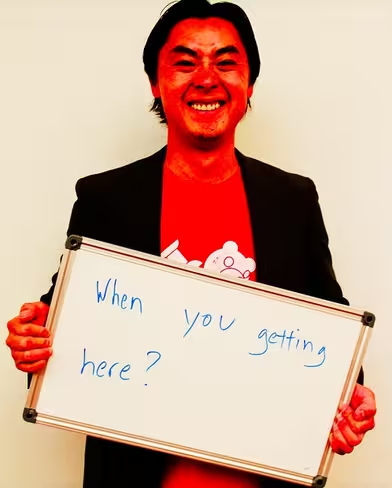
As a Start-Up Chile Round 1 participant, I’ve met Mr. Kohavi (pictured below) and even “pitched” to his fund along with other Start-Up Chile participants. While some of the statements made are legitimate (i.e. monopolistic hold on capital and a cultural shift was needed), Mr. Kohavi’s departure from the Chilean scene will– in the end– better serve the Chilean, and effectively South American entrepreneurial environment.

Time Horizon Expectations
Any experienced entrepreneur knows overnight success is a rarity. With a 6 month time horizon, Mr. Kohavi was expecting to raise US$40m after arriving to Chile to meet with business school friends, and conveniently meeting government representatives eager to create a startup scene.
I’ve worked on entrepreneurial efforts in India, Spain, and Singapore, and in any country, establishing a personal brand is not a simple 6 month effort. The acknowledgement that Start-Up Chile is starting the process but isn’t far enough along to change a culture, coupled with his own history as an entrepreneur, should have prepared Kohavi for the tough road that Chile has ahead.
As a Start-Up Chile participant finishing my round, it’s only recently that I feel at ease within the community and my brand in Latin America, and this is with the support of Start-Up Chile government representatives and my own business school network. In a region where business relationships are paramount, is six months really enough time?
His early departure brings to question Mr. Kohavi’s actual commitment to Latin America. If he understands the time horizon for entrepreneurship why did he commit to only six months? Currently, Yarden Venture Capitalis “leverage [in] our Silicon Valley and Latin American relationships to help startups in Asia”. As of writing, I am not aware of Mr. Kohavi having raised any money in Latin America.
Never fully committed
Choosing to be an entrepreneur is a silly decision. It’s a hard life. One of the many things entrepreneurs must do is to show your supporters that you will do whatever it takes to succeed. You must do all you can to alleviate your supporters of fear of failure while you yourself must accept possible failure.

Mr. Kohavi’s efforts in Chile were not successful. In the interview, he argues that the culture and the environment is not ready, yet takes little proactive measures to help boost and foster a community that is looking for change. While what he says may be accurate in regards to generation gaps, this also exists in many countries– including many Asian countries.
Chile is a country that is working to change this, that is why programs such as Start-Up Chile exist. Mr. Kohavi participated in only 3 months at the beginning of my Start-Up Chile activity. In the remainder 3 months, many of us heard little from him and even wondered about the fund he started. If in fact Mr. Kohavi did come to Chile and quickly received government support, he definitely had an advantage over many other entrepreneurs who struggle to get a meeting. He also recognized the pain problem in the Chilean style VC system; but offered no solution.
There are 110 teams in my round of Start-Up Chile, and over 100 in Rounds 2 and 3 for 2012. This is the making of a culture shift supported by the Chilean government. Mr. Kohavi had the opportunity to be part of this positive effort and failed. Now he points fingers at the culture and its people for his failings.
In the last few months of the program, the only information Start-Up Chile participants received from Mr. Kohavi were emails selling personal possessions. It was evident that he was looking to move. Did Mr. Kohavi really plan on 6 months or did he already have his foot out the door upon arrival?
Cultural Shift
I come from a family that lived the American dream. My father moved at the same age I am now (33) with a family of four from Taipei, Taiwan to Memphis, Tennessee. He spoke no English (and even still struggles today) and opened an Italian sandwich shop. The comedy is not lost on me.
Meanwhile, Mr. Kohavi’s thinks the Chilean startup community must “get used to talking English” as changes that will further along a startup environment. But cultural shift is a two way street. I know my father never asked any of his customers to speak Chinese to order an Italian sandwich.
An investor looking for a “commitment from the elite” of US$40M beyond government support might want to reconsider asking to conduct business in English when living in a Spanish native speaking country. In making a statement that a cultural shift is necessary, I see little effort in change from Mr. Kohavi’s side of the coin.
Mr. Kohavi’s next move is Singapore. A city where foreigners are easily welcomed and money is flowing. It is itself a city created by entrepreneurs in recent history. While I don’t know what Mr. Kohavi’s exact intentions are in Singapore, I know that in my experience as an entrepreneur, most investors would like to see some commitment to your efforts– and that commitment works both ways.
In a leaving comment, Mr. Kohavi admits it openly: “I will spend at least a few months in Singapore, although I’m not attached to a location”.
Good luck in Asia, Mr. Kohavi. I speak Mandarin too. It’s harder than Spanish.


I completely agree and thank you Rich for this response!
- spam
- offensive
- disagree
- off topic
LikePudo escribirlo en Español también ya que ahora defiende la "lengua materna":... por otra parte lo que dijo Kohavi lo sabe todo el mundo.
- spam
- offensive
- disagree
- off topic
LikeBravo!! Bravo! Excellent answer. Congrats to Startup Chile from Colombia.
- spam
- offensive
- disagree
- off topic
LikeAlso to note: Kohavi has NO experience as a VC or fund administrator. Yes, he has been an angel investor (smaller game), but he has never worked in a VC firm, never done VC investment or run a VC fund. Maybe if he had, he would have known without going that expecting to conclude a new fund in 6mths timeline in a foreign, conservative land is a pipe dream at best.
Plus, VC funds run on 10yr operating cycles, so assuming he was ready to be based in Chile for @ least 11.5yrs (incl time to setup), how could he run off after 6mths? Joker.
- spam
- offensive
- disagree
- off topic
LikeReads like a classic Chilean-style corporate-defense from Rich. Most of his arguments are ad-hominem and the "offers no solution" line is so darn right-wing... I think that Mr. Kohavi is not only right, but also very perceptive.
- spam
- offensive
- disagree
- off topic
Likevery ironic answer .. jajja. Very nice these guy, I got an opportunity to meet him.
- spam
- offensive
- disagree
- off topic
LikeRich,
Three questions for you:
1. Is your current startup a profitable business?
2. How much money have you raised from angels and/or VCs for your current startup?
3. Have you ever sold a startup for a lot of money, created a startup that was profitable or taken a startup public on a stock exchange?
A few milestones to achieve on the road to "successful entrepreneur".
* * * * * * * *
On another note: I read so many comments here about "commitment". Well, what about the time spent by this person in Chile? Surely that's worth a lot of money because it includes the opportunity cost of not having spent that six months in another place where (a) people are more eager to put money in a VC fund and (b) there is better deal flow.
- spam
- offensive
- disagree
- off topic
Likebabydoll2000
BabyDummy, 3 questions for you:
1) Do you know that starting, fundraising/selling a startup is not the same as running a VC fund?
2) Do you know that expecting to launch a new fund in 6mths timeline in a foreign, conservative land where you have no relationships with local investors/capital providers is a pipe dream at best?
3) Do you know that VC funds are ten-year investment cycles where dreamers don't run off after 6mths?
A few milestones for you to achieve on the road to "informed argument". #justsaying
- spam
- offensive
- disagree
- off topic
LikeGracias por el articulo Rich! Espero que nos podemos conocer en Santiago ( Mi equipo va ahi el Marzo ) o despues en otro lugar!
- spam
- offensive
- disagree
- off topic
LikeFor the record, there weren't 110 startups in our round of Start-Up Chile, only 83 actually participated.
- spam
- offensive
- disagree
- off topic
LikeExcelente artículo amigo mío.
- spam
- offensive
- disagree
- off topic
LikeGreat article .. loved the last line "Good luck in Asia, Mr. Kohavi. I speak Mandarin too. It’s harder than Spanish."
- spam
- offensive
- disagree
- off topic
LikeJulio Camarena 80% of Singaporeans speak English as a first language. It's the official language of the government, and it's what's taught in schools. So his comment was a bit odd considering Arnon won't be speaking a lick of Mandarin.
- spam
- offensive
- disagree
- off topic
LikeEric William WarnkeJulio Camarena Arnon says in his article: "However, I see Singapore as a great base to look at South-East Asia as a whole. There are huge markets all around – not only China, but also Indonesia and India", so I guess it's not just mandarin we're dealing with.
- spam
- offensive
- disagree
- off topic
LikeEric William WarnkeJulio Camarena he is not in Singapore for the Singapore market - more for countries around it. And if you are in Asia, you are either looking at China, Indonesia or India - places which English is hardly the first language.
- spam
- offensive
- disagree
- off topic
LikeI agree with all the topics stated by Rich (despite the irony in the fact that most startups in the Startup Chile program demand to speak english as a basic requirement for working with them).
But I feel Rich is missing what it strikes me as the core of Kohavi`s statements: In Chile we have "a handful of monopolistic families" that "control the country, and won’t move"... and
"chilean family offices may still give money to Endeavor, but for them it’s not about entrepreneurship – it’s just a way to brush their ego".
If you check hard data about the VC and angel investment culture in Chile you will find that is a fact.
1. In seven years, chilean angel investors have only invested US$8 million. Source: http://bit.ly/fQC1he
2. Most VC`s in Chile are not VC`s: They give little money and can demand up to 50% of your startup and want to tell you how to run the whole ball game (in spanish we call that someone who wants to become your owner not a venture capitalist; and I recognized that is probably a practice inherited from our colonial era of landholders and vassals)
Disclosure: I don`t know Rich nor Kohavi and I am neither a VC, angel investor or member or participant of StartupChile... yet:)
- spam
- offensive
- disagree
- off topic
LikeMiguel Paz English at Start-Up Chile wasn't a demand, the program is simply administered in English since there are so many nationalities represented.
- spam
- offensive
- disagree
- off topic
LikeEric William Warnke No it is not a demand. But if you review the job postings by start ups in the program you will see that most of them say "english speaking" is a must to be hired. Also, in the first round of Start-Up Chile, chilean entrepreneurs that live in Chile were not allowed to compete in the program, something that really bugged the locals that pay taxes that fund projects like Start-Up Chile. Just very recently Start-Up Chile included a "Español" area in it`s website. Finally, critics aside, Start-Up Chile is a great project.
- spam
- offensive
- disagree
- off topic
LikeI couldn't agree with you more!
- spam
- offensive
- disagree
- off topic
LikeGreat article. We are changing the way we do business and we need help from foreigners willing to accept this venture.
- spam
- offensive
- disagree
- off topic
LikeConversation from Twitter
miguelpaz quite precise! but there are many simple barriers that we eliminate to create or maintain a biz. LA isn't a paradise,but luv it.
PoloEscalona donde estas ?
JmaravenaB SCL viajando mañana de vuelta a ccp
PoloEscalona ok yo en CCP
Tarreo apro te diste cuenta que arnon kohavi se parece a Manimal (serie de los 90)
darwinalarcon jajaja cuando le están saliendo los colmillos.
Conversation from Facebook
Hey Muhammad Fajar Baskhara you can copy a short paragraph and link back to our post :)