As long as developers keep churning out killer apps, iOS will continue to grow as a highly successful platform. From simple games to audiovisual experiences, there’s a seemingly endless amount content in every genre imaginable, and developers want a piece of the action.
But with so much growth happening in Apple’s ecosystem (let alone the massive Android market), some pivotal changes have occurred in the developer community. You see, mobile platforms are great, but there’s a funny disconnect in the way iOS apps are developed, and it differs from the tradition of software development that has spanned the last few decades.
When you develop an application for Windows, you use a Windows computer. If you create for the Mac, you create it on the same platform. But if you’re building something for an iOS device, you’ll have to develop on your Mac and simulate it in Xcode. Then you’ll update your device and test it out separately.
It may seem like a tiny detail in the grand scheme of things, but some people really prefer to code on the platform they’re building apps for. And since tablets have enough screen real-estate for true creation, developers are starting to wonder why they can’t code and deploy on it.
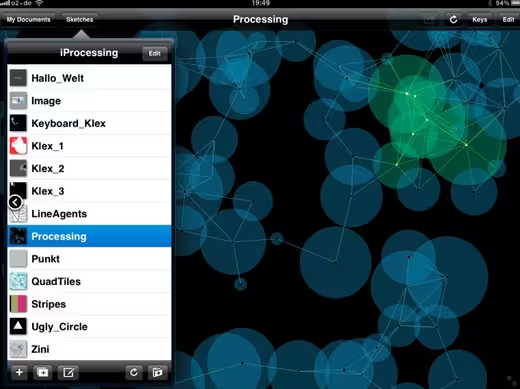
Only yesterday, we covered the impending release of Processing, a creative coding platform, onto iOS, and just today I heard wind of GLSL Studio, an app that lets you learn and code games on your iPad. If these apps were the only ones, there wouldn’t be enough evidence for a trend, but apps like Textastic, Markup for iPad and Gusto are already making a huge impression on developers everywhere. Other apps, like Codify, are being used exclusively for learning and apps like FTP On The Go seek to bring even more of the overall development experience to iOS.
Nobody can deny that there’s a lot of interest brewing on the subject, but does it actually make sense? Should iPad really be used for programming? This is now a common question asked by the community, and there are perks in both directions.
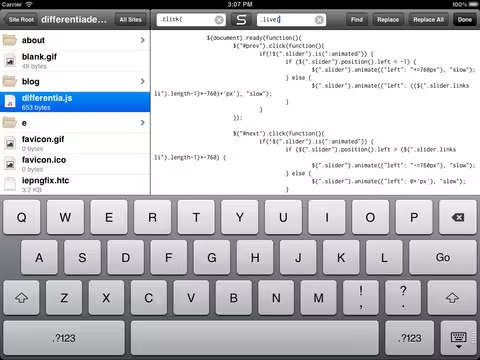
Some devs are attracted to the simplicity and gloss of the iPad, while others are tempted by the prospect of programming on the go. Some programmers seem to completely detest the idea of typing code out on a simulated keyboard, while others love the idea of integrating a touchscreen into their workflow.
As mobile platforms continue to grow, there’s a push for these devices to help us create as well as consume. And by create I don’t mean Apple’s simplistic iOS version of Garageband. I’m talking about getting your hands dirty. What do you think of the idea? Are iPad and other tablets ideal for development, or is this just a novel trend? Let us know in the comments below!


I don't do any coding on my iPad yet, although it can be great for tweaks or ideas while you're on the go. I do use my iPad for wireframing and app idea brainstorming. We developed an app for this called AppSketcher. http://www.AppSketcherApp.com
- spam
- offensive
- disagree
- off topic
LikeI guess programming on iPad could be really great, we haven't seen the possibilities in it yet.
Programming in old fashion way with typing in all the text I wouldn't like, because the screen is small, because the keyboard is small and other obvious reasons.
'BUT we haven't seen the possibilities of programming on a touch based device yet, what if you could use drag and drop, and gestures for to make it easy to create visible layout and lots of other stuff we can't imagine at the moment.
I think there can be a great idea in developing on a iPad, but we probably just haven't seen the possibilites.
- spam
- offensive
- disagree
- off topic
Likeshould be, but the screen with keyboard seems too small. but good enough may be.
- spam
- offensive
- disagree
- off topic
LikeThe great thing about the iPad and programming is the 'on the go' editing. If I want to work on a project in processing at school, I have to take my laptop. I recently bought the iPad and I knew the only things I wouldn't be able to do we're Photoshop, Flash and programming with Processing. But now the opportunity is there, and I think there is a market there too. Portability is possibly the best feature of the iPad, and tablets in general - its time programming should be portable.
- spam
- offensive
- disagree
- off topic
LikeApologies for my punctuation and grammar; a missed feature of Windows that's non existent on this slate. I forgot to develop my point about School. Its much easier to take my iPad to school than my laptop!
- spam
- offensive
- disagree
- off topic
LikeI do dev on my iPad using a Bluetooth keyboard
- spam
- offensive
- disagree
- off topic
LikeCharles McCarthy Cool. What app do you use?
- spam
- offensive
- disagree
- off topic
LikeI use Textastic code editor to make small changes on the go to the sites I've developed. It's an awesome piece of software and perfect for my use. I wouldn't develop a complete site on it though, since iPad lacks Apache and Photoshop.
- spam
- offensive
- disagree
- off topic
LikeI would never use an IPad as the primary device for web development only as something to develop towards (in terms of getting a site to display properly on it, much like IE really), it is a rediculous idea since it lacks one of the core functions required by many programming computers: multiple OS'.
My Windows PC at work and at home has VMed Linux distros and Mac OS versions to help me web dev a site that is a) complete and b) compatible on 95% of devices. An IPad just can't cut it here.
If a dev were to design JS and/or HTML/CSS for a site only on IPad I would personally consider that dev to be very short sighted in their approach.
On the other Hand I guess the IPad can be used for short bursts of coding genius while out in the park or something.
- spam
- offensive
- disagree
- off topic
Likesammaye Any coder worth their spit doesn't need a fancy OS to do code. What would you have done back in my DOS only days?
- spam
- offensive
- disagree
- off topic
Likejoe0101 I would of used DOS, fact is times have changed. There are many different OS' out there and you must program for all of them and the browsers that run on them as such you need this fancy Windows setup (can be done on Mac and Linux ofc) to see how they all react with one another and how the inputs look (including JS quirks etc). I am not sure if you would be able to imagine what a complex page, such as one of the ones you see on this site, would look like and react on every browser on every OS at any given point in time, the only real way to see is to use those OS' and browsers.
- spam
- offensive
- disagree
- off topic
Likesammaye I think I am missing something but I don't see where the article says anything about compiling or wysiwyg proggies. I don't mean to insult you but you not be able to read code/scripting and see how it reacts without a wysiwyg says more about your inability than shortcomings of the iPad. As a text editor it's perfect and thats the basis of programming. Thousands of applications and websites have been created using nothing more than notepad.
- spam
- offensive
- disagree
- off topic
Likejoe0101 And that is just 'PC' computers, you then got the devices such as iPad iPhone, etc
- spam
- offensive
- disagree
- off topic
Likejoe0101sammaye They don't need it, but why can't they want it? Devs like aesthetics too (sometimes)
- spam
- offensive
- disagree
- off topic
LikeI've used my a bit iPad for programming, running vim via SSH. It still lacks some things for me to be able to use it full-on for programming (for instance, command-tab to switch app), but it works when you don't want to bring the entire laptop. For longer sessions I absolutely need an external keyboard, but the touchscreen keyboard works nicely for short fixes.
- spam
- offensive
- disagree
- off topic
LikeConversation from Facebook
No way they werent built for it
i see ..
I couldn't imagine coding without a real keyboard
I would use mine!