Designers come from every background imaginable. They teach themselves, go to art school, or even begin as developers, business owners, etc. But no matter how a designer gets started, somehow the lure catches their eye and ropes them in permanently.
If you’re hooked, there’s typically no going back. You’ll begin absorbing everything you possibly can, reading books, watching tutorials, attending classes or browsing inspiration online. There are so many different ways to build your skill, because design spans across all industries, from automobiles to websites and editorials to hardware.
Like I said, everyone is taught differently and there really isn’t a right or wrong way to learn. But if you’re self taught to work on a computer (like I am), you probably started with one, and use it every step of the way.
It’s genuinely tempting to begin all of your projects with a computer if you’re going to finish there in the end, but the results will be so quickly polished that you’ll settle too early. Your results will keep you from experimenting in the raw.
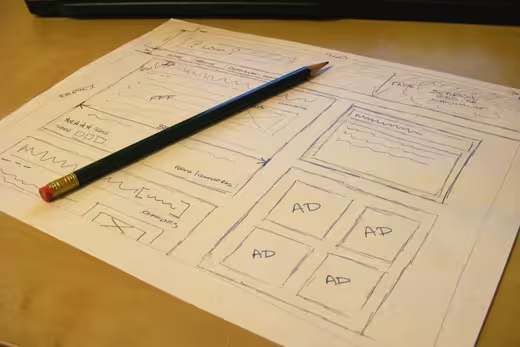
Drawing is at the heart of every design, and the best way to do it is with a pen or pencil and a sheet of paper. I’m not the only one who believes this, ether. The tactile sensations and permanent nature of a pen on paper helps you actually understand what you’re doing. Your specialized tools don’t really matter when it comes to design foundations anyway, so stripping down to the basics is the best thing you can do for yourself.
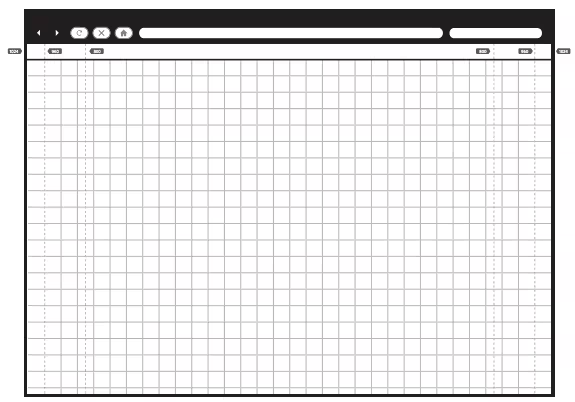
Above: Paper Browser wireframe tool
Remove yourself from your medium (in this case, a computer) and push your boundaries as a creator — then bring it all back to the web. The same goes with traditional designers who haven’t yet embraced a computer. Either way, learning and exploring other areas only make you smarter in the end.
The computer is simply a tool in the entire process, and should be embraced — so long as it isn’t the only tool in your kit, but others have stronger opinions. What do you believe? Is it right to ask web designers to pull out a notebook before they open up Photoshop? Let us know in the comments below.


@johndaus I like using an ipad with stylus then we can immediately email the draft ideas:)
- spam
- offensive
- disagree
- off topic
Likejohndaus Cool! Still drawing :)
- spam
- offensive
- disagree
- off topic
LikeEnvelopes are my ideal medium for a creative thought process, especially from speeding fine bills. They are at grabbing distance at most places. The sketch immediately gets a first-draft status by the very nature of being written on the back of an envelope, space is limited, so I get to the point fast. Also, if it's a good looking idea, it looks extra good on the back of a shoddy, ripped open envelope. If it's a bad idea, I pay the fine and chuck the envelope away.
After that phase, paper becomes an inhibition for me, because on paper I can't easily reorder, insert or move stuff. And I'm not in the paper clipping type like Matt Stone.
- spam
- offensive
- disagree
- off topic
LikeIn school we learned to sketch on paper. I got really tired with the process and tried to take the computer first as a shortcut and I believe my worked suffered greatly. I am back to sketching on paper first. The benefits are just too numerous but my top 3 are 1) Speed. It allows you to iterate very quickly through a lot of ideas 2.) Basics. Allowing you to think without getting caught up in the minutia of stylistic design choices 3) Choice. Sitting at the computer tends to push you into accepting whatever the first idea is which isn't normally the best idea. It becomes a time sink and you force yourself into that idea because you've put in time and you don't want to eat the opportunity cost that point 2 addresses.
I have tried "digital sketching" too and if that works for someone people, great. Doesn't work for me too many distractions at the computer like social media. I also find it useless at work because its much easier to let people build on your ideas and involve others instantly when using paper. Much easier for people to just jump in and add their own marks instead of the sketching being confined by a screen and needing to be printed for group contributions.
- spam
- offensive
- disagree
- off topic
LikeKristy T. I was taught the same thing in design school! Once I got in the industry I started to drift away from it, but have forced myself to go back to sketch my designs first.
- spam
- offensive
- disagree
- off topic
LikeThis also works for developers as well. Before diving into code, i always find producing flow charts along with the mockups help to keep code lean and feature based.
- spam
- offensive
- disagree
- off topic
LikeYou first decide what you want to do before you pick the tool to do it, not the other way around. You first decide you want to hang up a painting and then you pick a hammer and nails to do so. If you pick the hammer and nails first, then you limit yourself to doing things only that tool can do.
- spam
- offensive
- disagree
- off topic
LikeI wish designers would stop using Photoshop to lay things out. It's such a bad practice. Photoshop is for photo manipulation. Use a layout program when doing layouts.
- spam
- offensive
- disagree
- off topic
LikeJames Harris Yes I recommend every world wide web designer designs websites in InDesign. It's the best web design program ever. Don't learn HTML/CSS either, that isn't necessary to create brilliant world wide web designs. Developers always thank me for the extra time it takes to painfully extract a world wide web design from inDesign or Illustrator as they are generally paid hourly so this makes sense to do when you are creating a world wide web design for the world wide web. Ever heard of Fireworks? Me neither.
- spam
- offensive
- disagree
- off topic
LikeJames Harris Also if you're working with people who use Photoshop to layout print designs you really need to educate them.
- spam
- offensive
- disagree
- off topic
LikeHi Harrison,
Great write up. Agreed that sketching is integral to the creative process but does it necessarily need to be on paper? How about doodling on an iPad, so you can save your drawings and share them with co-workers and friends?
At Doodle.ly, we believe in the preservation of creative expression, and we encourage people to doodle (as they would on paper) digitally, so that it can be shareable.
Cheers,
Jen Charlton
- spam
- offensive
- disagree
- off topic
LikeSo true, did indeed manage to go back to paper for quite a few things, and even text in fact, (removing the typical edit re edit, de edit temptation).
- spam
- offensive
- disagree
- off topic
LikeYour minds eye iis really the place to start. If you can truly visualize your concept then everything else is documentation and the better your visualization the better your documentation will be.
- spam
- offensive
- disagree
- off topic
LikeI agree that all great designs start on paper. I design mobile apps and start all of them with a set of sketches. Just recently, I designed a very simple and minimalistic app for developers to do just that but on their iPads. It's called App Sketcher ~ http://www.appsketcherapp.com
- spam
- offensive
- disagree
- off topic
LikeWhat's wrong with making digital sketches? http://asainthemiddle.blogspot.com/2011/11/sketching-and-creating-with-digital.html I just do it the way that suits me best for the moment. It can be on paper too, but most often I find it more practical to sketc on my iPad or in Painter.
- spam
- offensive
- disagree
- off topic
Likei agree with you, sketching on papers will make designs better, moreover more symmetrical.
- spam
- offensive
- disagree
- off topic
LikeIf not physical paper, then paper desk or penultimate on the iPad, and a stylus. but something fast and rough, to get out a lot of quick thumbnails in a hurry. if you're new, by which I mean first decade, not first year, heheheh, a good discipline is 25-50 thumbnails before you settle on a concept. and, yeah, that kind of discipline wouldn't kill those of us who are still in our first three decades of design either.
- spam
- offensive
- disagree
- off topic
Likegarbage in garbage out. while i agree it's definitely better for designers to start on paper, it's not going to magically make the product more refined. great designers start from where they're most comfortable and produce output that reflects their skill (or lack there of) imo.
- spam
- offensive
- disagree
- off topic
LikeJason Wiener I completely agree. If you're bad, you're bad. There isn't much anyone can do about bad taste, but drawing can help refine other skills and lead to future improvement.
- spam
- offensive
- disagree
- off topic
Like@Harrison Weber totally concur.
- spam
- offensive
- disagree
- off topic
LikeAgreed, you gotta check out this site http://www.uistencils.com/ they have pads, stencils, pretty awesome stuff
- spam
- offensive
- disagree
- off topic
LikeJosh Podolske OMFG!
- spam
- offensive
- disagree
- off topic
LikeMaybe I took this too literally... shutdown com.
- spam
- offensive
- disagree
- off topic
LikeWedge Martin hah! Love it.
- spam
- offensive
- disagree
- off topic
LikeConversation from Facebook
No, because what you could have already established in Photoshop is something you now have to make extra time to do. You can make boxes in it, you can add the same text, and it'll save you from your hands becoming sore and possibly half a tree.
99% of my clients have no idea what they want, but what they do is a series of 100% completed mockups the next day to choose from and for me to make any changes/suggestions from there.
Even something like a tablet with squares is a better alternative because you can convert it.
And yes, designers should code their own stuff.
It's also "right" to ask web designers to actually code their own designs. This PSD to HTML/CSS bullshit is completely unacceptable.
Amen!
So true!
I agree, you should always have a design on paper, unless you doing a freehand session, but I don't open photoshop :) I open fireworks ;) much better for web design.
"Drawing First" is the most optimal way to design a website. After the drawing is done i create mockups to present to clients (so no color no font decisions yet, just basic element placement). When the client is happy with placement i turn into Photoshop. It does save time alot, the client is involved in the process of making, and the communication is on very good level early stage.
I wouldn't use them if they didn't
i do all my work in ms paint.
Every website should start out with what I call a "napkin sketch". I was taught to do site architecture with note cards.
Spot on! Photoshop makes you focus on the wrong things. Is the color right? is the spacing correct? Where Information Architecture and Logic should come first.