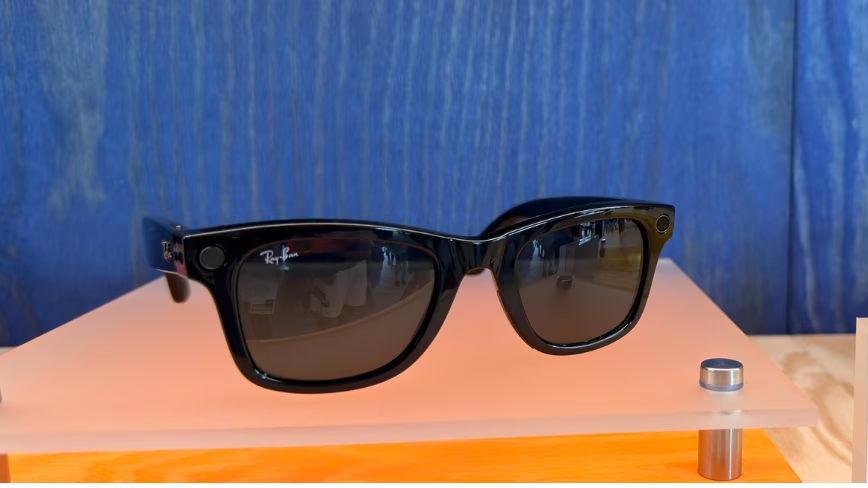
Meta Ray-Ban Smart Glasses
 Credit: TNW
A 30-year-old Polish software developer has built an iPhone app that detects Meta smart glasses in the vicinity and estimates how far away they are by reading the Bluetooth signals the glasses broadcast. It has around 5,000 users a month after launch.
Pawel Szydlowski bought several models of smart glasses and catalogued their Bluetooth fingerprints, then wrote software that matches what a phone hears against that catalogue.
“If the unique identifier matches, and also if the manufacturer identifier matches, then we have like an ultimate combo there,” he told Business Insider.
The app is free, with a paid tier that sends notifications in the background. His argument for building it is one sentence long.
“We as a society have the right to at least know that someone is recording,” he said.
We have been writing about the gap he is filling for two years. We reported that Meta’s glasses were selling by the million while the people being filmed had no way to know or object.
Venues did the only thing available to them: cinemas, schools and UK pubs started banning the glasses outright. The recording light was defeated by a $2 sticker, after which Meta made the glasses stop recording when the LED is covered.
Every one of those responses puts the burden somewhere other than on the person being recorded. A ban works only inside a building. An LED works only if the person you are worried about is facing you and you happen to look.
Detection is the first mechanism that gives the bystander something, and it works because Bluetooth is a broadcast: the glasses announce themselves to be useful, and that announcement is also the tell.
The technical approach also explains its limits and its durability. Szydlowski is not intercepting anything, breaking anything, or reading any content. He is listening to advertisements a device transmits openly so that phones can find it, and matching them against fingerprints he collected by buying the hardware.
That is legal, cheap, and reproducible, which is why two Android tools already do something similar, and why this will not stay a single-developer project for long.
Which is why the fix is awkward for Meta. Suppressing or randomising the identifiers would break pairing or degrade the product, and doing it specifically to prevent detection would be a decision to make covert recording easier, taken in public, in the middle of European regulatory attention.
Our reporting on the LED change noted the involvement of France’s CNIL and the European Data Protection Board. Any change here will be read the same way.
It is also worth saying plainly what this is. A single developer in Poland, working alone with a bag of glasses and a Bluetooth scanner, has produced the most practical privacy remedy anyone has yet offered European citizens against a product Meta sells here by the million.
The GDPR has been in force since 2018 and confers rights against exactly this kind of processing. What arrived was a free app from one person, and two similar tools on Android before it.
Five thousand users is not a movement, and detection is not consent. Knowing that a pair of glasses is nearby does not tell you whether it is recording, does not identify the wearer, and does not help at all if you are not holding a phone running the app. It converts an invisible problem into a visible one, which is worth something and is not a solution.
There is a coda. The app is called Zuckoff, which the developer chose as a message to Meta’s chief executive, and which is also the name of Mitchell Zuckoff, a Boston University journalism professor and author of nine books, who was not asked.
He wrote about it in the Boston Globe on 4 September, having learned of it from a news report:
“Its name: ‘Zuckoff,’ which also happens to be my name.”
He considered his options and declined to pursue them, on the grounds that protecting children from surveillance mattered more than his objection to the borrowing.
It is a small thing next to the regulatory questions, and it is also the only part of this story in which someone with a legitimate complaint about being used without permission got to decide what happened next.
Get the TNW newsletter
Get the most important tech news in your inbox each week.


