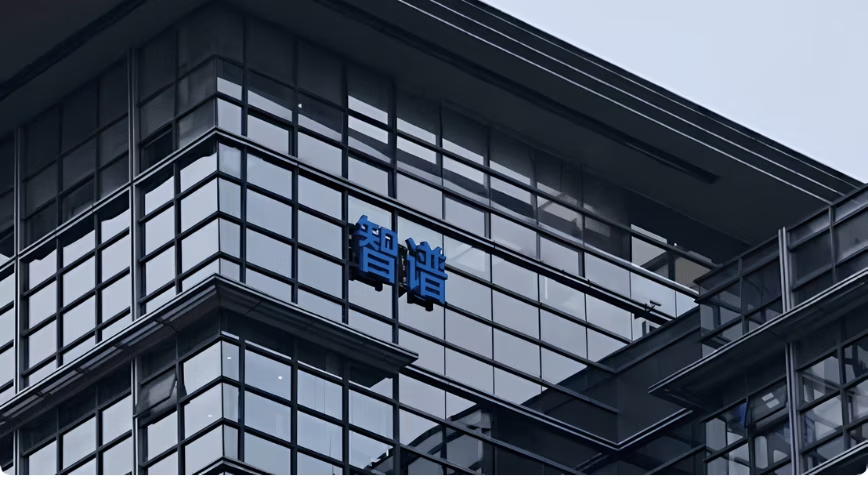
Zhipu’s Hong Kong Office
 Credit: Zhipu
A 2,000% rally has handed Beijing’s Zhipu a rare fundraising window, and Anthropic’s vanished Fable 5 widened it. The harder question is whether a deeply unprofitable lab can turn the moment into a durable business.
Six months ago, Zhipu was a Chinese artificial-intelligence lab fresh off a $558M Hong Kong listing. Its shares priced at HK$116.2. This week they touched HK$2,980.
That is a gain of roughly 2,000% since January. It has pushed the company, now trading as Knowledge Atlas Technology, above HK$1 trillion in market value. That is about $128bn.
Now Zhipu wants to use the moment. The company is weighing a Zhipu share sale to raise several billion US dollars in Hong Kong, people familiar with the matter told Bloomberg. A placement could come as soon as next month. A six-month lock-up from the IPO expires on 8 July. Zhipu also aims to issue shares in Shanghai. A deal of that size would dwarf the original listing.
The shares rose as much as 16% on Wednesday. They pared the gain after the Bloomberg report, closing at HK$2,174.
The obvious read: a hot stock doing what hot stocks do, striking while the iron glows. The more interesting shift is what the rally actually prices in. Investors are not just betting on a Chinese AI lab. They are betting on a geopolitical opening that a foreign government handed Zhipu by accident.
The Fable 5 window
That opening has a name: Fable 5. In early June, Anthropic released it as the public-facing version of its powerful Mythos model. The company had earlier described Mythos as good enough at writing code to pose a global cybersecurity risk.
Three days later, the US government placed export controls on the release. It barred all foreign nationals from access, including Anthropic’s own employees.
Unable to guarantee compliance, Anthropic pulled both Fable 5 and Mythos 5 worldwide on 12 June. The most advanced AI model on the planet went dark. Developers, enterprises and governments started asking whether they wanted to depend on something Washington could switch off.
Zhipu launched its answer the next day. GLM-5.2, a 744-billion-parameter model, ships fully open. Anyone can build on it for free. It climbed to second place on Arena’s front-end coding leaderboard, behind only Fable 5. No Chinese model had reached the global top three before, on the Artificial Analysis Intelligence Index, where only Anthropic and OpenAI rank higher.
Jefferies called it “a milestone for Chinese AI”. JPMorgan projected a revenue jump of more than 534% this year and a swing to profit by 2028.
The confidence is loud enough that Zhipu’s founder picked a fight about it. In a rare exchange on X, Elon Musk predicted that a Chinese rival to Fable 5 was “probably” a first-quarter event. Tang Jie, Zhipu’s founder and chief scientist, replied that it “won’t take that long”. Musk pushed back.
Benchmarks were not the same as “true usefulness”, he said, and Anthropic’s edge “shows up in revenue”. Tang answered: “Focus is all we need, especially focusing on what intelligence truly is.”
The bull case meets the balance sheet
Revenue is exactly where the bull case gets thin. Bloomberg Intelligence analysts Robert Lea and Jasmine Lyu wrote that comparisons with Anthropic “don’t stand up to scrutiny”.
The American company holds the firepower, the operational reach and the research resources. Zhipu, they said, “will likely remain deeply unprofitable”, with rising agentic demand driving its losses higher over the next 24 months.
After the share-sale report, the pair added a warning. The cash-hungry business will need continual fundraising for three years as agentic AI use widens its operating losses. Read that way, a multibillion-dollar placement looks less like a victory lap and more like a refuelling stop.
The migration story invites doubt too. Open-weight models still trail the best proprietary systems. Jefferies argues that a Fable 5 ban will not translate into meaningful revenue for Chinese labs, because most enterprise AI still runs through direct interface access rather than self-hosted open models.
Jonathan Zhun Qiu, a partner at Meridian Capital Asia, rates GLM-5.2 as comparable to Anthropic’s previous-generation Opus 4.7, and still behind Opus 4.8 on coding. The gap keeps narrowing. It has not closed.
US versus the world
What has changed is the politics, and that is what the rally is really about. The Fable 5 shutdown made one thing plain. Access to a leading American model can hinge on US domestic decisions. Lizzi Lee of the Asia Society Policy Institute said the market “immediately understood the opening that Anthropic just created”.
French politician Bruno Retailleau called the episode a “wake-up call” for Europe.
Analysts such as Albright Stonebridge’s Paul Triolo increasingly frame the contest differently. It is no longer simply US against China, but, as one IMD professor put it, “US versus the world”. A tech stack that cannot rely on a single provider starts shopping. China’s open models are cheap, capable and unrestricted.
Zhipu’s plan has clear precedent. Contemporary Amperex Technology, the battery giant, raised $5bn in a Hong Kong placement in April, not long after its own debut there. CATL’s market value is still more than twice Zhipu’s. The difference: CATL sells a profitable physical product. Zhipu sells a story about where intelligence, and sovereignty, will come from next.
The deliberations may lead nowhere.
Bloomberg’s sources stressed the talks are ongoing and might not produce a deal, and Zhipu did not respond to requests for comment. But the timing tells you what the company sees. A lock-up is about to lift, a rival’s flagship has vanished, and the stock is up 2,000% on the bet that the gap stays open.
The test is not whether Zhipu can raise the money. It is whether, by 2028, it has built a business worth what June 2026 decided it was.
Get the TNW newsletter
Get the most important tech news in your inbox each week.


