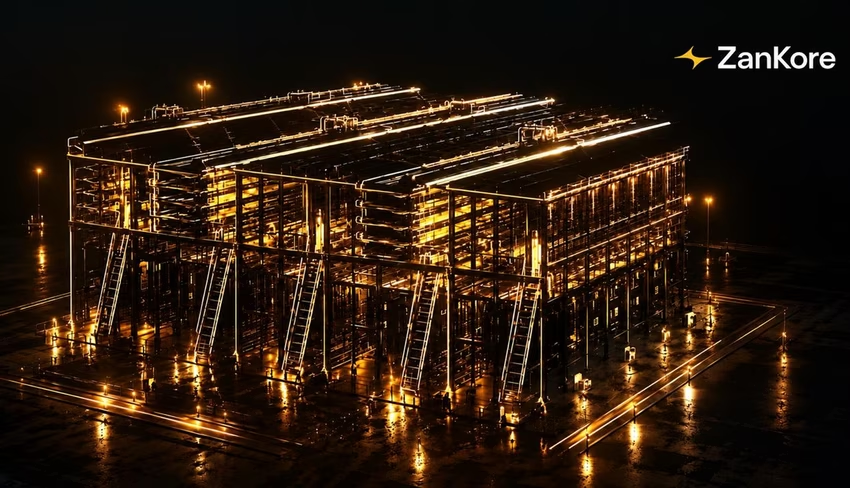
Zankore’s rendering of an AI factory. The company’s first 100MW of Nvidia capacity in Indonesia has not been built.
 Credit: Zankore
Zankore has secured a senior term loan facility of up to $3.1bn to buy and deploy Nvidia GPUs across Indonesia and Southeast Asia. Nvidia is one of the company’s backers and also the supplier of the hardware the financing will pay for.
Citi acted as exclusive debt adviser, while Citi, ING, Natixis CIB, Qatar National Bank and UOB served as senior mandated lead arrangers, underwriters and bookrunners.
Moreover, the deal also includes revenue-sharing and credit-support arrangements designed to link the pace of deployment to customer demand.
Zankore launched in August, just one month ago. It is backed by Indosat Ooredoo Hutchison, the Ooredoo Group, Nokia, and Nvidia.
The company sells GPU capacity for AI training, fine-tuning, inference and agentic workloads to enterprises and developers across the region.
Five international banks have now underwritten up to $3.1bn for a business with only about four weeks of operating history and a telecoms parent.
The telecoms connection helps explain how the financing came together. Indosat Ooredoo Hutchison is one of Indonesia’s largest mobile operators, with the land, power connections, regulatory position and balance sheet needed to support a large infrastructure project.
Zankore is new, but much of the infrastructure behind it is not. The credit-support arrangements appear to reflect that.
Zankore plans to start with 100MW of Nvidia infrastructure in Indonesia, reach around 200MW of capacity in the first half of 2027, and eventually build 1GW of what Nvidia calls DSX AI Factory capacity over three years.
The financing is particularly interesting because of Nvidia’s role, as the company has a stake in Zankore and supplies the GPUs that Zankore will buy with the financing. Nvidia has also spent the past year developing ways to bring outside capital into AI infrastructure projects.
TNW reported when six finance giants backed Nvidia’s $500bn plan to mobilise third-party capital for AI infrastructure, and when Nvidia began offering startups compute now and payment later.
Zankore is a straightforward example of that model. Nvidia backs the company, banks provide the financing, and Zankore uses that money to buy Nvidia’s hardware.
There is nothing improper about that structure, and the relationships are disclosed. But it does mean that some of Nvidia’s demand is now being financed through other companies’ balance sheets.
The risk of the AI infrastructure buildout is therefore shared with a growing group of lenders. If customers sign enough contracts, the model works for everyone. If demand falls short, the lenders are left with a large pool of GPUs whose value could decline as the market changes.
Indonesia is becoming an important test case for this approach. We already covered Firmus, another Nvidia-backed company building a 360MW site in Batam, based on expectations of $30bn in offtake deals.
Both companies are planning large Nvidia-powered facilities in Indonesia, with Nvidia as an investor in each. Across Southeast Asia, meanwhile, developers are planning roughly four times the data centre capacity currently in operation.
One important detail about Zankore’s loan remains unclear: what exactly secures it. Bloomberg reported last week that an Nvidia partner had found strong demand for a rare GPU-backed financing facility in Asia, which suggests the hardware itself could be part of the collateral.
A loan secured against GPUs, whose resale value depends partly on the same demand that is expected to repay the loan, carries a different risk from one secured against long-term customer contracts.
Get the TNW newsletter
Get the most important tech news in your inbox each week.


