
 Credit: Torras
Fast charging has a heat problem.
You’ve felt it before: your phone gets hot while navigating in the car, your MagSafe battery pack turns into a hand warmer during a Zoom call, or charging suddenly slows because thermal throttling kicks in. As smartphones become more powerful, portable chargers are struggling to keep up.
That is the pitch behind the new MiniMag Pro from TORRAS, a magnetic power bank built around an idea most accessory makers rarely talk about: cooler charging.
And surprisingly, the company’s solution borrows from the same battery conversation happening inside the EV industry.
Portable chargers have hit a wall
For years, power banks competed on one thing: capacity. Bigger numbers won. More mAh, faster charging, thinner designs.
But modern smartphones have changed the equation.
Phones now run AI-powered photo tools, console-level mobile games, 4K video workflows, always-on navigation, and constant background syncing. That creates more power demand and more heat, especially during fast charging.
The issue is not just comfort. Heat is one of the biggest long-term stressors on lithium batteries. The hotter a charging system gets, the harder it becomes to maintain efficiency, battery health, and consistent charging speeds.
Most accessory brands still treat that as a tradeoff.
TORRAS does not.
The MiniMag Pro’s big idea: stay cool
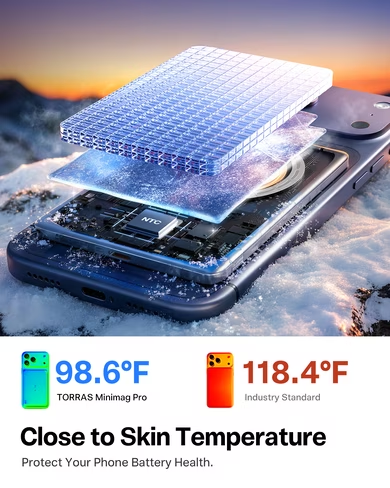
According to TORRAS, the MiniMag Pro maintains a surface temperature around 98°F (37°C) during sustained charging sessions, even under heavier loads.
That matters because magnetic wireless charging is convenient, but it is also notoriously prone to heat buildup. Anyone who has used a magnetic battery pack while traveling or multitasking has probably noticed it.
The MiniMag Pro approaches the issue differently by using a semi-solid-state battery architecture instead of a traditional lithium-ion setup.
That sounds like marketing jargon until you realize semi-solid-state batteries are becoming one of the most talked-about technologies in next-generation electronics and EV development.
Wait, semi-solid-state? In s power bank?
Traditional lithium-ion batteries rely on liquid electrolytes. Semi-solid-state batteries replace part of that structure with a more stable gel-like material designed to improve thermal stability and reduce internal risks.
In plain English: less heat, better stability, and a lower chance of things going sideways under stress.
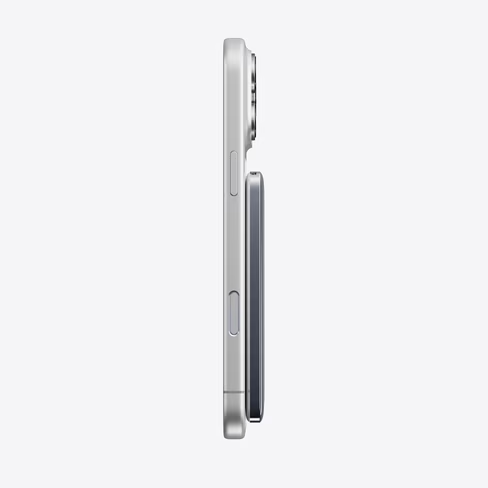
The technology also allows for denser battery packaging, which helps explain why the MiniMag Pro feels unusually thin for a magnetic charger.
The 5000mAh version comes in at just 8.5mm thick. The larger 10000mAh model is still only 14mm thick while supporting faster charging speeds and PPS support.
This is where the product starts to feel less like another Amazon accessory and more like an early example of where mobile power is headed.
Because the real innovation here is not necessarily faster charging. It is smarter charging.
The era of “Invisible” tech accessories
The best tech accessories are increasingly the ones you stop noticing altogether.
Nobody wants to carry extra cables, bulky battery bricks, or overheating chargers anymore. Consumers want accessories that integrate into their lives with as little friction as possible.
That shift helped make magnetic charging mainstream. Snap a battery onto the back of your phone and keep moving.
The MiniMag Pro leans hard into that behavior. Its magnetic alignment system is designed for secure attachment during movement, allowing users to keep texting, navigating, filming, or streaming while charging one-handed.
Combined with the slim profile, it feels built for modern everyday carry culture rather than emergency-only battery backup.
That distinction matters.
Portable charging is evolving from “just in case” tech into an always-on companion product.
Safety is quietly becoming the new premium feature
There is another reason companies are suddenly investing more heavily in battery architecture: consumers are paying attention.
As devices become thinner and charging speeds get more aggressive, battery safety is no longer an invisible engineering problem. It is becoming part of the buying decision.
TORRAS says the MiniMag Pro underwent puncture testing and extreme pressure testing to validate thermal stability and structural integrity under stress.
Most consumers will never watch those test videos. But they will notice when a charger stays cooler in a backpack, charges more consistently during travel, or does not feel like it is cooking their phone battery over time.
That is increasingly where the premium accessory market is moving.
Not necessarily toward maximum power, but toward smarter thermal management, better materials, and products that feel more reliable over the long run.
Portable charging is entering its next phase
For years, portable power felt stagnant. Every new release promised the same thing: more battery, faster charging, smaller footprint.
Now the conversation is shifting.
Consumers are starting to care less about spec-sheet races and more about real-world experience. Does it overheat? Is it annoying to carry? Does it feel safe? Can it keep up with how people actually use smartphones today?
The MiniMag Pro feels designed around those questions.
And if semi-solid-state battery tech continues moving into mainstream accessories, this may be the beginning of a much bigger shift than just one magnetic power bank.
Get the TNW newsletter
Get the most important tech news in your inbox each week.
Contributed article. Not produced by the TNW newsroom and does not reflect the editorial stance of TNW.


