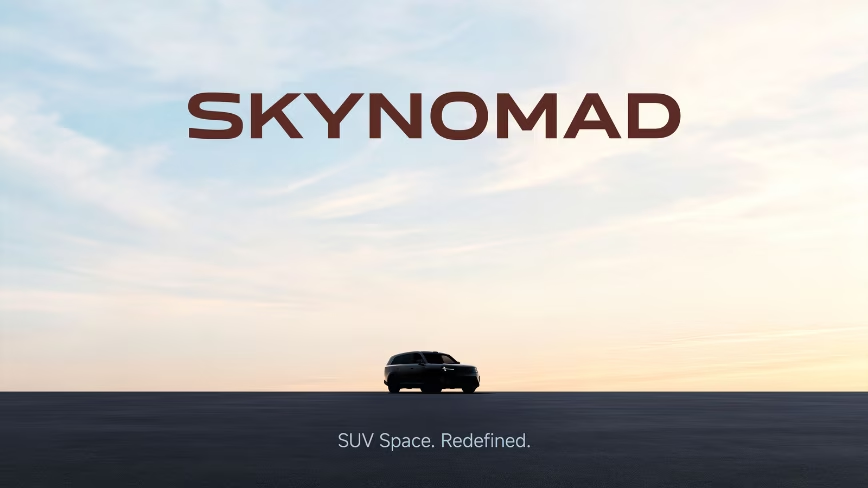
Xiaomi has opened a second front in its rapid march into carmaking, confirming on Thursday a new SUV series called Sky Nomad and offering the first proper look at the boxy family hauler that will lead it.
The move pushes the smartphone maker squarely into China’s most lucrative vehicle segment, and away from the sports-saloon image built by its SU7 and YU7 models.
The company’s electric vehicle unit described Sky Nomad as its second product line after the SU7/YU7 range, casting it as an “intelligent, transformable large-space SUV”. In China the series will trade under the name Xiaomi Pengcheng, according to the company.
Founder and chief executive Lei Jun drew a firm line between the two families, calling the SU7 and YU7 a “driver’s car” while framing Sky Nomad as a mobile living space.
He said the vehicle should shift with its owners’ needs, turning when parked into “a studio for one, a café for two, a reception room for three, or a playground for the whole family”.
Lei said the lineup had been honed over three and a half years on an all-new platform, the Xiaomi Kunlun architecture, which the firm began building from scratch in early 2023. A completely flat floor and long-rail seating give the interior room to be reconfigured, he added.
The first model, internally codenamed Kunlun N3 and expected to reach showrooms as the N90, is a full-size SUV measuring more than 5.3 metres long with a 3.1-metre wheelbase. Unlike every Xiaomi car to date, it is not a pure battery-electric vehicle.
Instead the N90 is an extended-range electric vehicle, using a 1.5-litre turbocharged engine purely as a generator that never drives the wheels. Paired with a battery pack of more than 70 kWh, it is rated for 400 to 500 km of electric-only range and over 1,500 km combined, figures reported across Chinese and specialist outlets.
The styling marks a sharp break from Xiaomi’s sleek saloons, with a rugged, upright body, a roof-mounted lidar unit, and electrically deployed door steps. Five- and seven-seat layouts are expected, and the seven-seater is said to come with a built-in rooftop tent aimed at China’s fast-growing camping crowd.
Pricing has not been confirmed, though the model is expected to start as low as 200,000 yuan (about $29,400), according to the Chinese outlet 21jingji.
That would undercut the Li Auto L9 and Huawei-backed Aito M9, which both sit above 250,000 yuan and dominate the extended-range field, where seven of last year’s 10 best-selling models came from those two brands.
The timing is deliberate. China’s Ministry of Industry and Information Technology cleared Xiaomi to build extended-range vehicles at its Beijing plant on 10 June, removing the final regulatory hurdle for a firm that had until then produced only battery-electric cars.
Xiaomi needs the new line to sell, and quickly. It has set a 2026 delivery target of 550,000 vehicles, up roughly 34% from about 410,000 last year, yet delivered only 185,055 cars in the first half, around a third of that goal.
Clearing the shortfall would mean averaging more than 60,000 deliveries a month for the rest of the year, a pace it has yet to sustain.
Demand for Chinese electric cars has spread well beyond the mainland, with enthusiast reviews of models from BYD, Xiaomi, and Zeekr circulating across US social media despite steep import tariffs. At home, though, the family SUV fight is where the margins are, and it is one Xiaomi has so far left to rivals.
Whether Sky Nomad is a standalone sub-brand or merely a new series remains slightly blurred, with Lei declining to spell it out.
The company has meanwhile kept adding convenience features for existing owners, including a robotic charging arm for home garages, and says the SUV will launch “soon” in the second half of the year.
Get the TNW newsletter
Get the most important tech news in your inbox each week.
Also tagged with


