TL;DR
A federal judge dismissed xAI’s trade secret lawsuit against OpenAI with prejudice, ruling it would be “futile” to continue. It is Musk’s second court loss against OpenAI in four weeks, following the May jury verdict that rejected his $150 billion claim on statute of limitations grounds.
A federal judge has permanently killed xAI’s lawsuit accusing OpenAI of stealing trade secrets related to the Grok chatbot. US District Judge Rita Lin dismissed the case with prejudice on Monday, meaning xAI cannot bring the same claims again.
Lin said xAI failed to show that OpenAI induced former xAI senior engineer Xuechen Li to divulge confidential information, or that OpenAI engineers even knew Li might have disclosed any. Allowing further amendment, she wrote, would be “futile.”
A routine interview, not espionage
The case turned on a presentation Li gave while OpenAI was recruiting him. xAI alleged OpenAI sought secrets related to the July 2025 release of Grok 4, claiming its own ChatGPT update “could not compete” on complex reasoning and that it was “lagging” in the reinforcement learning techniques Li understood.
Lin was not persuaded. Asking job candidates to discuss their previous work is routine, she wrote.
“To hold otherwise would potentially expose employers to liability any time they inquire about a candidate’s past work,” Lin said.
A devastating line from opposing counsel
OpenAI has maintained that Li never worked for the company and that it never acquired xAI’s secrets. In its filing seeking dismissal, OpenAI’s lawyers wrote: “OpenAI does not need or want anyone’s trade secrets, especially not from xAI, which is failing in the marketplace and hemorrhaging talent.”
That barb has an uncomfortable amount of evidence behind it. All 11 of xAI’s original co-founders have now left the company, which was absorbed into SpaceX in a $1.25 trillion combined deal in February.
Musk himself has said xAI “was not built right first time around” and needs to be rebuilt from the ground up.
Two defeats in four weeks
Monday’s ruling is Musk’s second legal loss against OpenAI since mid-May. On 18 May, a federal jury in Oakland unanimously rejected his $150 billion lawsuit accusing Sam Altman of betraying OpenAI’s original charitable mission.
The 11-day trial ended abruptly when the jury deliberated for less than two hours and found Musk had simply filed his claims too late. His legal team has said it will appeal.
What the ruling means for AI hiring
Lin’s reasoning carries implications beyond this one dispute. AI companies routinely recruit from each other, and candidates routinely discuss their prior work in interviews.
The ruling affirms that this does not, on its own, constitute trade secret misappropriation.
Li is being sued separately by xAI and has denied wrongdoing. That case remains active.
For Musk, the courtroom scoreboard against OpenAI now reads 0-2. The internal documents surfaced during the May trial, including co-founder Greg Brockman’s journals describing the nonprofit mission as “a lie,” may still complicate OpenAI’s path to IPO.
But as a legal strategy, Musk’s campaign to dismantle his former company through the courts has produced nothing but defeats.


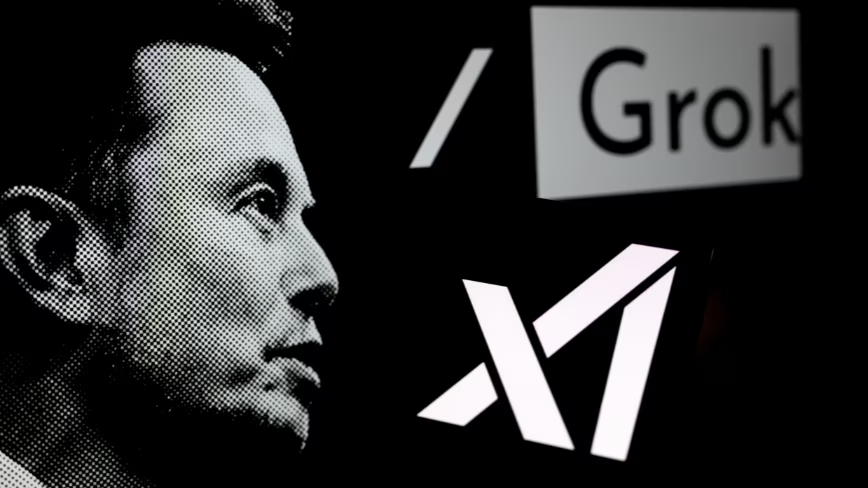
 Credit: via Shutterstock