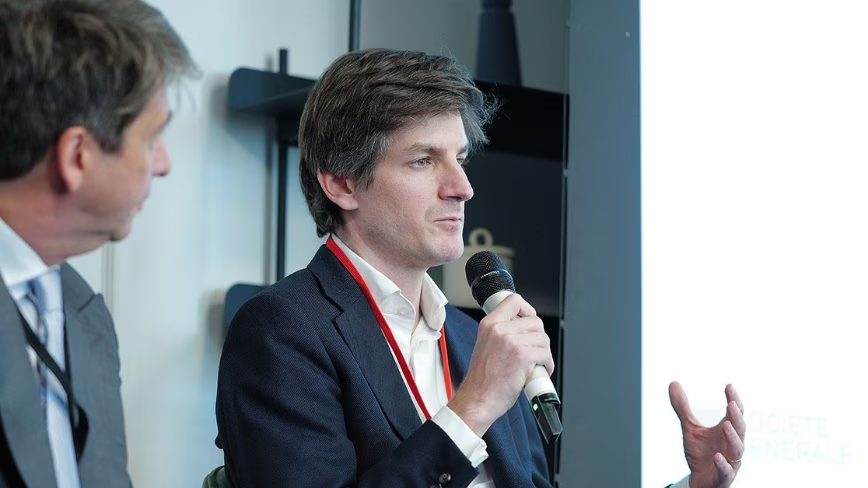
 Credit: LinkedIn Ricard Boada
A new company wants to be the one that pays for everyone else’s AI chips. Volta Infra Holdings has raised $300m in venture funding and lined up a further $5bn in financing to help a broader range of tech firms afford Nvidia’s costly hardware, in a round that values it at $2.4bn.
The raise was co-led by Andreessen Horowitz and Altimeter Capital, with Nvidia and Michael Dell also taking part.
Volta’s pitch is a financing problem dressed as a cloud company. Its founders argue that only the biggest firms with the strongest balance sheets can afford the upfront cost of cutting-edge chips, and Volta wants to spread that cost so smaller labs can compete.
The model places Volta among the neoclouds, the wave of GPU-focused providers renting out AI compute, though its emphasis is as much on the money as the machines. A $5bn financing pool, arranged by the asset manager Azora from a mix of banks, is meant to bankroll its customers.
The company was founded this year by Ricard Boada and Sofia Gumuzio, both former executives in Brookfield’s infrastructure business.
‘We saw a massive opportunity and a massive gap in the market,’ Boada, now chief executive, said.
That background is the pitch. Building AI clouds has become as much a problem of power contracts, project finance, and bank relationships as of servers, and Volta’s founders come from that world rather than from software.
It is not starting small. Volta says it has already signed a $10bn, six-year contract to supply cloud capacity to a leading AI developer it declined to name, a marquee deal for a firm only months old.
That contract will run partly on borrowed ground. It is to be delivered with Bitdeer, a bitcoin miner turned data-centre operator, using a 133-megawatt site in Norway, with further sites planned in Texas and Wyoming.
The Bitdeer tie-up fits a wider shift. Bitcoin miners, sitting on cheap power and ready-built sites, have become unlikely landlords to the AI boom, repurposing infrastructure built for one gold rush to serve the next.
There is a European thread here, too. The first big site sits in Norway, and the founders came out of infrastructure investing rather than pure tech, a reminder that the AI buildout is not only an American story.
Power is the real constraint, and Volta has been securing it. The company says it has locked up a gigawatt of capacity in the near term, enough to power hundreds of thousands of homes, and is aiming for several gigawatts by 2030.
Volta is one of many trying to grease the same wheels. Nvidia itself has offered startups compute now and payment later, and Broadcom, Apollo, and Blackstone have lined up to fund chips for Anthropic.
Nvidia’s fingerprints are all over this market. The chipmaker has topped $40bn in AI equity bets this year and has discussed backing hundreds of billions of dollars in chip purchases for OpenAI, blurring the line between supplier and financier.
That blurring worries some. Critics call the arrangements circular, an interconnected web in which suppliers help fund the customers who buy their products, a structure that could magnify losses if AI demand falls short of the hype.
Even Volta’s backers had been sceptics. Andreessen Horowitz had largely avoided neoclouds and data-centre startups, but was won over by the founders’ record in financing projects and securing power, according to managing partner Raghu Raghuram.
Dell will act as a technology partner, supplying gear to Volta’s sites and adding another established name to its roster. Success, Raghuram said, would depend on mastering ‘the financial complexities of building and operating new clouds and selling to customers’.
Not everyone will survive the boom. ‘There’s going to be so many dead bodies and so much consolidation eventually,’ said Altimeter’s Jamin Ball. Volta is betting that its banker relationships and blue-chip partners are what keep it upright when the tide turns.
Get the TNW newsletter
Get the most important tech news in your inbox each week.
Also tagged with


