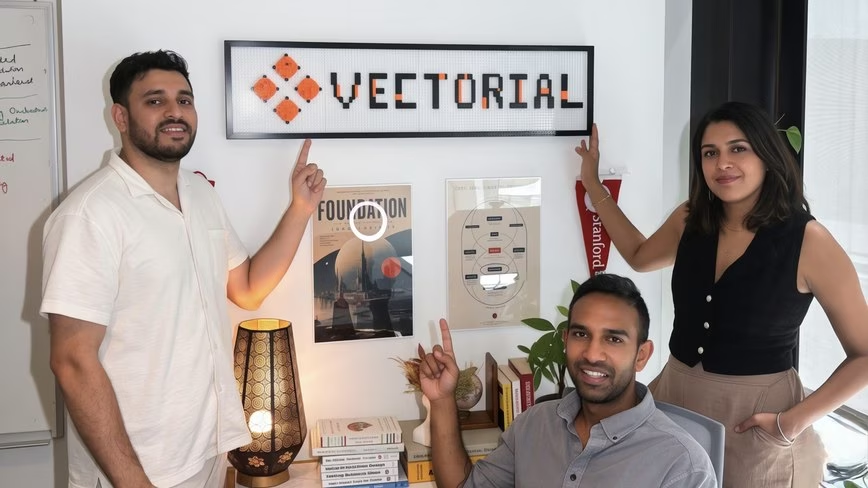
Vectorial founders Taranveer Singh (left), Rahul Garg (seated) and Jasmine Kaur (right) at the company’s office in Menlo Park
 Credit: Vectorial
AI is making building and launching products exponentially faster, but current user research is still painfully slow, expensive and biased. Even with AI-moderated interviews, getting user feedback from 50-100 participants still takes days. That is slow when you’re iterating on your product’s development and launch in hours.
So companies skip user research at many important steps, which leads to AI slop.
Vectorial believes the next frontier in user research is every company having a living model of its target customers. That model is built from thousands of customers. It keeps up to date with new emerging behavior and offers speed, breadth and depth in user research.
The company announced a $3 million seed round. It is backed by industry leaders and institutional investors (Smilegate, SenseAI Ventures) and UC Berkeley ecosystem (Berkeley SkyDeck, Berkeley AI Research Lab). Stanford-led funds (Stanford GSB fund, Dent Capital) also backed it. Product leaders from Meta, Shopify and Mastercard also participated.
The round reflects the company’s deep academic backbone with AI ecosystems of Stanford (StartX), CMU (Venture Bridge) and UC Berkeley.
A bet on simulation
The founders of Vectorial are making a bold bet: within four years, running a behavior simulation with audience models before building or launching a consumer product or agent will be the norm.
Simulations have been common in the aerospace, manufacturing and chip industries. Yet the consumer products that touch billions of people still launch on gut instinct and a few experiments with live users.
“We believe AI is creating two distinct frontiers. One focuses on reasoning and solving complex problems, while the other focuses on simulations and decoding human behavior,” said Taranveer Singh, Co-founder and CEO, Vectorial. “Two pieces are missing: the ability to simulate many scenarios, and bringing your users into the same room as you build.”
How the platform works
Vectorial’s human behavior simulation platform for software products and digital experiences lets product, design and marketing teams watch their model of target customers react. They can test a product journey, campaign design or AI agent before a single real user touches it.
These modeled users are powered by SAPIENS. It is a behavior model that learns the latent traits (socio-demographic, psychographic and behavioral traits) of the target customer. It is 30 percent more accurate in predicting behavior than general-purpose LLMs. It outperforms academic behavior models such as Be.FM and Centaur, and is validated against real-user studies.
Vectorial has already modeled more than 2.5 million real people and run more than 30,000 simulations.
“Enterprises we serve treat a continuously enriched model of their target audience as a strategic investment,” said Jasmine Kaur, Co-founder and Chief Business Officer, Vectorial. “We see organic adoption across product, design and marketing, because they all design for the same audience.”
“We continue to invest in our behavior model, but a model alone doesn’t solve the problem,” said Rahul Garg, Co-founder and Chief Product Officer, Vectorial. “That’s why we put behavior models to work inside the product development loop. We believe this fundamentally changes how products are designed and built. Vectorial puts users in the room where you build.”
Where user research falls short
Existing leaps in user research fall short, Singh argues. AI-moderated interviews have become the norm. But every new question means a multi-day study with a handful of participants, which is slow, expensive and biased.
At the other extreme, simulated user agents answer instantly. But they use synthetic users with no grounding in real behavior data, which doesn’t build trust with customers.
Other simulation companies focus on market research to support strategic decisions. But they don’t help with downstream decisions or put users inside the product development and launch loop.
By contrast, Vectorial’s audience is grounded in real behavior data at massive scale. It fits inside the product development, launch and build workflow.
The founding team
Vectorial’s founding team comes from Stanford, CMU, ISB and BAIR. It has deep domain expertise in understanding and modeling behavior and how it applies to business today.
Taran has spent a decade modeling human behavior, including in defense research and research labs. Rahul, who launched multiple products at unicorn companies, worked on a behavior graph for sales at his last startup. Jasmine led synthetic users for marketing at Pfizer.
Customers
Vectorial’s customers span healthcare, gaming and e-commerce. They include public companies and billion-dollar enterprises serving enterprises across the globe. Customers include Midi Health, GoodRx, Suki AI, boAt, Everkind, Concrete Software and many more.
Customers run around 600 simulations a month (40 user studies a month), 20x more research than before. Simulations have reproduced prior user-study findings with more than 85% accuracy.
What customers say
“At Everkind, we hold an exceptionally high bar for AI behavior and alignment. But a conversation that works for one person may land very differently for a first responder coming off shift or a parent running on no sleep. Vectorial lets us simulate those real-world differences end to end, extending our evaluation across diverse human behaviors before an update ever reaches a real user,” said Supreet Pal Singh, CTO of Everkind (a publicly traded company in Canada).
“Building a successful consumer brand involves hundreds of decisions, from product features and pricing to positioning, messaging, and campaigns. Yet traditionally, consumer research has only informed a fraction of those decisions. What excites me about Vectorial is the possibility of changing that equation entirely, bringing consumer understanding into everyday decision-making at a speed and scale that simply wasn’t possible before,” said Vedansh Kumar, CMO of boAt (an Indian company with $350M revenue, valued at $2B).
“The challenge in game development is knowing what to build first. Vectorial gives our teams a way to engage with modeled players throughout development and live ops, test feature and content ideas against different audiences and get a first read in minutes instead of days or weeks. It helps us make better decisions about where to deploy our resources, without relying solely on the instincts of a few experienced people interpreting feedback from a small handful of players,” said David Nixon, VP Data Services at Concrete Software (it launched the PGA Tour and NHRA Drag Racing games).
What the funding is for
Vectorial will use the fresh funding round to expand its behavioral datasets through new data partnerships. It will also advance SAPIENS 2.0 to become the de facto generative simulation infrastructure for building and launching products.
“Building software has evolved to lightspeed, but understanding user needs remains painfully slow,” said Rahul Agarwalla, Managing Partner, SenseAI Ventures. “Vectorial replaces the slow theater of surveys with millions of simulated humans using the product and providing insights. This is a new class of AI to predict human behavior and not just the next word like an LLM. That is why we invested.”
About Vectorial
Vectorial is a human behavior simulation platform for companies building software products and digital experiences. It works in two steps.
First, it builds a highly accurate behavior model of a company’s target audience: thousands of modeled users, grounded in real data. The behavior model SAPIENS understands their behavior, psychographic and socio-demographic traits, which allow it to predict how they will act.
Second, it allows product, design and marketing teams to run simulations with that modeled audience. Teams can run simulations, evaluate a product experience, marketing campaign, brand message or customer-facing AI agent across web, mobile and AI-native apps.
Get the TNW newsletter
Get the most important tech news in your inbox each week.
Contributed article. Not produced by the TNW newsroom and does not reflect the editorial stance of TNW.


