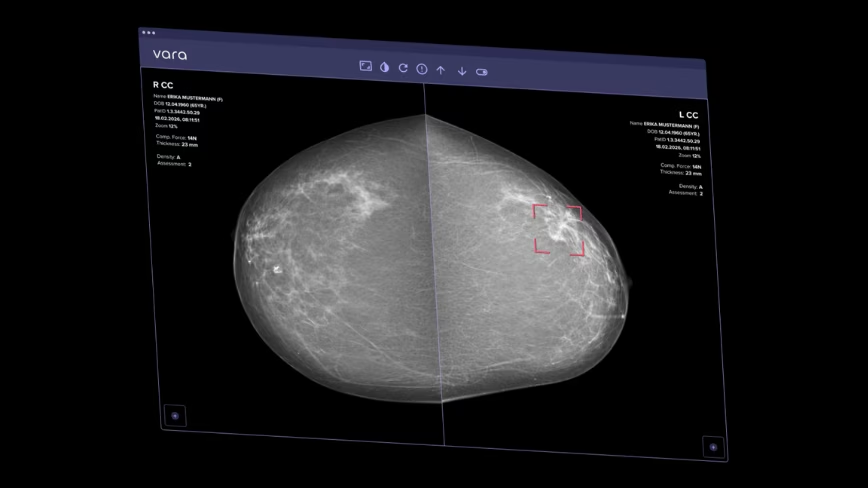
Vara’s reading interface, showing a demonstration case on the company’s product site.

A Berlin company has won the world’s first regulatory clearance for AI that closes a breast screening case. No radiologist looks at it.
Vara, which trades as MX Healthcare GmbH, announced the certification on Wednesday in a statement issued through Business Wire. Chief executive Jonas Muff set out the reasoning in a longer post the same day. The mark is a Class IIb CE certification under the EU Medical Device Regulation, covering what Vara calls autonomous triage in organised breast cancer screening.
Screening programmes across Europe read every mammogram twice. Vara puts the share of those images that turn out normal at around 97%. Meanwhile the radiologist workforce is shrinking and screening ages keep widening. That is the pressure the certification addresses.
What the certification permits
Under autonomous triage, the AI reports the examinations it classifies as clearly normal. No radiologist reads them. Every other examination still goes to at least one. The mode covers organised population screening only, not symptomatic patients or diagnostic work.
That is a different category of product from almost everything else in the field. Computer-aided detection tools, which have been sold since the early 2000s, mark a region for a doctor to inspect. The deep learning generation that followed adds a judgement about how suspicious a finding is. Both run alongside the radiologist. Neither one replaces the read. Vara now holds a certificate to do exactly that on a subset of cases.
The system built to watch the system
Vara credits the certification less to the model than to the safety layer wrapped around it. It calls that layer ATMON, for Autonomous-Triage Monitoring. The company says ATMON sets and monitors each site’s operating point, then tracks changes in mammography hardware, system health and daily performance signals. It also watches cancer detection and recall rates. When those numbers move outside defined limits, it reverts the site to full radiologist reading.
Stefan Bunk, Vara’s chief technology officer and co-founder, said the case rested on “seven years of continuous monitoring of how our AI performs in the real world, on every single case.” Muff compares the arrangement to an autopilot that hands control back for takeoff and landing.
Vara is opening ATMON to all its customers. That includes those whose national guidelines bar autonomous triage, and those with no intention of adopting it.
The evidence base tested something else
Both Vara documents point to the same study as the foundation for the certification. PRAIM, published in Nature Medicine in 2025, screened 463,094 women at 12 German sites between July 2021 and February 2023. Some 119 radiologists read 260,739 of those cases with AI support. Detection came out at 6.7 cancers per 1,000 in the AI group against 5.7 in the control group, a relative increase of 17.6%. Recall ran slightly lower.
PRAIM tested AI-supported double reading. It did not test autonomous triage. The radiologists taking part also chose for themselves whether to use the AI. The paper records this, and it makes the two groups something other than randomised. Vara’s release calls the study nationwide and puts the cohort at 461,818 women, a figure the paper does not carry.
None of that makes the certification unsound. A notified body assessed it, though Vara has not said which one. But the largest published evidence behind the world’s first autonomous breast screening AI measured a different deployment mode from the one now approved. Screening programmes weighing it up should hold on to that distinction.
Ophthalmology got there in 2018
Breast imaging is not the first specialty to cross this line. IDx-DR won FDA authorisation through the De Novo route in April 2018, the first autonomous diagnostic AI in any field of medicine. It reads retinal images for diabetic retinopathy in primary care, with no clinician interpreting the result. Vara’s claim is narrower and specific to breast imaging, where the milestone had gone unclaimed for a decade.
Closer to home, Flok Health won approval for an AI physiotherapist the NHS lets work unsupervised. French startup Raidium has built a radiology viewer with AI at its core. The counterweight arrived on Sunday, when Healthwatch found AI scribes getting diagnoses wrong in NHS records.
The AI Act clock has not started
Vara presents ATMON as the human oversight the EU AI Act demands of high-risk systems. Its two documents put that in different tenses. The Business Wire release says the Act “will require” it. Muff’s post says the Act requires it now.
The release has it right. The Act treats AI inside MDR-regulated devices as automatically high-risk. But Brussels deferred the obligations for that Annex I category, including the Article 14 human oversight duty, which now apply from 2 August 2028. Regulators already hold enforcement powers over general-purpose models. Medical devices sit on a slower clock, so Vara is early rather than compliant.
Vara’s own figures for its footprint also drift between documents. The release says more than 50% of Germany’s organised screening programme runs on its software at over 250,000 screenings a month. Muff’s post says more than 60%. The company’s newsletter page says roughly 50% and over 150,000 a month.
What happens next
European screening programmes can take autonomous triage from now. Adoption follows national guidelines, and no programme has to take it. Vara says as much itself and expects nobody to switch tomorrow. Its earlier certifications followed the same Class IIb route through the MDR.
What changes immediately is smaller and procedural. Until Wednesday no autonomous system existed in this category, so screening guidelines had nothing to write rules about. Now they do.
Get the TNW newsletter
Get the most important tech news in your inbox each week.


