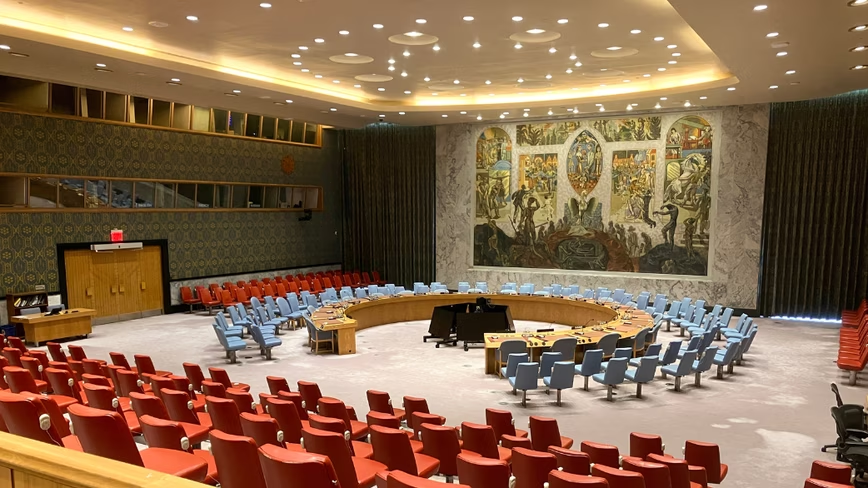
United Nations Security Council Chamber at United Nations Headquarters in New York City
 Credit: Mikaela Ryden via Shutterstock
The United States is rejecting any global governance of advanced AI, telling the UN Security Council in New York today that each country should regulate the technology itself.
Michael Kratsios, director of the White House Office of Science and Technology Policy, delivers the US statement after the meeting’s four briefers from science and industry.
“The frontier of intelligence is advancing rapidly. That is not a reason to pause its further development or to constrain it with new global governance structures,” Kratsios says.
Throughout his statement, he refers to advanced AI as superintelligence.
The US, which he calls the leader in the field, has worked with frontier labs to test new models and has set up cybersecurity clearinghouses to coordinate on vulnerabilities, he says.
Washington is committed to dialogue on emerging technologies, Kratsios adds, but talks at the UN and elsewhere must not drift towards global governance.
“As President Trump said before the General Assembly yesterday, the United States totally rejects any attempt to construct a global scheme of control of superintelligence,” he says.
He points instead to the Carolina Principles, agreed by G20 innovation ministers in Chapel Hill, North Carolina, this month. Countries should keep national control over how they govern emerging technologies, he says.
“The American people’s representatives will legislate and regulate on the American people’s behalf. You should do the same for your people,” Kratsios tells the Council.
The US offer to other countries is its technology. Through its exports program, American companies will help partners build secure infrastructure and their own AI capability, he says.
“If you take the risks and benefits of superintelligence seriously, the most important thing you can do is to develop your country’s ability to understand and use it,” Kratsios says.
The Council and similar bodies, he argues, should focus on sharing best practice to build that capacity at home rather than creating a global regulatory scheme.
“A prosperous future will not be secured by a global regulator,” he says.
His position sets Washington apart from Sam Altman, Dario Amodei and Clément Delangue, the heads of OpenAI, Anthropic and Hugging Face.
Each called for international standards or disclosure rules earlier in the meeting, but Yoshua Bengio went further, calling for frontier AI to be licensed.
Get the TNW newsletter
Get the most important tech news in your inbox each week.
Also tagged with


