 Credit: DailyNewsBay via Shutterstock.com
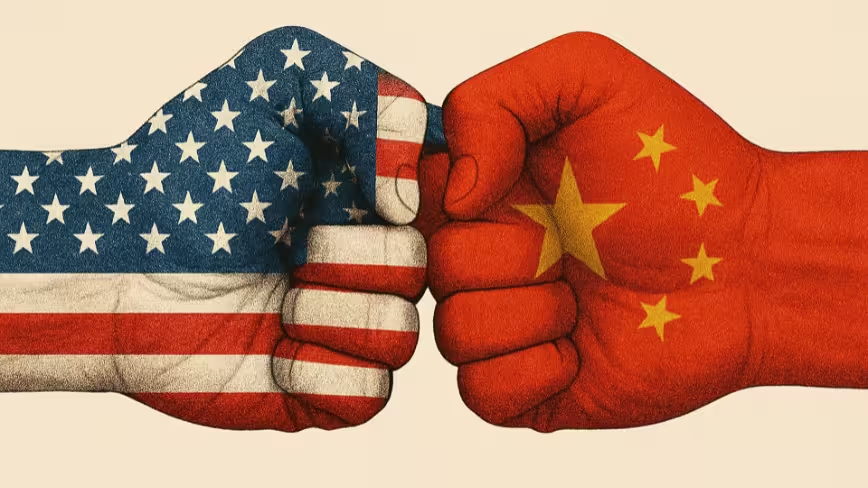
Washington is preparing to hand its partners an ultimatum, and it is not a subtle one. According to a draft State Department letter reported by Reuters, the US is about to tell friendly nations they must choose between the American and Chinese artificial intelligence ecosystems, because belonging to both is no longer an option.
The letter is addressed to the 35 countries that signed a June “AI Opportunity Statement”, and its language is unusually blunt for a diplomatic cable. “To be part of everything is to be part of nothing,” the draft reads. “Signature of the Pax Silica Declaration is not merely a membership subscription, but a commitment.”
The mechanism doing the work here is Pax Silica, an initiative launched last year to lock down supply chains for AI models, semiconductors and critical minerals.
The carrot is access to shared AI investment opportunities reserved for members. The stick is exclusion for any country that also signs up to China’s competing framework. It is leverage dressed as a club membership.
Roughly two dozen nations have joined so far, including Japan, Australia and South Korea. Only one country, Kazakhstan, currently sits inside both the American and Chinese coalitions, which is less surprising once you remember it is a significant source of the critical minerals everyone wants.
That awkward overlap, one foot in each camp, is precisely the kind of arrangement the letter is designed to end, and Astana may soon find its hedging position untenable.
One US official put the reasoning plainly. “It’s difficult to see how a country can credibly position themselves as trusted partners in one technology ecosystem while simultaneously signing up for an initiative designed by China to advance a competing vision for AI,” the official said. The subtext is that neutrality now reads, in Washington, as a form of defection.
The timing is not accidental. Cheap Chinese open-weight models have been steadily eating into the market once owned by proprietary American systems, and a cheap Chinese model is now closing in on Anthropic and OpenAI on both cost and capability. When your commercial lead is narrowing, geopolitics starts to look like a handy substitute.
China, for its part, has stopped playing defence. In July, Xi Jinping launched a rival “World Artificial Intelligence Cooperation Organization”, built explicitly around open-weight technology and open to anyone who wants in.
It is the mirror image of Pax Silica, and its openness is the whole pitch. Beijing is even weighing curbs on overseas access to its best models, a sign of how much leverage it now thinks it holds.
For anyone who lived through the last decade, the choreography feels familiar. This is the Huawei-era 5G pressure campaign, restaged for large language models, with allies once again asked to rip one vendor out of the stack and commit to the other.
Not everyone in Silicon Valley thinks that works. Mark Zuckerberg has argued the US should not block Chinese AI models at all, on the grounds that bans tend to backfire.
Europe, predictably, is caught in the middle. The bloc has spent years insisting on “strategic autonomy”, the polite European term for not having to choose between Washington and Beijing. Being handed a signature line and told to pick a side is exactly the corner it hoped to avoid, and the draft letter offers no obvious room to wriggle.
The State Department, for the record, declined to comment on what it called “purportedly leaked internal documents”, which is diplomatic code for confirming very little while denying nothing.
The letter may yet be softened before it is actually sent. But the direction of travel is clear enough: the AI cold war has quietly acquired a loyalty test, and for America’s partners the comfortable era of hedging your bets is drawing to a close.
Get the TNW newsletter
Get the most important tech news in your inbox each week.


