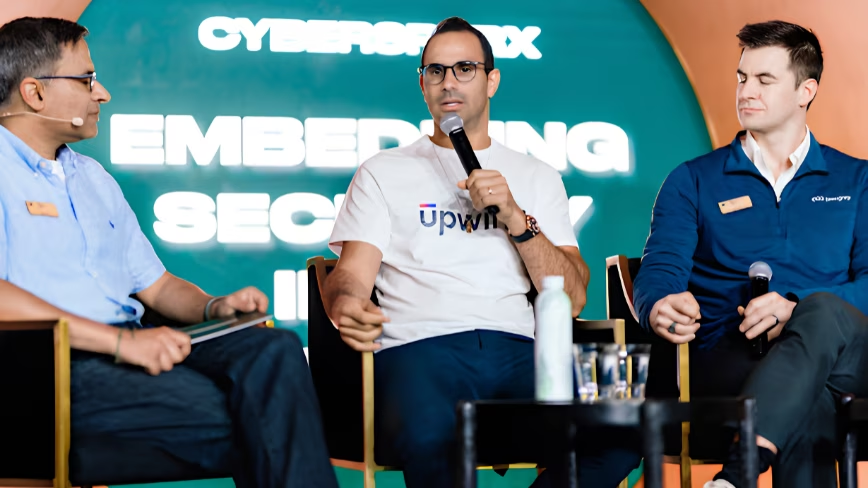
 Credit: Upwind
When cloud computing transformed enterprise IT, security vendors followed the workloads. Visibility into cloud infrastructure became a central requirement as organizations shifted applications and data into new environments.
Artificial intelligence is now driving another change, but this time the challenge is not simply where applications run. It is understanding how actions move between developer devices, AI systems, SaaS platforms, and cloud resources.
Upwind Security is the latest company to address that challenge with the launch of AI Sensor for Endpoints. The new capability extends the company’s cloud and AI security platform to developer workstations, providing security teams with visibility into AI-related activity that begins on endpoints and extends across connected environments.
The release comes as enterprises continue integrating AI tools into software development workflows, creating new links between devices and cloud-based systems.
Why Developer Laptops Are Drawing More Attention
For years, security teams have treated developer workstations as important assets because they contain credentials and access to sensitive resources. According to Upwind, AI is increasing both the importance and complexity of those devices.
Modern AI tools are often connected to MCP servers and other services that allow them to retrieve information and perform actions across multiple platforms. In practice, that means a developer workstation can become the starting point for activity that reaches far beyond the endpoint itself.
A single device may interact with SaaS applications, cloud services, and enterprise resources through AI-driven workflows. As those connections grow, understanding activity on the endpoint becomes increasingly relevant to understanding what happens elsewhere in the environment.
The company argues that this shift is creating a new attack surface that spans both endpoints and the cloud.
The Challenge of Fragmented Visibility
One of the difficulties facing security teams is that endpoint and cloud activity are often monitored separately. Analysts may have visibility into cloud workloads and infrastructure while relying on entirely different tools to investigate endpoint behavior.
That separation can make it difficult to reconstruct AI-driven workflows.
An action executed in a cloud environment may have originated from a developer workstation. Likewise, suspicious endpoint activity may ultimately affect resources that exist across cloud and SaaS platforms. When data is distributed across multiple systems, security teams may spend significant time connecting events to establish a complete picture.
As AI becomes more deeply embedded in daily operations, those investigative challenges are likely to become more common.
Extending Visibility Beyond the Cloud
Upwind says AI Sensor for Endpoints is designed to help bridge that divide. The capability allows organizations to monitor MCP connections initiated from developer devices and correlate endpoint activity with cloud identities and cloud actions.
The company also says the sensor can detect anomalous AI-driven behavior across SaaS and cloud platforms. By bringing endpoint telemetry into the same platform as cloud security data, organizations can view activity across multiple environments through a single lens.
Rather than investigating isolated alerts, security teams can trace how activity progresses from a workstation to the cloud resources it touches.
“In the new world of AI Agents and MCP servers, the cloud risk extended to the edge, where tokens, permissions, and cloud actions are now taken automatically from the developers’ workstations. To truly protect the cloud, we must help security teams see the journey from the endpoint,” said Amiram Shachar, CEO of Upwind Security.
Security Strategies Evolve With AI
The launch highlights a broader trend emerging across enterprise security. AI is creating workflows that no longer fit neatly into traditional security categories. Endpoint activity, identity activity, and cloud activity increasingly form part of the same operational process.
As a result, organizations are looking for ways to understand how those elements interact rather than treating them as separate areas of visibility.
With AI Sensor for Endpoints, Upwind is extending its effort to provide a unified view of cloud, application, and endpoint risk. The company’s premise is that AI has fundamentally changed where security investigations need to begin. In many cases, understanding what happens in the cloud may require first understanding what happened on the developer workstation.
Get the TNW newsletter
Get the most important tech news in your inbox each week.
Contributed article. Not produced by the TNW newsroom and does not reflect the editorial stance of TNW.
Also tagged with


