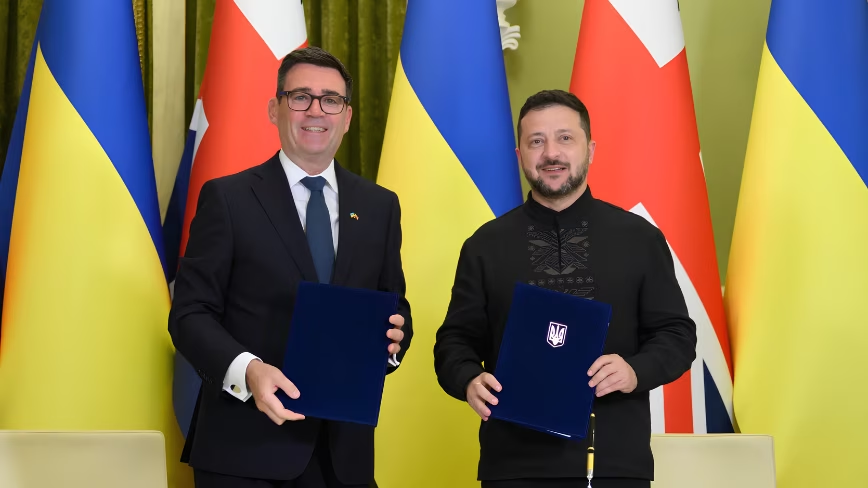
Kyiv, President of Ukraine Volodymyr Zelenskyy met with Prime Minister of the United Kingdom Andy Burnham.
 Credit: President of Ukraine
Ukraine and the United Kingdom have signed a joint declaration on artificial intelligence partnership covering the development and deployment of AI-enabled military capabilities, according to the Ukrainian presidency’s account of talks in Kyiv between Volodymyr Zelenskyy and Andy Burnham.
It formalises a direction British defence policy has already been moving in, having committed £2bn to an AI combat laboratory for the British Army.
“We will work together to build next-generation Armed Forces and accelerate development and deployment of AI-enabled military capabilities,” Zelenskyy said. Neither side has published the text of the declaration or indicated what funding, if any, sits behind it.
The visit was Burnham’s first foreign trip since becoming prime minister, which gives the AI component more weight than a routine bilateral would carry.
Ukraine has spent four years turning battlefield necessity into a software industry, and Britain is the partner most explicitly trying to buy into what it has learned.
Munitions were the other substantive item. The two discussed localising production of Storm Shadow and SCALP cruise missiles inside Ukraine, which would move the country from receiving weapons to manufacturing them under licence.
A missile built in Ukraine is not subject to the export licences and political reversals that have repeatedly interrupted supply, and it keeps industrial capacity in the country rather than in a donor’s factory.
Air defence dominated the rest of the agenda, with anti-ballistic interceptors singled out specifically. Zelenskyy has been pressing allies to close a substantial funding gap for air defence as Russian strikes have intensified, and the arithmetic of interceptor cost against drone cost remains the central problem.
Europe’s defence technology sector has been reorganising around exactly that asymmetry. Berlin’s Stark Defence raised €500mn at a valuation above €3.5bn building cheap strike drones, and Helsing has been taking its defence AI into Japan through a partnership with Rakuten.
Ukraine has become an unusual kind of exporter in this field. Its drone and electronic warfare firms iterate on a timescale Western procurement cannot match, because their feedback loop is measured in days of combat rather than quarters of testing, and that experience is the asset London is really contracting for.
The financial track ran alongside the military one. The two discussed Ukraine’s fiscal resilience through the end of 2026 and into 2027, and war-risk insurance for maritime exports, where the London market underwrites much of the shipping that keeps Ukrainian grain moving.
Insurance is an unglamorous but decisive piece of infrastructure here. Without cover written in London, vessels do not sail, and a significant share of Ukraine’s remaining export earnings depends on that market continuing to price the risk.
On sanctions, Burnham indicated British support for further measures aimed at Russian energy revenues, the shadow fleet moving oil outside Western insurance arrangements, the financial sector, and the defence-industrial complex.
“We will stand with you,” he said. “This has been the case under every government.”
Zelenskyy, for his part, thanked Britain for support extending back to the opening weeks of the invasion, saying it was something Ukraine would never forget. Both statements are the expected register for a first visit, and neither commits either government to a figure.
What the AI declaration actually produces will depend on procurement rather than diplomacy. Britain’s defence establishment has been slow to buy from startups even as capital has poured into European military technology, and a declaration signed in Kyiv does not by itself change a contracting process in Whitehall.
There is a precedent worth remembering here, since the two countries signed a hundred-year partnership agreement in January 2025 that was similarly broad and similarly light on enforceable commitments. Declarations are cheap; contracts are not.
No timeline, budget, or delivery milestones were attached to any of it. The signature is real, the substance behind it is still to be published, and the Storm Shadow localisation in particular would take years and a licensing agreement neither government has yet described.
Get the TNW newsletter
Get the most important tech news in your inbox each week.


