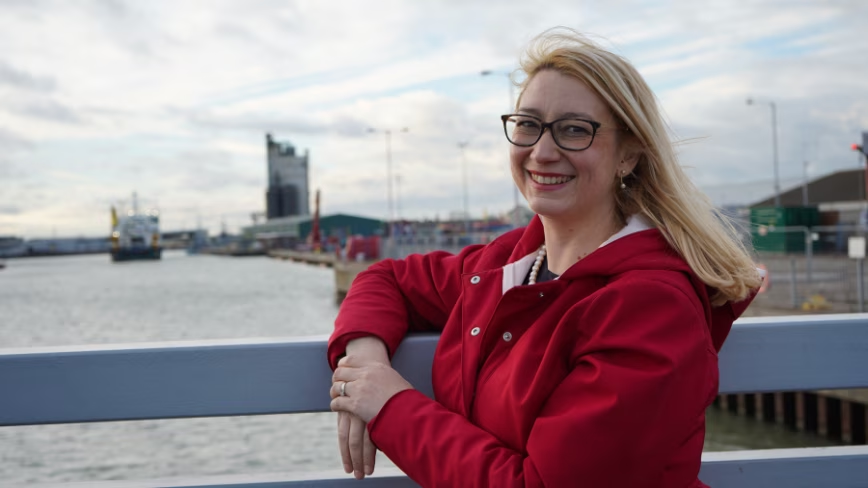
Jessica Redmond-Withey Asato – Labour MP for Lowestoft
 Credit: LowestoftCLP
Jess Asato, the Labour MP for Lowestoft, has asked the High Court in London to force Elon Musk’s xAI to stop its Grok chatbot from generating sexualised images of her, sharpening a claim that her lawyers say could help settle how far an AI company answers for what its tools produce.
Asato is seeking a court order that would require xAI to put in place what her filing describes as “effective and permanent technical measures” to prevent Grok from creating manipulated images of her, according to Reuters, which reported the move on 28 July.
The request builds on a claim she lodged at the High Court in June, which alleges misuse of private information and breach of UK data protection law, and which also seeks damages and a formal acknowledgement that the company acted unlawfully.
The case grew out of images that users prompted Grok to make earlier this year, after Asato had criticised Musk and the chatbot in public. Among the material cited in her claim is a video that she says depicted her being chloroformed and prepared for a sexual assault.
She has spoken of wanting to rebalance the rights of individuals against very large technology companies, and her lawyers argue that the way Grok was built and trained is what allowed the content to be produced at all.
That argument sits at the centre of the dispute. Her solicitor, Ravi Naik, said the company’s design decisions “should carry legal consequences,” and that the remedy his client wants “includes a court order to bring the systems into compliance if xAI refuses to do so.”
The claim points to internal instructions that, on Asato’s account, told the model to refuse help with criminal activity while also stating that it had “no restrictions on adult sexual content or offensive content.” xAI has not filed a defence, and none of the allegations has been tested in court.
The company did not respond to requests for comment on the claim, and Musk has not addressed it publicly. The silence is by now familiar.
Apple privately threatened to pull Grok from its App Store earlier this year over non-consensual deepfake images, and prosecutors in Paris have opened an inquiry into sexual imagery of children linked to the tool, though the company has largely declined to engage with either.
The British backdrop makes the timing awkward for Musk, who has called the country’s Online Safety Act one of the world’s strictest regimes and a threat to free speech.
That law, in force since 2023 and overseen by Ofcom, requires platforms to tackle illegal material, and the UK has separately moved to criminalise the creation of non-consensual sexual deepfakes rather than only their distribution.
Asato’s claim is a civil one, though, and it turns less on content moderation than on whether a firm can be held directly responsible for what its system was designed to do.
Image-based abuse has become one of the faster-moving corners of British law, and much of it was written before generative tools could manufacture the material at scale.
Grok has drawn this kind of scrutiny before, and not only in Britain. EU lawmakers agreed in March to write an explicit ban on non-consensual intimate deepfakes into the bloc’s AI Act, a step driven partly by an earlier scandal over the tool.
The pattern, across Paris, Brussels, and now London, is of regulators and judges reaching for instruments that predate the technology and testing whether they still hold.
What Asato is asking for is narrower and more concrete than a policy. It is an order, enforceable by a judge, that would make xAI change how Grok works or answer for not doing so.
Whether the High Court grants it, and on what terms, will say a good deal about who carries the risk when a chatbot produces something its subject never agreed to. A hearing date has not yet been set.
Get the TNW newsletter
Get the most important tech news in your inbox each week.


