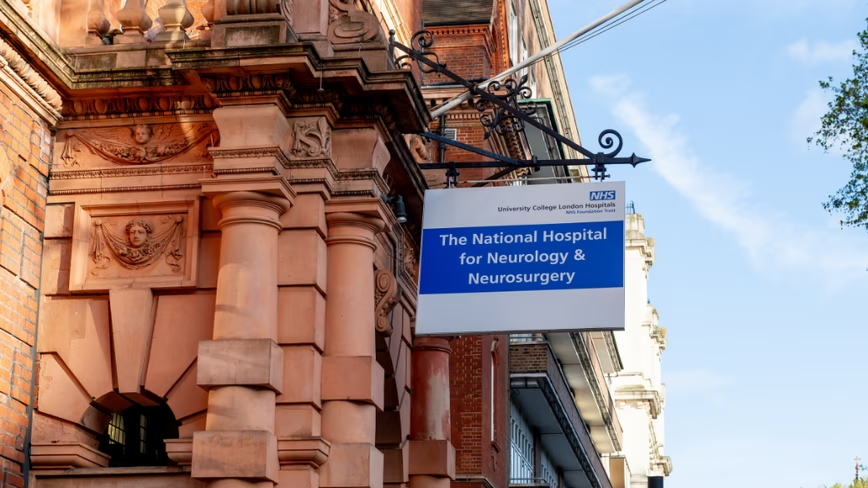
Exterior view of The National Hospital for Neurology and Neurosurgery
 Credit: Yau Ming Low via Shutterstock.com
Surgeons at the National Hospital for Neurology and Neurosurgery in London have removed a brain tumour in what University College London Hospitals says is the world’s first successful AI-assisted operation of its kind.
The system analysed live camera footage during the procedure, helping the team identify nerves and blood vessels near the tumour, and joins a set of clinical tools that includes AI shown to assess some rare cancers more accurately than biopsy.
The operation was carried out in May, and details were withheld until Thursday while the patient recovered. It took place at NHNN, part of University College London Hospitals NHS Foundation Trust, which was founded in 1859 as the world’s first dedicated neurosurgical hospital.
The patient was Rhys Hibbert, a 48-year-old customer service manager from Bedfordshire. He had an 11mm tumour on his pituitary gland, diagnosed in 2024 and initially managed without surgery.
His symptoms worsened after the diagnosis and included severe hormone imbalance and problems with his vision. Health officials said that without the operation, he faced going blind.
The pituitary gland sits behind the nasal cavity and directly beneath the optic nerves, and in this type of surgery it is reached by an endoscope passed through the nose. That endoscope provided the camera feed the system read.
According to UCLH, the system helped the team recognise critical anatomy, surgical instruments, and tissue interactions in real time. The surgical team remained in full control of the procedure throughout.
The technical lead was Dr Sophia Bano, associate professor in robotics and AI at UCL. “By learning from hundreds of surgical videos, [the system] has been exposed to a breadth of surgical examples that would take a surgeon many years to encounter,” she said.
An earlier stage of the same UCL research programme was described publicly in 2023, when the technology had been trained on more than 200 recordings of pituitary surgery.
Researchers said at that point that they expected AI assistance in brain surgery within about two years. UCLH said the system had gathered in roughly 10 months an amount of surgical experience a trainee would take about a decade to accumulate.
Hibbert described his recovery in terms of his eyesight. “When I came round, I could see everything in the room clearly,” he said, adding that it now feels as though he has “a 360-degree panoramic view of everything around me”.
He returned to work within weeks of the operation, and his vision and mobility recovered quickly. He also pointed to the hospital’s history, saying it “seems very fitting that the same hospital should also be the world’s first to carry out an AI-assisted neurosurgery”.
The operation was funded by the National Institute for Health and Care Research, the health research body funded through the Department of Health and Social Care, as part of a clinical trial. Prof Mike Lewis, the NIHR’s scientific director for innovation, called it “pioneering surgery” that showed “the potential of advanced AI to support surgeons and improve patient care”.
The team has published earlier findings on the same problem. A 2024 paper in npj Digital Medicine, which tested the approach offline on still images rather than during surgery, reported that AI assistance raised the accuracy of anatomical annotation from 70.7% to 77.5% on a standard overlap measure.
In that study, the improvement was larger for medical students, whose scores rose from 66.2% to 78.9%, than for more experienced participants. Working without a human, the model scored 79.1% on a held-out test set.
The model used in that paper was trained on 640 images drawn from 64 surgical videos. The authors described the work as an offline evaluation rather than a test of the system in an operating theatre.
The system used in the operation has not been publicly named, and no accuracy or outcome figures from the procedure have been released.
The trial’s name, size, and design were not given, and no regulatory status was stated, unlike clinical devices such as the robotic blood-draw system authorised by the FDA or the clinical AI agents hospitals are deploying commercially.
Get the TNW newsletter
Get the most important tech news in your inbox each week.


