TL;DR
Social media did not create anger or dishonesty, but it gave those instincts an extraordinarily efficient distribution system. With global news trust at 37% and AI making fakes harder to spot, Booker Loud argues the question is no longer whether platforms influence us but what we choose to let them amplify. He calls for digital environments where kindness, connection, and constructive disagreement can compete for attention.
We have built an internet space where attention can be more valuable than truth. That decision is beginning to cost us something far more important: trust.
What concerns me is how quickly attention has become its own form of currency.
Social media did not invent anger, dishonesty, division or human frustration. Those things existed long before smartphones. What digital platforms have done is give those instincts an extraordinarily efficient distribution system.
When outrage generates engagement, outrage travels. When sensationalism produces clicks, it gets repeated. When people discover communities that reinforce their existing frustrations, those beliefs can become stronger.
That creates a problem far larger than having an unpleasant experience online.
It creates a trust problem.
We are entering an era when determining what is real online is becoming increasingly difficult. Artificial intelligence can generate convincing images, video and text. Misleading clips can remove important context. Fabricated stories can be packaged to resemble legitimate reporting. Even authentic events can be surrounded by commentary designed primarily to provoke an emotional response.
The Reuters Institute’s 2026 Digital News Report found that global trust in news has fallen to 37%, while trust in news encountered through social media and AI chatbots stands at just 22% and 20%, respectively. The report also found that 62% of respondents globally are concerned about what is real and what is fake online.
Those numbers should make all of us uncomfortable.
The danger is that we may eventually reach a point where people become so accustomed to manipulation that they stop knowing what deserves their confidence.
That creates an entirely different problem.
If people believe everything they see, misinformation spreads. If people eventually believe nothing they see, truth loses its practical value.
A functioning society needs reliable reference points. We need to know enough about the world around us to make decisions, participate in our communities, hold institutions accountable, and understand people with whom we disagree.
Truth is part of that foundation.
I believe individual responsibility has to be part of this conversation. Every one of us has agency. We choose what to post. We choose what to share. We choose whether to react immediately or take a moment to verify something before amplifying it.
Those choices have consequences.
At the same time, platforms influence the environment in which those choices are made. If the systems distributing information consistently reward the material that produces the strongest emotional reaction, they are influencing what becomes visible.
The Reuters Institute has found that more than half of people across its surveyed markets are concerned about distinguishing what is real from what is false in online news. In the United States, that concern reaches 73%.
This is where I believe we need an off-ramp.
People are allowed to disagree. They are allowed to have strong opinions. They are allowed to be frustrated. A healthy society requires room for disagreement.
Disagreement does not require hostility.
It does not require humiliation. It does not require dishonesty. It does not require us to turn another human being into an enemy simply because we see the world differently.
I have seen the opposite kind of interaction too, and those moments give me hope.
I was reminded of that possibility recently while watching the global response to Michael Jackson’s birthday. Across social media, people from countries around the world were celebrating his music and the ideals of humanitarianism, unity and compassion associated with his legacy.
I believe we should give those stories more room to travel.
It reminded me that social media can amplify what is good, too. The question is whether we choose to give kindness, connection and hope the same opportunity to spread as outrage.
I have also become increasingly convinced that the future of social media will depend on the choices we make about what we reward. If we reward outrage, we should expect more outrage. If we reward attention at any cost, we should expect people to pursue attention at almost any cost.
We have another choice.
We can build environments where kindness, connection, cooperation, curiosity, and constructive disagreement have a genuine opportunity to spread.
This matters especially for children.
Young people are learning social norms from the environments adults create and participate in. The U.S. Surgeon General has warned that social media presents meaningful risks to young people and has called for action involving technology companies, families, policymakers, researchers, and communities.
That means as adults, we have to ask ourselves the difficult questions.
Do I want my child to learn that this is how people should treat one another?
Do I want them to believe that the loudest person deserves the most attention?
Do I want them to think that winning an argument matters more than understanding another human being?
Our behavior becomes part of the answer.
I think about this whenever I see people searching online for validation from others who already share their frustration. That cycle can become remarkably powerful.
Frustration leads to validation. Validation leads to amplification. Amplification strengthens the position. The stronger position creates greater division. Then the cycle starts again.
We need a way out.
I remain optimistic because I believe people generally want to do better. We see it after disasters, when strangers help strangers and communities rally around people they may never have met. We see it when someone opens a door for another person, offers a job, provides encouragement, or simply chooses compassion.
Those moments tell me something important.
The desire for connection is still there.
The question is no longer whether social media can influence us.
It already does.
The question is what we want it to amplify.
We can build digital spaces where truth has value, where disagreement has boundaries, where kindness can compete for attention, and where connection is treated as an achievement worth pursuing.
Because ultimately, the technology is only part of the equation.
We are the people deciding what it becomes.


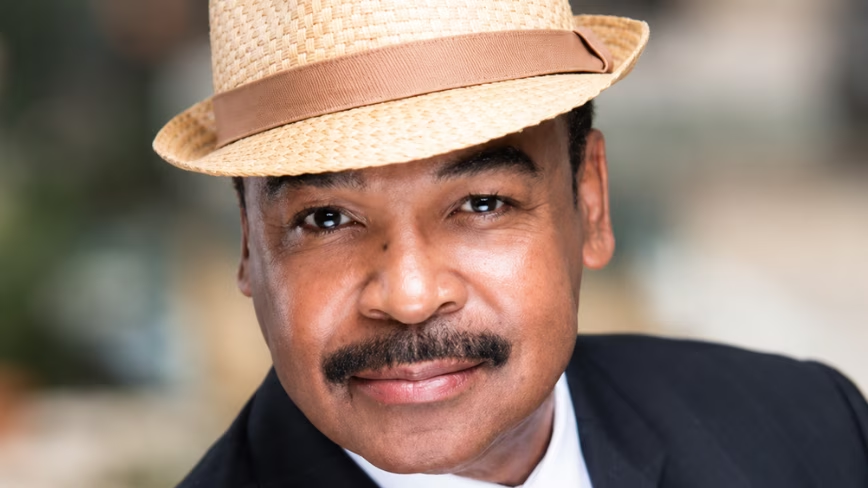
 Credit: Booker Loud