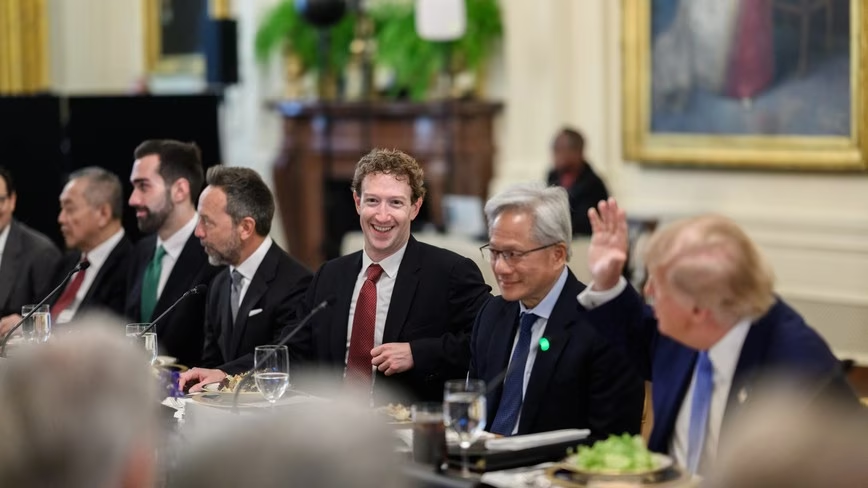
Meta’s Mark Zuckerberg and Nvidia’s Jensen Huang sit beside President Donald Trump at his luncheon on AI in the East Room of the White House, 29 September 2026.

Mark Zuckerberg came up with the AI safety accord that President Donald Trump signed on Tuesday, Semafor and Politico reported. He also circulated the draft. Microsoft and Amazon did not sign it. Satya Nadella and Jeff Bezos both attended the White House lunch where the CEOs agreed it.
Ashley Gold first reported the story for Semafor on Wednesday, citing a source familiar with the matter. Two other sources confirmed it. The idea came from a talk between Zuckerberg and House Speaker Mike Johnson. The two sat next to each other at last week’s state dinner for Chinese President Xi Jinping.
Zuckerberg then spoke to Nvidia chief executive Jensen Huang, according to Semafor. They discussed principles for the executives’ next meeting with Trump. He sent a draft round before the lunch, and Huang helped gather support among the guests.
Owen Dahlkamp and Gabby Miller of Politico confirmed the account later on Wednesday, citing five people familiar with the meeting. They described Zuckerberg as the accord’s chief architect. Two of the people said Huang and administration officials helped shape the text before the lunch. Meta declined to comment to Politico.
“The idea isn’t that this is the only thing that we will ever do. It is that this is a start and an accord that the whole industry could come to,” Zuckerberg told reporters outside the White House on Tuesday.
Who signed the Trump AI accord
Its title is the White House Accord on Super Intelligence. Trump posted it on Truth Social late on Tuesday. Earlier that day, he had called it “morally binding”. Trump and Zuckerberg signed it. So did Huang, Anthropic’s Dario Amodei, Google’s Sundar Pichai, OpenAI president Greg Brockman and Elon Musk.
Nadella and Bezos were among the guests, but neither Microsoft nor Amazon signed, Mashable reported. The signed copy also contains a typo. It describes Trump as “President of the Unites States”.
Earlier in September, Zuckerberg declined to join a proposal from Amodei for labs to coordinate on the pace of frontier AI. In an August phone call with Trump, he also opposed an independent AI regulator, Politico reported. The plan was modelled on the Financial Industry Regulatory Authority.
What the accord asks for
The one-page accord asks each company for four layers of controls, Reuters reported. The first is internal monitoring of its models during training and deployment. It covers areas such as cybersecurity, biosecurity and chemical threats. The goal is to stop models hacking or reaching technical systems in ways nobody intended.
The second is an internal team that checks the controls work. The third is an independent external auditor or evaluator. The fourth is an independent committee of the board, which receives reports from the team and the auditors. The companies will also meet regularly to set shared safety standards.
“Over time, it may make sense to codify these steps into laws or regulations,” the accord says.
It sets no penalties and no timeline, and it does not require the companies to publish audit results, Mashable reported. Politico reported that it has no clear enforcement mechanism.
What the signatories said
“We agreed to a number of things that include joint monitoring, board special committees, just generally grading each other’s homework,” Musk said at the America.gov launch on Tuesday, Nextgov reported.
“I thought that the declaration has a lot of teeth,” Huang said at a panel after the signing, according to Politico’s Digital Future Daily.
“We all need to work together to make sure that we can win, and we can win safely,” Amodei said outside the White House, CNBC reported.
Amodei added that the rules to address the risks of AI are “still under discussion”.
Vice President JD Vance argued against of a regulator modelled on the Food and Drug Administration or the Federal Aviation Administration, Nextgov reported.
“The solution to some of the AI risks is for you guys to take the risk seriously, not to come to the government for a regulatory regime that may make things worse if it’s not smart and careful,” Vance said.
What comes next
Trump told reporters that the administration is considering a 10-person committee to oversee the AI industry. He also said he would name a new AI czar within three to four days, CNBC reported. The same day, he ordered federal agencies to call AI super intelligence.
Congress will need to legislate “at some point”, Senate Majority Leader John Thune told reporters on Wednesday, Politico reported. On the same day, the Federal Trade Commission confirmed it is investigating OpenAI, Anthropic and other AI labs over the risks to consumers.
Get the TNW newsletter
Get the most important tech news in your inbox each week.
Also tagged with


