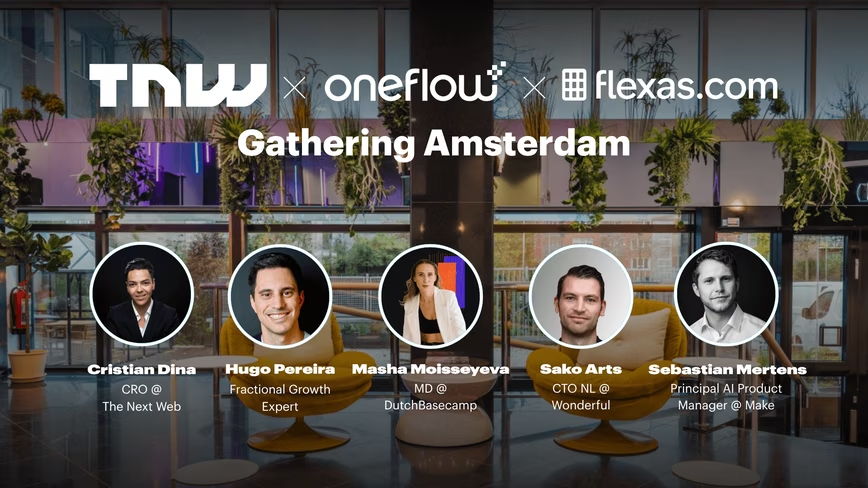
Four guests, one question: when everyone has AI, what will actually make a SaaS company win? The panel on 3 June in Amsterdam will try to answer it.
There is a moment, somewhere between the third and the fourth AI feature release of the quarter, when even the most enthusiastic founder begins to wonder whether anyone is actually buying any of this.
Which is precisely why the panel at the TNW, Oneflow & Flexas Gathering Amsterdam on 3 June is structured around a single, uncomfortable question: when everyone has AI, what will make SaaS companies win?
Today, we are confirming the four guest who will take that question on, moderated by Cristian Dina, co-founder of Tekpon and CRO at TNW who has interviewed several hundred SaaS founders and seems to know everyone in the room before they arrive.
The brief, broadly, is this. Generative AI has moved from feature to substrate. The interesting work, the work that decides who survives the next two years, is no longer about adding an assistant to a sidebar.
It is about rebuilding product, go-to-market, and operations around the assumption that the model is part of the company, not a bolt-on.
Three threads will run through the conversation. Which functions inside a SaaS company get redesigned first, which get redesigned last, and which quietly become irrelevant. What turns into a competitive moat in an AI-native world, and what slides into commodity.
How AI changes the pricing, packaging, and unit economics that investors are still being shown in board decks. Threaded through all of it is a fourth question, which most founders are quietly trying to answer: how do you avoid shipping demo AI, the kind that wows in a thirty-second video and disappoints in production, instead of real customer value?
Who is on the panel?
Sebastian Mertens, Principal AI Product at Make. Make is the no-code automation platform that, over the last two years, has quietly become one of the most-used surfaces for non-technical teams to build with large language models.
Mertens runs its applied AI work: the agents, the toolkits, the things that turn a model into something a sales operations lead can actually deploy on a Tuesday. Before Make, he co-founded Wemakefuture, a German automation consultancy.
He is the panel’s closest read on what an AI-native product surface actually looks like once the novelty wears off.
Masha Moisseyeva, Managing Director of DutchBasecamp. DutchBasecamp is the Amsterdam-based programme that helps founders enter new markets, a function that becomes considerably more complicated when every product you are competing against has shipped its own version of the same AI feature in the past six months.
Moisseyeva is herself a two-time founder, and her remit at DBC, which recently joined forces with ACE, gives her an unusual cross-section of the European startup landscape: who is hiring, who is consolidating, and who is quietly running out of runway. Expect her to anchor the operations and expansion side of the conversation.
Hugo Pereira, fractional CGO/CMO and former Chief Growth Officer at EVBox. Pereira spent seven years at EVBox, where he took the business from roughly five million euros in revenue to over a hundred million, and grew the team from ten people to seven hundred.
He now works as a fractional operator, advising B2B SaaS and deep-tech founders, and he is the author of Teams in Hell, a book about the kinds of organisational dysfunction that scale faster than revenue does.
On a panel about AI-native go-to-market, he is the person most likely to say something unflattering about pipeline coverage ratios.
Sako Arts, CTO at Wonderful. Arts is the technical voice on the panel. Wonderful is the enterprise agent platform that raised a $150 million Series B in March at a two-billion-dollar valuation, deploying AI agents across voice, chat, email and back-office systems for telecom, financial services, manufacturing and healthcare in more than thirty markets.
Before Wonderful, Arts co-founded FruitPunch AI, the global AI-for-Good community that pairs engineers with applied problems in conservation, healthcare and climate, with partners including the World Wildlife Fund and the European Space Agency.
He has spent the last several years building production AI systems for organisations that cannot afford for the model to hallucinate, which gives him a useful perspective on the gap between what AI can demo and what AI can ship.
Between them, the four cover the surfaces an AI-native company has to rebuild: product (Mertens), growth (Pereira), operations and expansion (Moisseyeva), and the underlying technical architecture (Arts). Dina’s job, as moderator, will be to keep them from agreeing too quickly.
Two years on from the first wave of generative AI launches, the SaaS conversation has shifted. The early debate, which asked whether incumbents would win or whether a new generation of AI-native companies would eat their lunch, has given way to something more granular.
Founders are no longer asking whether to use AI, they are asking which parts of their company to rebuild, in what order, and on what timeline.
The 3 June gathering is built for the smaller room. The panel runs from 6 pm to 7:30 pm, after food and drinks, and before the evening returns to open conversation.
The venue, Flexas.com on Weesperstraat, is small enough that the audience and the speakers will still be talking at nine.
- Date: 3 June 2026
- Time: 4:30 pm – 9 pm (panel: 6 pm – 7:30 pm)
- Location: De Weesper, Weesperstraat, Amsterdam
- Tickets: Free, register here.
- Hosts: TNW, Oneflow, and Flexas.com
- Sponsors: L40 and Bolt Business
Get the TNW newsletter
Get the most important tech news in your inbox each week.


