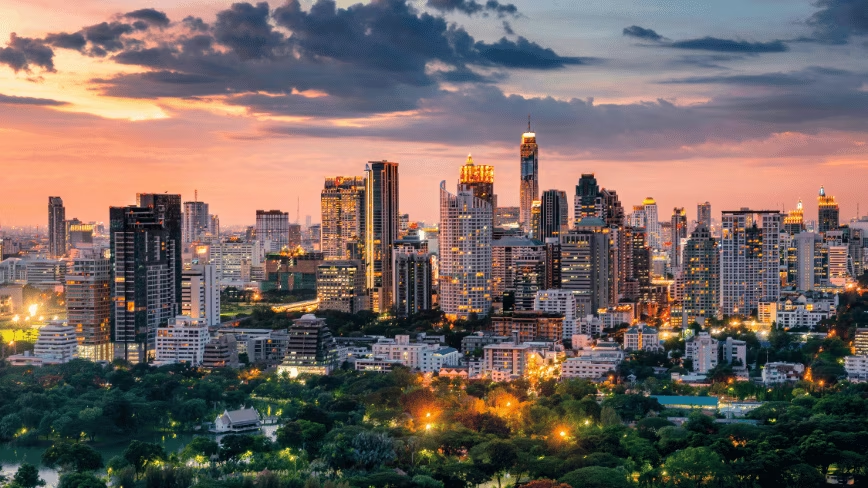
Bangkok, Thailand.
 Credit: © keanu2 / Getty Images via Canva.com
Thailand has stopped construction on 49 data centres, which is more than it currently has running.
Anuchit Nguyen reported the suspension for Bloomberg on Friday, after the first meeting of a new supervision commission chaired by finance minister Ekniti Nitithanprapas. The country has 35 data centres in operation and 117 more waiting on investment approval.
The pause buys time to write rules. Danucha Pichayanan, secretary-general of the National Economic and Social Development Council, said new regulations are expected within a month. Thailand will then put uniform oversight over facilities already running as well as those being built.
Public concern about what these buildings do to the places around them is what forced the meeting.
The loophole that triggered it
The reason this happened now sits a few paragraphs down in Bloomberg’s story, and it is the part worth keeping.
Bangkok authorities paused approvals on three more projects after complaints about a data centre going up next to a hospital. Governor Chadchart Sittipunt told reporters the case exposed a regulatory gap. Data centres can apply for their permits as warehouses.
He said there should be some environmental impact review of these buildings. At present a facility drawing tens of megawatts and millions of litres of cooling water can be waved through under the same category as a shed full of pallets.
That is not a Thai peculiarity so much as a Thai example. Planning categories almost everywhere predate the idea that one building might draw the power of a small town.
The practical consequence is that nobody was counting. A country can approve dozens of these without any single authority holding a list, because on paper they are storage.
Thailand approved $27bn of this in six months
The scale explains the reversal.
Thailand’s Board of Investment approved 88 AI and data centre projects worth 886 billion baht, about $27bn, in the first half of 2026. Tech investment over those six months already exceeded the 623 billion baht recorded across the whole of 2025.
In May the government cleared TikTok System (Thailand) to expand its data infrastructure, covering hosting, servers and storage.
Thailand has been a deliberate destination for this. Google, Amazon and Microsoft have all been building regional capacity there, drawn by costs below the global average and an electronics manufacturing base that already existed.
We reported in July that foreign investment bids in Thailand had surged 80% on the back of the AI build. This is the other side of that number arriving fourteen months later.
What the government is now weighing
Ekniti was careful about the framing. The decision does not mean Thailand is closing the door to data centre investment, he said, because the industry matters to the country’s competitiveness. What the government wants is clear and consistent standards so the sector can grow sustainably.
Two specific measures are under consideration. Higher electricity rates for large data centre operators, and closer scrutiny of projects in densely populated areas after the Bangkok complaints.
Neither is a ban. Both raise the cost of building in Thailand relative to a neighbour that has not yet had its hospital moment.
Both are now standard moves. Spain has drafted a rule requiring 80% renewable supply every hour or no grid connection. Australia is preparing to impose federal energy rules over Queensland’s objection. New York froze new data centres for a year in July.
The energy question underneath it
Southeast Asia has a harder version of this problem than Europe does.
Coal and gas supply roughly 70% of generation across the region’s six largest data centre markets, according to figures cited in a Fortune commentary by Brian Wong, Boris Babic and Nikola Ilovski. Indonesia had blackouts in mid-2026. Five ASEAN states are now looking at nuclear.
So a Thai data centre boom is, in practice, a fossil fuel boom. The electricity pricing measure is the government acknowledging that the grid pays for it either way.
The same commentary makes a second point worth noting. Thailand has stayed out of both AI blocs now forming, the American Pax Silica and the Chinese-led WAICO launched in Shanghai in July. Only Singapore and the Philippines among the eleven ASEAN members have signed with Washington.
That neutrality is easier to hold while you are the place everyone wants to build. It is a harder position to keep if the rules written next month make Thailand a slower place to build than its neighbours.
Seventy-five projects, $130bn, three months
Thailand is late to a pattern rather than starting one.
Data Center Watch counted at least 75 projects worth roughly $130bn blocked or delayed by local opposition in the first three months of this year. In the United States the backlash has become a factor in the November midterms.
The industry has noticed. We covered the charm offensive Big Tech launched in August to keep the buildout moving.
What none of it changes is the money behind the pressure. PricewaterhouseCoopers put global data centre spending at $31.6tn through 2050, which we reported on Wednesday. Every planning department on earth is about to meet some fraction of that.
What happens in a month
The regulations are due in October, and the 49 suspended projects are presumably waiting on them.
Nothing published so far says which projects those are, who owns them, or what happens to a permit already granted under the warehouse category. Thailand has not said whether the new rules will apply retroactively to the 35 facilities already running, beyond Danucha’s statement that oversight will be uniform.
There is also no public accounting of what the suspension costs. A halted construction site still carries financing, and the operators involved have said nothing on the record.
The number to watch is not 49. It is 117, the queue still waiting for approval, and whether the rules written next month leave it standing.
Get the TNW newsletter
Get the most important tech news in your inbox each week.


