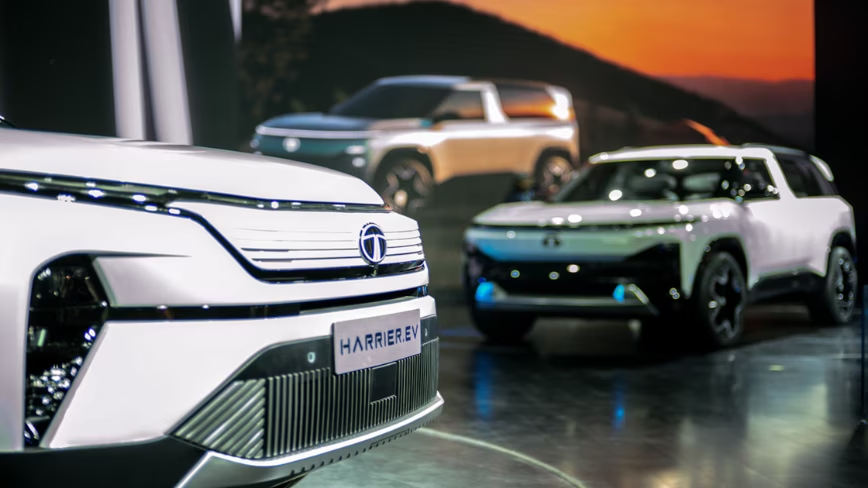
India’s biggest electric carmaker will build its delayed Avinya models on a Chery platform, the latest Indian firm to borrow Chinese tech while avoiding a Chinese partner.
Tata Motors has a premium electric-vehicle problem and a Chinese solution to it. India’s largest EV maker plans to license a vehicle platform from China’s Chery to get its delayed premium models back on track, according to people familiar with the matter, a stop-gap that says as much about the state of the global EV race as it does about Tata.
The plan is specific. Tata will use the Freelander platform, produced in a joint venture between Chery and Jaguar Land Rover in China, to build EVs under its premium Avinya brand at its new factory in Tamil Nadu.
The first Avinya model on the Chery platform is due in 2027, initially shipped from China as a kit and assembled in India while localised components are sourced, with a second EV due in 2029 and scope for two more beyond that.
The word the sources use is “stop-gap,” and it is the honest one. Tata is India’s electric-vehicle leader, but leads are perishable, and developing a premium EV platform from scratch is slow and expensive. Without fresh products it risks losing ground to rivals at the moment the Indian market is opening up.
Licensing a ready platform compresses years of development into an assembly-and-localisation exercise, buying Tata time it does not have to spend building the underlying engineering itself.
What makes the deal more than a procurement footnote is its shape. India has placed strict curbs on investment from neighbouring countries, rules aimed primarily at China, which make deep equity partnerships between Indian and Chinese companies politically fraught.
So Indian carmakers have settled on a workaround: license the technology, avoid the ownership. Tata gets Chinese EV engineering without a Chinese shareholder, and the arrangement stays on the right side of New Delhi’s sensitivities.
That pattern is becoming the defining feature of the global car industry’s relationship with China. Chinese manufacturers have moved ahead on EV platforms, batteries and software fast enough that legacy and emerging automakers alike increasingly find it cheaper to borrow the technology than to build it.
Across the market, foreign carmakers are turning to Chinese partners for the software and platforms they cannot develop quickly enough on their own, and Tata’s licensing route is the same logic adapted to India’s political constraints.
The Freelander platform’s provenance adds a neat twist. It comes from a Chery joint venture with Jaguar Land Rover, the British marque that Tata itself owns, so the Indian company is, in a roundabout way, reaching back through its own subsidiary’s Chinese partnership to source the engineering it needs at home. The global car industry’s supply chains have always been tangled; this is a particularly tidy illustration of how tangled.
The arrangement is, as reported, sourced to people familiar with the plans rather than to an official Tata announcement, and timelines and product counts of this kind tend to shift before launch.
What the reporting establishes is the direction: Tata has concluded that the fastest way to defend its premium EV ambitions is to license a Chinese platform rather than wait for its own, and to do it through a licence rather than a partnership. The first Avinya built on it is two years out. Whether two years is fast enough to hold a lead is the question the stop-gap is meant to answer.
Get the TNW newsletter
Get the most important tech news in your inbox each week.


