 Credit: Canva
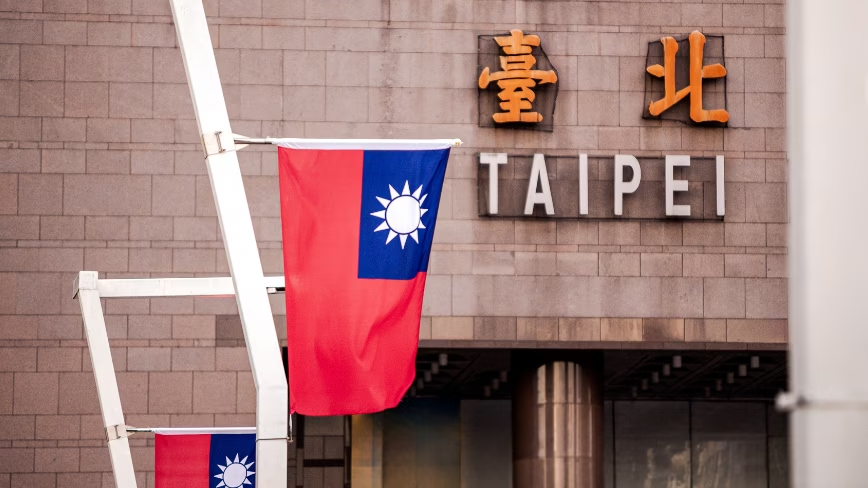
Taiwan spent this week’s SEMICON trade show in Taipei making the same argument twice over, once to Washington and once to Brussels: that its chips arrive with democratic governance attached.
The commercial half of that argument came with a number, and economy minister Kung Ming-hsin supplied it, announcing a further $20bn of planned Taiwanese investment in the United States, Reuters reported from the show.
That pledge sits on top of the trade agreement Taipei signed with Washington earlier this year, which cut the reciprocal tariff on Taiwanese goods to 15% in return for at least $250bn of Taiwanese investment in American semiconductor production.
Commerce Secretary Howard Lutnick has since kept the pressure on, warning that semiconductor tariffs will fall on companies that do not build on US soil.
Alongside the credit guarantee behind the $250bn, Taipei committed to buying $44.4bn of American liquefied natural gas and crude oil, $15.2bn of aircraft and engines, and $25.2bn of power-generation equipment, the last of which is a reminder that fabs are, among other things, enormous consumers of electricity.
President Lai Ching-te appeared at two events during the week and made the political case rather than the commercial one, arguing that Taiwanese firms expanding abroad allow resilience to create shared prosperity, and tying the industry’s strength to democratic governance and the rule of law.
The executives on the same stage were more direct about what the arrangement actually asks of them.
Foxconn chairman Young Liu reduced it to a change of preposition, telling the show that companies must “think about how to make with Taiwan, not in Taiwan; make with Taiwan in the country where the market is.”
Tien Wu, chief operating officer of the chip packaging group ASE, told Reuters the shift was both politically right and, at this point, unavoidable.
The bill for it is already visible in Arizona. TSMC’s American programme reached $265bn in July, a figure that now covers as many as 10 fabrication plants, two advanced packaging facilities, and a research centre, according to chief executive C.C. Wei.
Taiwan spent four decades concentrating that capacity on one island, which is why the phrase “silicon shield” keeps surfacing in Taipei whenever a new tranche of it is promised to somebody else.
Europe got the softer pitch. Deputy foreign minister Francois Wu leaned on shared democratic values and a rules-based international order, and drew the contrast Taipei wants Brussels to hear:
“We use technology to connect with the world, not to control it.”
It is a line aimed squarely at a bloc that has almost no manufacturing leverage of its own in this negotiation.
That imbalance is the awkward part of the European courtship. Europe’s chip sector is being squeezed between American industrial policy and Chinese capacity, and chip independence is not realistically on offer to the EU or to anyone else.
What Taiwan can sell Brussels is therefore access rather than capacity, closer in scale to its stake in Lithuanian chip production than to anything resembling a fab.
None of which changes where the wafers are made. Taiwan remains the epicentre of the AI build-out, and the week’s diplomacy was an attempt to convert that fact into political cover before the tariff schedule does it for them.
The unresolved questions are not about the tariff rate. The Council on Foreign Relations has noted that the agreement leaves several of the harder issues open, including a US trade deficit with Taiwan that ran to $150.1bn in 2025, Taipei’s management of the New Taiwan dollar.
And the question the industry keeps circling back to: how much of the supply chain can be moved at Washington’s pace before the shield stops working.
Get the TNW newsletter
Get the most important tech news in your inbox each week.


