TL;DR
T-Mobile US executives told Deutsche Telekom they oppose the $300B merger after shareholders signalled they would block it
Non-controlling shareholders including large institutional investors told T-Mobile they would oppose the deal, Semafor reported, raising doubts about whether the transaction could win approval
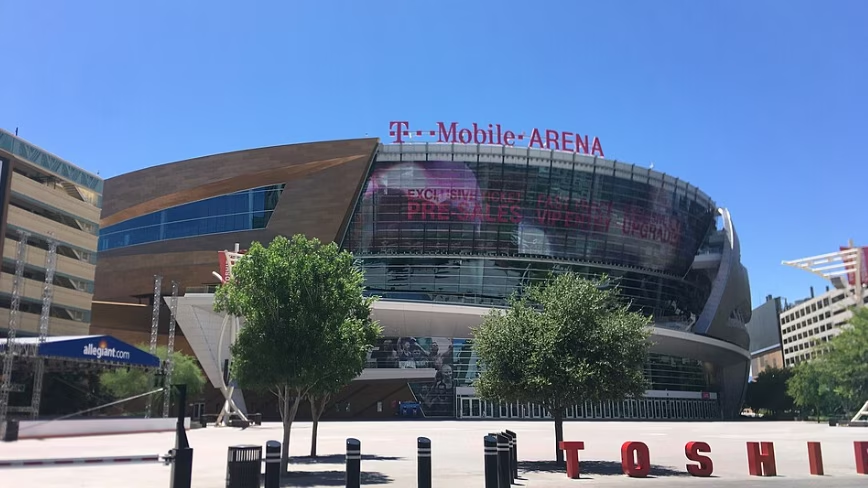
T-Mobile Arena in Las Vegas
 Credit: Ron Mader
T-Mobile US executives told Deutsche Telekom they oppose the $300B merger after shareholders signalled they would block it
T-Mobile US executives have told Deutsche Telekom they no longer support a proposed merger that would have fully combined the two companies in a deal valued at roughly $300 billion, Semafor reported on Thursday. The reversal came after non-controlling shareholders, including large institutional investors, told T-Mobile they would vote against the transaction. T-Mobile’s leadership concluded the deal was unlikely to win shareholder approval under those conditions.
The merger talks began earlier in 2026, with Deutsche Telekom exploring a full takeover of T-Mobile US, in which it already holds a controlling stake of roughly 50 to 54 percent. The deal would have been among the largest corporate transactions in history, dwarfing Paramount’s $110 billion acquisition of Warner Bros Discovery, which itself faced fierce regulatory and legal resistance this year.
The shareholder opposition centred on concerns that the deal undervalued T-Mobile’s US operations. T-Mobile generated approximately $18 billion in adjusted free cash flow last year and paid more than $2 billion in dividends to Deutsche Telekom. Institutional investors argued that folding the company entirely into its German parent would not reflect the scale of its American business.
National security scrutiny added another layer of complexity. The Committee on Foreign Investment in the United States would have reviewed the deal, and people familiar with the matter told Semafor that CFIUS would likely have sought guarantees that US revenue remained in the country. That prospect raised questions about whether the merged entity could freely move capital across borders.
T-Mobile has been the most aggressive competitor in the US wireless market since its 2020 merger with Sprint, which gave it the spectrum and subscriber base to challenge Verizon and AT&T on coverage and price. The company has consistently grown its subscriber count while investing heavily in 5G infrastructure. A full Deutsche Telekom takeover risked disrupting that momentum by introducing regulatory uncertainty and governance changes.
Deutsche Telekom’s motivation was straightforward. The Bonn-based company wanted to consolidate its most profitable asset and simplify a corporate structure that splits ownership across public shareholders on two continents. But the resistance from T-Mobile’s minority investors suggests the market believes T-Mobile is worth more as a separately traded entity than as a wholly owned subsidiary.
A T-Mobile spokesperson declined to comment on the matter, according to Semafor. Deutsche Telekom and the US Treasury Department did not respond to requests for comment.
The collapse of the merger talks does not change Deutsche Telekom’s controlling position. It remains T-Mobile’s largest shareholder and can continue to collect dividends and exercise board-level influence. What it cannot do, at least for now, is absorb the company entirely without the consent of minority shareholders who have made clear they are not willing sellers at the terms on offer.
Get the most important tech news in your inbox each week.


