TL;DR
Stellantis CEO says the company sees “space” for Chinese Leapmotor EVs in Canada and Mexico but “no space” in the US right now.
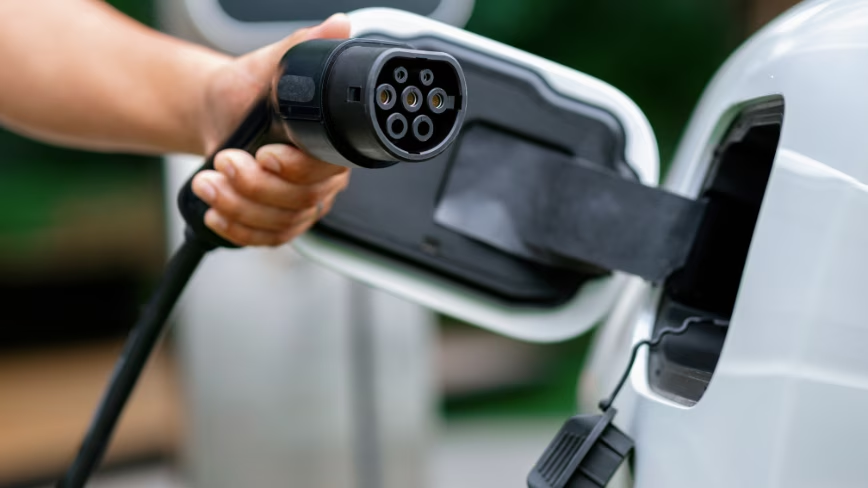
EV car charger
 Credit: Canva
Stellantis CEO says the company sees “space” for Chinese Leapmotor EVs in Canada and Mexico but “no space” in the US right now.
Stellantis CEO Antonio Filosa said on Thursday that the company sees opportunity to produce and sell Chinese-branded vehicles in Mexico and potentially Canada. In the United States, the answer is different. “Now there is no space in the United States. We don’t see that,” Filosa said at a news conference following the company’s investor day near Detroit.
The statement is remarkable for what it concedes. Stellantis, the parent of Jeep, Ram, Dodge, and Chrysler, is openly discussing using its own plants to produce vehicles designed by a Chinese competitor. The partner is Zhejiang Leapmotor Technology, in which Stellantis holds a 21% stake.
Stellantis also owns 51% of a joint venture with Leapmotor. The JV gives Stellantis exclusive rights to sell and manufacture Leapmotor products outside greater China. That structure makes Stellantis both a legacy Detroit automaker and a licensed distributor of Chinese EVs.
The most obvious candidate for production is Stellantis’ assembly plant in Brampton, Ontario. The facility, a suburb of Toronto, has not produced a vehicle since the Dodge Charger and Challenger ended production in December 2023. Bloomberg reported in April that Stellantis was in discussions with Leapmotor about building EVs at the idled plant.
Canada’s trade deal with China allows 49,000 Chinese-made EVs to be imported annually at a 6.1% tariff. Building Leapmotor vehicles in Brampton would circumvent even that modest tariff. The cars would be Canadian-manufactured.
Filosa framed the partnership as a way for Stellantis to grow sales, learn from its Chinese counterpart, and share capital expenses. The learning dimension is as significant as the commercial one. Leapmotor’s engineering speed, cost structure, and software-defined vehicle architecture represent capabilities Stellantis has struggled to develop internally.
Leapmotor’s T03, a compact electric hatchback, has been selling through Stellantis dealerships across 13 European markets since September 2024. Prices start from approximately €18,900. The B10, an electric compact SUV from approximately €36,400, followed in early 2026.
Earlier this week, Stellantis expanded the partnership further. It also announced a European joint venture with a second Chinese automaker, Dongfeng. The Dongfeng deal covers shared sales, distribution, manufacturing, purchasing, and engineering.
The US political environment makes domestic production of Chinese-branded vehicles impossible for now. More than 120 House lawmakers signed a letter urging President Trump to keep Chinese automakers out. Bipartisan legislation introduced on 12 May would ban connected vehicles and components linked to China.
Filosa’s distinction, “space” in Canada and Mexico, “no space” in the US, is a reading of political reality. It is not a reading of market demand. American consumers are paying $49,000 on average for a new car while Chinese models start below $15,000.
The company also announced a partnership exploration with Jaguar Land Rover for US product development. “JLR is a partnership that can work very well for both parties,” Filosa said. The JLR collaboration is designed for the US market where Chinese brands cannot go.
The Leapmotor and Dongfeng partnerships are designed for everywhere else. The strategy is clear: Chinese engineering for markets where politics permit, legacy brands for markets where they do not. Stellantis is playing both sides of the trade wall.
The competitive logic is straightforward. BYD overtook Tesla as the world’s largest EV seller in 2025. Xiaomi launched a $34,300 SUV this week that undercuts the Model Y by $4,350 with more range.
Chinese automakers produce vehicles that legacy manufacturers cannot match on price or technology. Stellantis’ response is not to compete head-on but to partner. Use Chinese engineering to fill its own plants and reach consumers who want affordable EVs.
Stellantis unveiled a $70 billion turnaround plan at investor day. It targets a 35% increase in North American sales led by Ram Trucks and a Chrysler revival. Positive cash flow is projected by 2027.
The Leapmotor and Dongfeng partnerships are a parallel strategy. While Stellantis invests in reviving legacy brands for the US, it is building a Chinese-powered vehicle pipeline for every other market. The Brampton plant, idle for two and a half years, may be where those two strategies meet.
Get the most important tech news in your inbox each week.


