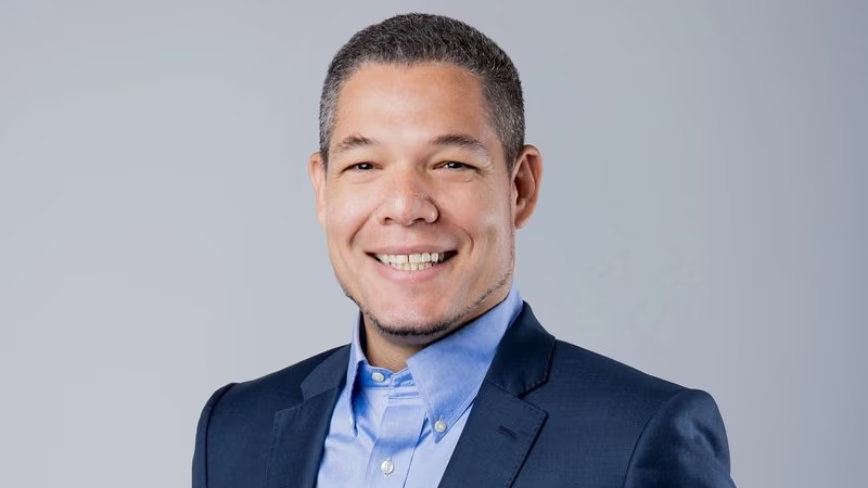
David Hardoon, who left Standard Chartered after less than a year, will lead advanced AI for the region at a consultancy betting heavily on enterprise adoption.
The corporate AI leadership market moves quickly enough that a year now counts as a tenure. David Hardoon, Standard Chartered’s former global head of AI enablement, has joined Accenture as managing director and head of advanced AI for Southeast Asia, a move that says as much about where demand for AI expertise is pooling as about any one executive’s career.
Hardoon arrives with a résumé that spans the institutions most concerned with how AI is governed rather than merely built. He joined Standard Chartered in April 2025 as global head of AI enablement, bringing more than two decades of experience across government, academia, and banking.
Before that he served as the Monetary Authority of Singapore’s first chief data officer, a role that placed him at the centre of how a major financial hub thinks about data and algorithmic risk.
His departure from Standard Chartered came less than a year after he arrived, a brevity that drew notice when it was reported earlier this year.
Short senior tenures in AI have become common enough to constitute a pattern, as banks and corporations stand up AI functions, discover how hard it is to translate ambition into deployed systems, and reshuffle the leadership meant to deliver it.
The role of enterprise AI chief is new, loosely defined, and frequently caught between the promises made to a board and the realities of legacy infrastructure.
For Accenture, the hire fits a clear and well-capitalised strategy. The consultancy has positioned itself as the firm that helps large organisations actually implement AI, the layer between the model makers and the enterprises that want results without building everything themselves.
It has been investing accordingly, taking a stake in General Robotics to orchestrate factory robots under a single AI layer and rolling out its own systems for coordinating autonomous machinery in industrial settings.
Southeast Asia is a deliberate place to plant a senior AI hire. The region combines fast-growing digital economies, governments keen to be seen leading on AI policy, and a financial sector under pressure to modernise, which is precisely the mix where a consultancy selling AI transformation expects to find buyers.
Hardoon’s regulatory background, particularly his time at the MAS, is an asset in a market where the question of how to deploy AI responsibly is often inseparable from whether a deployment is allowed at all.
The move also reflects a broader migration of AI talent toward the firms positioned to monetise enterprise adoption.
As the largest model developers absorb much of the research talent, the consultancies, the systems integrators, and the platform companies are competing for the people who know how to make AI work inside a real organisation, with its compliance constraints, its messy data, and its reluctant middle management.
That is a different and arguably scarcer skill than building the models, and it is the one Accenture is paying for.
It lands amid a wider scramble to give AI systems the identity, security, and operational scaffolding that enterprise deployment demands, the kind of unglamorous plumbing that startups raising to give AI agents a corporate identity are built to supply.
Hardoon’s new brief sits squarely in that territory, where the hard part is not the intelligence but the integration.
Neither Hardoon nor the companies involved detailed the specific mandate beyond the regional remit, leaving the shape of the role to emerge in the work. What is clear is the direction of travel.
The talent that spent the past few years inside banks and regulators learning how AI behaves in high-stakes settings is now being recruited by the firms whose business is selling that knowledge onward, and Accenture has just added one more name to the column.
Get the TNW newsletter
Get the most important tech news in your inbox each week.


