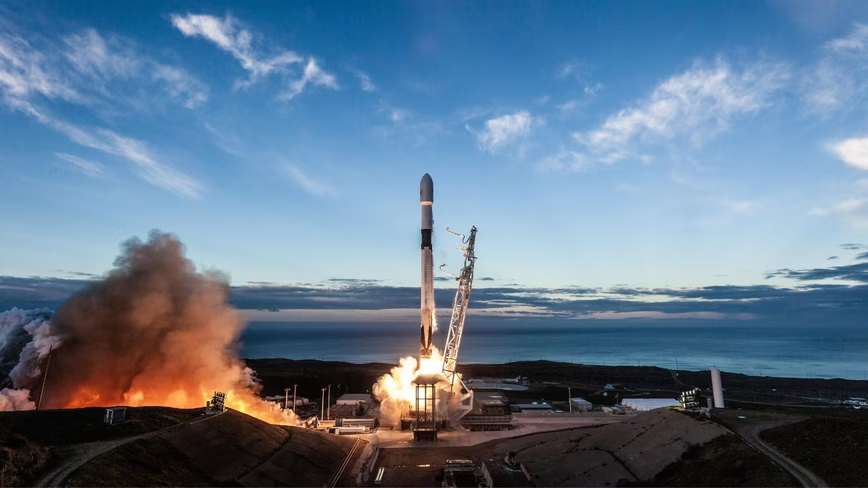
The SpaceX IPO is set to price the biggest stock-market debut in history this week, raising about $75bn at a valuation near $1.75tn, with shares trading on Nasdaq from Friday.
But the most consequential thing about Elon Musk’s rocket company going public may have little to do with rockets, or with Musk. It is what the listing does to everyone else.
For the venture-capital industry, SpaceX is the thaw after a long freeze. Just 23 venture-backed tech firms went public in the US in 2025, down from 77 four years earlier, and the capital that funds have tied up in private bets has had nowhere to go.
SpaceX’s debut, already oversubscribed nearly four times over, hands that ecosystem its first large payout in years: early backers such as Antonio Gracias’s Valor Equity Partners, on a roughly 4 per cent stake worth almost $70bn at $135 a share, alongside Peter Thiel’s Founders Fund and Sequoia, stand to return tens of billions to their own investors, who will recycle much of it into the next wave of startups.
The listing will also mint thousands of employee millionaires.
The read-through to OpenAI and Anthropic
The more important signal is what comes next. OpenAI and Anthropic have both confidentially filed to go public, and together with SpaceX they make up an IPO pipeline that could eventually bring $3.6tn of new stock onto public markets.
How SpaceX trades in its first weeks will shape the benchmark investors use to price the two AI labs, and test whether the market has the appetite to absorb that much new equity at once.
Wall Street already has a name for the worry: more shares than buyers.
That makes the debut a genuine stress test rather than a victory lap. SpaceX is targeting revenue multiples beyond even Palantir’s, leaving ‘virtually no margin for error’, as PitchBook’s Franco Granda put it. Bulls point to real income, including reported payments of around $920m a month from Google for Starlink capacity and about $1.25bn a month from Anthropic for AI infrastructure.
Bears remember Facebook’s 2012 IPO, which slumped after listing and froze the new-issue market for more than a year. A wobble this time would land on OpenAI and Anthropic before they have even priced.
The structural caveats remain.
Musk keeps roughly 79 per cent of the voting power on about 42 per cent of the equity through a dual-class structure that led one Danish pension fund to blacklist the deal, and a tangle of opaque special-purpose vehicles has sprung up to sell SpaceX exposure to investors who could not get in directly.
None of it has dented demand.
But the deeper question, posed by Caplight’s Javier Avalos, is whether any company can ‘be private for 20-plus years, raise billions privately and still have juice once they go public’. SpaceX is about to provide the answer, and OpenAI and Anthropic are watching as closely as anyone.
Get the TNW newsletter
Get the most important tech news in your inbox each week.
Also tagged with


