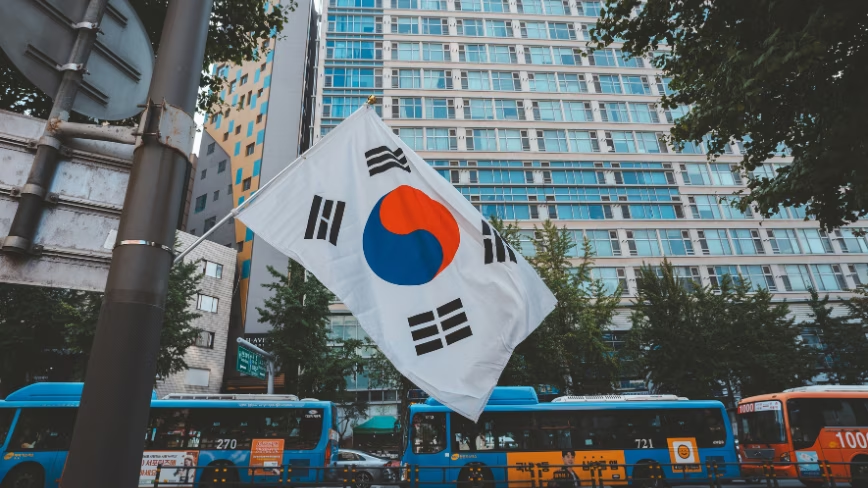
South Korea flag and Street scenery of between Hongdae and Hapjeong station in Seoul, Korea.
 Credit: 2p2play via Shutterstock.com
South Korea negotiated tariff protection for its chipmakers, and Washington is pressing for American factories anyway. Semiconductor investment is now part of the broader talks between the two governments, a presidential official in Seoul has confirmed.
The confirmation was reported by Reuters, and it follows Washington signalling plans for targeted tariffs on semiconductor imports.
Howard Lutnick has put the American position in a single sentence. “If you don’t build here, expect to pay to enter the greatest market in the world,” the commerce secretary said.
Seoul thought it had already settled this. Under the agreement struck between the two presidents, South Korea committed $350bn towards US manufacturing investment in return for tariff terms “no less favourable” than those given to competitors with comparable chip trade volumes.
That clause is the crux of the disagreement. It promises parity rather than exemption, which means Korean chipmakers are protected against being singled out but not against a tariff that lands on everyone.
The companies involved are the two largest memory makers in the world. Samsung Electronics and SK Hynix have seen demand climb as American technology companies build out AI infrastructure, which is what gives Washington leverage and Seoul something to protect.
The comparison being used against them is TSMC. Analysis published in Seoul this week put the figure at roughly six and a half times more US investment needed for the two Korean firms to match the Taiwanese company’s American footprint.
That gap is a matter of manufacturing type rather than willingness. Memory fabs are enormously capital intensive, and their economics depend on scale concentrated in one place, which is why the industry clustered in Korea to begin with.
The domestic build-out has not paused for any of this. SK Hynix is spending $720bn on memory fabs at Yongin, and Seoul has been in talks with both companies about a second chip cluster inside the country.
Capital is moving in the other direction too. SK Hynix has set out a $29bn US listing, which raises money from American investors without moving a single fab.
There is a circularity in the tariff plan. Samsung and SK Hynix supply the memory that goes into American AI data centres, so a levy on their chips raises the cost of the build-out that Washington is trying to accelerate.
The pull works alongside the push. Nvidia has put $1bn into Naver and struck a $500bn arrangement with SK Group, which is the American industry deepening its ties to Korean capacity at the same time as the American government presses for that capacity to move.
The negotiation is not confined to chips. The same official said talks on South Korea’s planned nuclear-powered submarine programme have stalled, and acknowledged that the various issues between the two countries are “sometimes affecting each other”.
That is an unusually candid description of linkage. It means a semiconductor concession can be traded against a defence question, and that neither file gets resolved on its own merits.
Still, nothing has been agreed. No figures for additional US chip investment have been published, no tariff rate has been set, and neither Samsung nor SK Hynix has commented on what is being discussed on their behalf.
None of this is fast to change. A memory fab takes years to build and qualify, so even a settlement that satisfies Washington today would not move production for the rest of the decade.
The immediate question is what the parity clause is worth. If a tariff applies to every foreign chipmaker equally, South Korea will have secured fair treatment and a bill at the same time.
Get the TNW newsletter
Get the most important tech news in your inbox each week.


