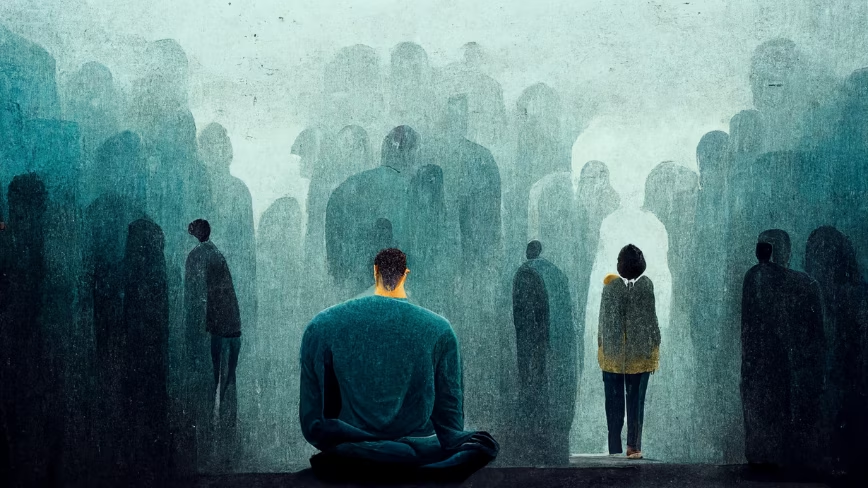
We can no longer pretend that the bridge between generations is invisible, because it stands before us, growing wider every day, harder to cross and harder even to name.
Nor can we deny that technology has had its hand in this rupture, since it has not merely changed the tools we use but changed the tempo of thought, the shape of desire, and the way each of us comes to see ourselves among others.
The question that follows me every time my feed fills again with news of invention, disruption, automation, and intelligence is simple and almost unbearable: is this still good for us?
I do not reject evolution, because without it we would not be here, formed as we are and living in the societies we have built. But something in our present age feels inverted, in the sense that the more technology advances, the more the human being appears to withdraw from the world around them.
Progress, once imagined as a collective ascent, now often feels like a private enclosure in which the individual is placed at the centre of everything and somehow becomes smaller there.
We no longer simply live, but classify the way we live. We no longer inherit time, but brand it. Every instinct, every habit, and every loneliness must now be given a name, polished into a trend, and sent back to us as though it were a revelation.
I am not old-fashioned anymore, I am a baby boomer. I am not young and restless, I belong to Generation Z. I am not ambitious, I am optimised. I am not alone, I am independent. I am not taking a trip by myself. I am solo-maxxing.
Perhaps this is the most revealing thing about us, that even solitude, the last private territory of the self, must now be packaged as strategy.
Sooner or later the suffix finds you, whether through a colleague who mentions they have been sleepmaxxing, a teenager who talks about looksmaxxing, or a fitness account that tells you to start gymmaxxing.
Solo-maxxing means maximising your aloneness.
According to the coverage that has tracked the term across the spring and summer of 2026, in outlets including Psychology Today, it describes the deliberate choice to invest your time, money, and energy in yourself rather than a relationship, and to treat single life not as a phase between partners but as the goal itself.
In practice that means solo travel, solo dining, money redirected towards fitness and savings, and tightly structured days built around independence, all of it documented and posted.
It would be easy to file this under internet froth, a hashtag gone by autumn, but that reading misses the through-line. Solo-maxxing is the point at which a logic that has been migrating through the culture for a decade finally reaches companionship itself, and the technology that carried it there is already preparing to sell the next thing.
To see why, it helps to know where the word actually comes from.
A word with a paper trail
The suffix has a surprisingly clean lineage. It begins, of all places, in 1940s game theory, with the idea of maximising a single variable at the expense of everything else, and it passes through tabletop role-playing games as “min-maxing,” the strategy of pouring all your resources into one stat.
Then, in the early-to-mid 2010s, it lands somewhere darker, on incel message boards, where men began applying the language of optimisation to their own bodies.
The prototype was looksmaxxing, maximising your physical attractiveness to raise what those forums coldly called your “sexual market value.”
The linguist Adam Aleksic, who has traced this history in The Washington Post and his book Algospeak, makes a point worth sitting with, which is that the terms that escaped the incel forums and went mainstream were precisely the ones that could shed their overt misogyny while keeping their competitive, quantitative edge.
Maxxing made the jump, and so did sigma and chad, while the cruder vocabulary stayed behind. By late 2023 the suffix was fully viral, carried onto TikTok in large part by women repurposing it for makeup tutorials, mostly unaware of where it came from.
Aleksic has described polling a Georgetown lecture hall in early 2024 and finding that around 40% recognised the terms, and that two months later, at Stanford, recognition had reached 80%.
This is the inheritance solo-maxxing carries. The framing did not soften when it crossed over, but simply found new variables to optimise, and it kept the central, slightly chilling assumption intact: that a human life is a set of metrics, and that the rational move is to maximise your numbers.
The economics of opting out
None of this would matter if the trend were not landing on extraordinarily fertile ground, but young people are, by a great many measures, retreating from the messy business of romance, and they have their reasons.
The first is money, since the reported average cost of an all-in date in the United States, once you include dinner, drinks, transport, and the grooming beforehand, has climbed to somewhere around $189, with Gen Z reportedly spending closer to $205.
The second is exhaustion, because in one multinational survey of roughly 14,380 adults, close to half of those aged 18 to 34 said that being single felt more peaceful than being in a relationship, and 46% said dating apps had made relationships feel more disposable.
Surveys have repeatedly found that more than three-quarters of Gen Z feel burned out by the apps entirely.
The market is registering the mood. Tinder’s paying users fell 7% across 2024, and its parent, Match Group, cut around 13% of its workforce while citing weakness among younger users as it did so.
A generation handed a gamified, ranked, swipeable marketplace for human connection has looked at the leaderboard and, in growing numbers, decided not to play.
Solo-maxxing gives that decision a flattering name, because where the apps offered a competition you could lose, solitude offers a game you can win simply by playing it alone.
The bigger picture deserves care, though, because the trend pieces tend to overstate it. The often-cited Pew figures, that 86% of adults aged 18 to 24 and 42% of those aged 25 to 39 are unpartnered, describe people who are not living with a partner, which is a far broader category than the lonely and includes plenty of people who are dating happily.
Pew’s 2025 update also found that the share of unpartnered adults had actually ticked down slightly, for the first time in two decades. Singlehood is a long, slow tide rather than a sudden flood, and what is new is not that young people are alone, but that being alone has become content.
Solitude, repackaged?
Here the technology stops being background and becomes the engine, because the reason loneliness influencers exist at all is that the recommendation systems reward them.
Footage of a quiet café, a structured day, or a meal for one edited in soft, slow, aestheticised cuts is exactly the emotionally resonant material that algorithms surface and replay, and solitude, it turns out, performs.
The platform incentive then does something subtler than merely distributing the content, in that it pushes creators to make solitude permanent and to brand themselves around it, because a consistent identity is what the feed rewards.
A passing season of being alone becomes a personal franchise, emotional states become content formats, and loneliness is no longer only a private experience but a public aesthetic shaped by whatever gets seen.
This is where the honest debate sits, and it deserves both sides, because there is nothing wrong with chosen solitude. Psychologists distinguish, rightly, between the restorative quiet a person elects and the corrosive isolation that creeps up on them unbidden.
Writing in Psychology Today, the physician Bruce Y. Lee grants the real benefits, the peace, the independence, the money saved, and the time freed to build the rest of a life, before adding the necessary caution that solo-maxxing can become “a crutch to keep you from addressing avoidant behaviour,” a way of dressing up a fear of being hurt as a programme of self-improvement.
The real danger is not the quiet, but the blurring, the way a feed cannot tell the difference between a person who has chosen to be alone and a person who has simply stopped being able to do anything else, and has no incentive to find out.
The 2023 advisory from the US Surgeon General put hard numbers to what is at stake, describing the health toll of social disconnection as comparable to smoking up to 15 cigarettes a day, and finding that people aged 15 to 24 now spend roughly 70% less time in person with their friends than the same age group did in 2003, around a thousand fewer hours a year.
A culture that aestheticises being alone is pouring accelerant on that, and calling it a candle.
The machine that names the wound
Technology did not invent loneliness, and that would be too easy an accusation, and therefore a false one.
Human beings were alone long before the machine, before the algorithm, and before the bright little altar of the phone, since we had solitude in bedrooms, in train stations, in marriages, in crowded cities, and in families that spoke every day and still said nothing.
What technology did was more precise, and therefore more dangerous, because it amplified solitude and gave it a language, a market, a feed, a performance, and a price. The old solitude was a condition, whereas the new solitude is a product category.
This is where the discussion becomes uncomfortable, because we speak endlessly about innovation, efficiency, automation, safety, privacy, and transparency, which are the respectable words, the ones that can enter a policy paper without making anyone nervous, while almost nobody wants to speak about the emotional architecture being built underneath them.
So it is worth asking plainly what technology does to the human being who is already tired of people. It gives them tools that make withdrawal feel rational, metrics that make comparison feel objective, and platforms where every attempt at intimacy is ranked, scored, filtered, rejected, and repeated.
Then, when they retreat from that exhaustion, the same system offers them a new identity for the retreat, so that they are not lonely but intentional, not excluded but optimising, not giving up on others but solo-maxxing.
The next step is already visible, since we have written about the fact that nearly half of young Europeans have turned to AI to talk about intimate and personal matters, many of them finding it as easy as talking to a friend.
The machine first wounds the need, and then sells the bandage.
And still the public conversation remains strangely poor, because we regulate the visible danger, or we attempt to. We ask if the user knows he is speaking to an AI, whether his data is protected, and whether the platform is transparent enough, safe enough, and compliant enough, and these are necessary questions that are nonetheless not sufficient.
The greatest danger may not be deception in the simple sense, but consent shaped by exhaustion, because a person does not need to be tricked into choosing artificial companionship and only needs to be made tired enough of human complexity.
No law quite knows what to do with that. How do you regulate a product that does not merely answer a need but trains the need to depend on it, or measure the harm of a chatbot that never insults you, never rejects you, and never leaves you, yet slowly makes the living world feel unbearable by comparison?
How do you name the injury when the wound is not a single event but a gradual lowering of the appetite for real people?
Regulation is coming, of course, as it always comes after the appetite has already been trained. Europe is moving through the AI Act, with transparency rules that will force certain systems to disclose when a human being is speaking to a machine, while the Digital Services Act already scrutinises minors, targeted advertising, recommender systems, and the addictive design of online spaces.
A Digital Fairness Act, expected to be proposed in late 2026, is being prepared to confront dark patterns, unfair personalisation, influencer marketing, and the commercial exploitation of vulnerability.
In the United States, regulators have begun asking what AI companions do to children and teenagers, and states such as New York and California have started drawing the first legal lines around artificial companionship, with disclosure requirements, self-harm protocols, and user-safety standards that took effect from late 2025.
So the machine is not entirely unobserved, but observation is not the same as understanding.
This is the blind spot, because technology has moved faster than our moral vocabulary and has entered the intimate life before society has found the courage to ask what intimacy becomes under optimisation.
The law can require a label that says “this is AI,” the platform can provide a disclaimer that this is not a real person, and the company can add a safety feature that suggests you take a break, yet none of these answers the harder question of what happens when a generation learns to seek comfort from systems designed to retain attention rather than to love.
What happens when companionship becomes frictionless, when affection becomes available on demand, and when the other no longer has to remain other at all?
Human relationships have always been dangerous precisely because the other person is free to misunderstand us, refuse us, bore us, desire something else, and leave, and the machine removes that danger, and with it, perhaps, the final discipline of love.
It gives us company without resistance, and maybe that is exactly why it is so seductive, not because it is human, but because it saves us from the burden of another human being.
It is worth remembering, as we have documented elsewhere, that this frictionless company is also a business, and that the AI companion which never leaves you still wants your data, your subscription, and your continued, billable attention.
The real failure, then, is not only technological but political, cultural, and philosophical, because we built systems that reorganise attention, desire, solitude, and companionship, and then acted surprised when people began to live differently inside them, and we allowed the market into the most fragile rooms of the self and called the result innovation.
This is why regulation, as it exists now, feels late, since it looks at the machine and asks whether it is safe, and rarely looks at the human being and asks what kind of creature the machine is producing.
Until that question is asked, the industry will continue to move first, naming the wound, branding the coping mechanism, monetising the retreat, and returning to us with another solution, not because it understands loneliness, but because loneliness converts.
Get the TNW newsletter
Get the most important tech news in your inbox each week.


