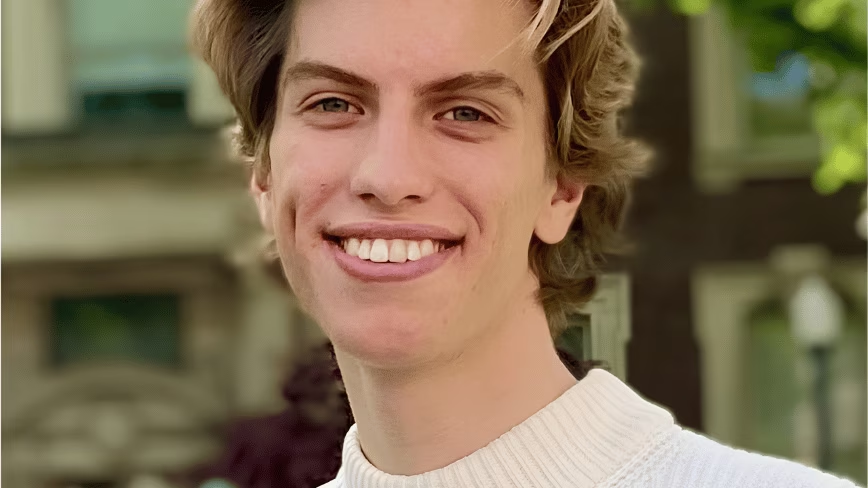
 Credit: Leopold Aschenbrenner / LinkedIn
Situational Awareness lost roughly $30bn in July. The desk reported that three weeks ago.
What happened inside those six days has not. Gregory Zuckerman, Juliet Chung and Peter Rudegeair have reconstructed it for the Wall Street Journal, and the sequence is stranger than the number.
The phone call that gave it away
David Mann runs the Mannsion Group, a family office holding stakes in Anthropic and other private companies. On the afternoon of Wednesday 29 July he was in a taxi to LaGuardia when someone acting for Leopold Aschenbrenner’s fund rang.
Did he want to buy a piece of its Anthropic stake? The deal had to be done overnight.
Mann drew the obvious inference. Nobody offloads pre-IPO shares in a company valued near $1tn unless something has gone wrong.
“Aschenbrenner was being forced to sell,” Mann told the paper. “He needed the money and was sounding people out.”
John Pfeffer of Pfeffer Capital, an investor in the fund since it started, described the atmosphere by then. “It felt like he was being hunted.”
The stake he could not simply sell
Here is the constraint that shaped the week.
Anthropic holds approval rights over transfers of its privately held shares. Situational could not run an open auction. It could only approach firms that already held Anthropic stock.
That narrowed the buyer list to a handful. On the Wednesday the fund approached Sequoia, Greenoaks, Michael Dell’s family office DFO Management, and the New York firm XN.
It offered a 20% discount and set a 12-hour deadline.
The Greenoaks group worked overnight. The deal was set to close at eight the next morning, and Anthropic signed off on the transfer.
The auction those bidders knew nothing about
While that ran, Situational Awareness was negotiating something much larger with Citadel and Millennium Management. The Anthropic bidders were not told.
A Citadel executive had contacted Sven Khatri at the fund on 28 July. Khatri had joined recently from Citadel’s own treasury research team.
Talks moved from Citadel buying the entire liquid stock portfolio to buying only the leveraged positions. Ken Griffin joined from London.
Citadel won in the early hours of Thursday 30 July, at a discount of around 10% to market prices.
Aschenbrenner then went back to the investors who expected to close on the Anthropic stake that morning and told them he had a better deal. The Journal reports some were angry.
Signing finished at about 9.10am, roughly 20 minutes before US markets opened.
How the street worked it out first
The fund was found out before it announced anything, and the mechanism is worth understanding.
Prime brokers send clients regular reports on the aggregate shape of their hedge fund customers’ books. Through July those reports showed leverage falling in tech, which told the market someone large was in trouble.
Rival traders had also studied what Aschenbrenner owned. When his holdings fell they inferred the rest.
Nebius, Bloom Energy, Sandisk and Core Scientific dropped between 9% and 24% in the four days from 24 July. Positions he had bet against, including Adobe, AppLovin and Figma, rallied at the same time.
By the Wednesday, the Journal reports, the street openly assumed a major fund was degrossing.
The structure underneath
The fund grew from about $1.5bn last summer to more than $45bn by early July, and borrowed roughly $3 for every $1 of its own capital.
Its longs and shorts pointed the same way. Chips and infrastructure up, software down, both expressing one view about AI. Traders call that a Texas hedge, and it removes the protection a hedge is meant to provide.
Goldman Sachs financed the fund from the start and showcased it at an emerging-manager conference in March 2025. It monitored the fund closely, because the book was concentrated and levered. JPMorgan, Bank of America and Citigroup also lent, and Morgan Stanley was in talks.
Jefferies and Barclays passed. One prime brokerage executive who turned the fund down told the Journal that Aschenbrenner’s unshakable confidence was itself the warning sign.
For most of the run the investment team came to two analysts, an economist, a research director and a risk manager.
The concentration was extreme even by that standard. Justin Choi and Sheetal Banchariya reported for the New York Post that quarterly filings showed a $5.7bn position in SanDisk and $5.6bn in Micron at the end of June.
Those two holdings made up more than half the US stock portfolio. SanDisk fell 47% in July and Micron 29%. Bloom Energy, the next largest, fell 31%.
What set it off
Sentiment turned in mid-July when cheaper open-source Chinese models unsettled the AI trade.
The desk has tracked that pressure separately. Nebius raised $775mn against its GPUs in the same period, and it was among the holdings that fell.
We covered the margin call itself on 30 July, when the man who wrote the AI-boom bible ran out of collateral.
Who else paid
Jane Street lost about $15bn in July, much of it through its investment in the fund.
Situational Awareness finished the month down about 67% and, on the Journal’s figures, still up 80% for the year. It now runs about $15bn.
Aschenbrenner married Avital Balwit, chief of staff to Anthropic’s Dario Amodei, that weekend in Carmel. One toast thanked Griffin and Citadel for making the day possible, half in jest, according to a guest.
He is already rebuilding, having put $400mn into a stealth chip startup.
What would settle it
The Anthropic stake is the part still worth watching, because the numbers around it keep moving.
Anthropic told investors this week its run rate had passed $65bn, and its listing rests on a 2028 forecast. A stake in that company was worth a 20% discount to a seller who needed cash in twelve hours.
Two questions follow. Whether Situational still holds any of it, which nobody has said. And whether banks price the next concentrated fund differently, given four lent and two refused on the same evidence.
Get the TNW newsletter
Get the most important tech news in your inbox each week.


