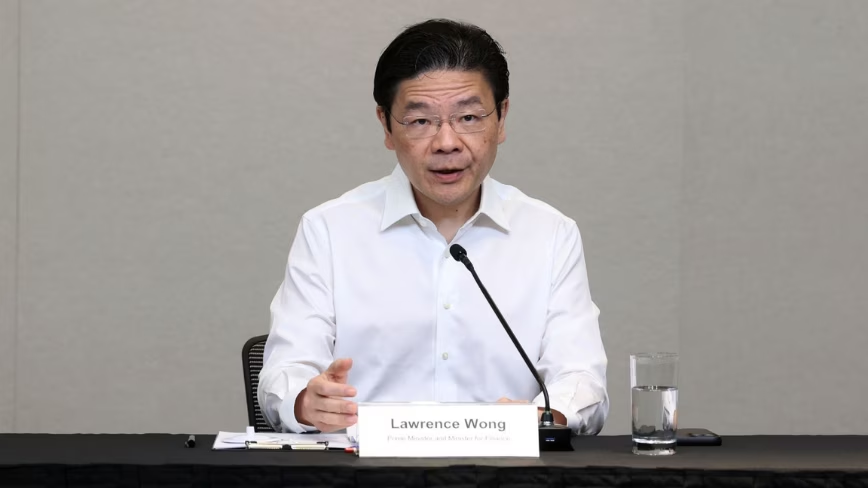
 Credit: Lawrence Wong
Singapore’s prime minister has tried to turn one of the anxieties of the AI age into a promise. In his National Day message, Lawrence Wong pledged that the country will harness the technology to create better jobs rather than let it hollow out the workforce.
He did not pretend the worry was imaginary. Wong acknowledged that many workers fear for their livelihoods as AI reshapes industries, a candour that set his message apart from the boosterism politicians often reach for when talking about new technology.
His framing leaned on Singapore’s familiar theme of control amid chaos. “We cannot control events beyond our shores,” he said, “but we can control how we respond,” positioning the government as an active hand rather than a bystander to disruption.
On AI specifically, he was matter-of-fact about the stakes. “AI is already transforming industries and changing the way we work,” Wong said, before setting out the two-part bargain at the heart of his pitch to nervous workers.
That bargain tries to hold productivity and protection together. “We will make full use of AI to raise productivity and create better jobs,” he said, adding that the country would “invest in skills and training, so that every worker can adapt, grow and thrive.”
The concrete measures follow that logic. The government plans to expand reskilling and career-transition programmes, with particular attention to mid-career and older workers, the people most exposed when the skills they built a career on are suddenly automated.
Younger workers were not forgotten either. Wong said Singapore would help young people gain industry experience and move into emerging sectors, an acknowledgement that the traditional on-ramps into work are shifting as fast as the jobs themselves.
There was a nod to children’s online safety, too, as part of the same broad social agenda, tying the message to the wider global push to shield young users from the harms of the platforms they grow up on.
Singapore has reasons to feel more optimistic than most, mind you. Wong noted the economy stayed resilient through a difficult year, with solid first-half growth, and the country has been a direct beneficiary of the AI boom, especially in semiconductors.
His instinct, characteristically, was to stay open rather than retreat. “When times are uncertain, it is tempting for countries to turn inward,” he warned, “but Singapore cannot afford to do so,” a rebuke to the protectionism spreading elsewhere.
The optimism is not universally shared across the industry, however. Even those who play down the threat, like Adecco’s chief executive, tend to argue that AI is changing jobs rather than destroying them, a reassurance that still concedes real upheaval for the people living through it.
The most visible damage so far is to the bottom rung. AI has been eroding the entry-level pipeline, from internships to junior roles, which is precisely why Wong’s emphasis on getting young people into emerging fields is more than a throwaway line.
Whether any of this works is the real test, and other governments are grappling with the same puzzle. Europe has been debating how to protect workers from displacement without smothering the productivity gains AI promises, a balance no country has yet convincingly struck.
Singapore does, however, start from an unusual position of strength. It has a long record of state-led retraining and a workforce accustomed to reinventing itself, which makes its promises more credible than the same words would be in many larger economies where such programmes barely exist.
For Singapore, the message is a statement of intent more than a finished plan. Promising that AI will create better jobs is the easy part; making good on it, for every worker rather than the fortunate few, is the harder work that lies ahead, and it is the part on which Wong’s government will ultimately be judged.
Get the TNW newsletter
Get the most important tech news in your inbox each week.


