
 Credit: LinkedIn
As artificial intelligence systems scale rapidly across enterprise environments, a critical gap is becoming harder to ignore: security is not evolving at the same pace as deployment. Organizations are integrating AI into production workflows, customer platforms, and decision-making systems, but many still lack robust frameworks to ensure those systems are secure, trustworthy, and resilient.
This growing tension between innovation and security is shaping the next phase of enterprise technology. It is also where professionals like Tresor Lisungu Oteko are focusing their work.
Currently serving as a Subject Matter Expert Lead at AWS Marketplace, Oteko operates at the intersection of cloud infrastructure, AI systems, and secure software delivery. His work centers not only on enabling organizations to scale AI-powered solutions, but also on addressing the deeper challenge of how those systems can be deployed safely in increasingly complex environments.
The Missing Layer in AI Adoption
While AI adoption continues to accelerate, many enterprises are encountering a structural issue: deploying models is often easier than securing them.
AI systems introduce new categories of risk, from data exposure and model manipulation to vulnerabilities in API-driven architectures. As these systems become embedded in critical business processes, the consequences of failure or compromise grow significantly.
At the same time, traditional security models are not always designed to handle the dynamic and distributed nature of modern AI systems. This has created a growing need for approaches that integrate security directly into system design, rather than treating it as a secondary layer.
Oteko’s work reflects this shift. Rather than focusing solely on performance or scalability, he is part of a broader movement toward building AI systems that are secure by design, systems that can scale without introducing new points of failure.
Bridging Research and Real-World Systems
One of the defining aspects of Oteko’s work is his ability to operate across both academic research and enterprise implementation.
He is completing a PhD in Electrical and Electronic Engineering Science, with research focused on deep learning, cryptography, and biometric authentication. His academic contributions, available on his Google Scholar profile, include multiple peer-reviewed publications in pattern recognition and AI-driven cryptographic systems, with one paper receiving over 50 citations.
He also serves as a reviewer for IEEE Access and Springer Nature, reflecting recognition within the global research community working on some of the most pressing challenges in AI and cybersecurity.
What makes this work particularly relevant is its direct application. As organizations struggle to move AI systems from experimentation into production, the ability to combine theoretical research with practical deployment becomes increasingly valuable.
Securing AI at Scale in the Cloud
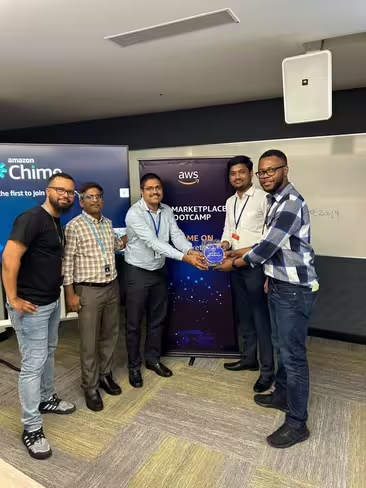
At AWS Marketplace, Oteko’s role focuses on enabling software vendors to deploy and scale their solutions efficiently, but also reliably and securely.
Cloud marketplaces are becoming a central distribution layer for enterprise software, including AI-driven applications. However, they also introduce new complexities around integration, compliance, and system integrity.
Through his work, Oteko has contributed to frameworks and practical guidance that help organizations onboard and operate software more effectively. His published AWS contributions, such as Successfully Testing Your SaaS Listing in AWS Marketplace and Speed Product Provisioning with Customized SaaS Landing Page Fields, provide actionable insights for vendors navigating cloud distribution.
While these efforts improve speed and scalability, they also strengthen the consistency and reliability of how software is delivered and maintained across the ecosystem, an increasingly important factor as AI systems move into production at scale.
For a broader context on how AI marketplaces are reshaping software distribution, publications such as The Next Web have highlighted the growing role of platform ecosystems in enterprise AI adoption.
Preparing for a Post-Quantum Future
Beyond current challenges, a more fundamental shift is on the horizon: the long-term impact of quantum computing on modern encryption.
Many of today’s widely used cryptographic systems could become vulnerable in a post-quantum world. While practical quantum threats may still be years away, the need to develop quantum-resistant security approaches is already driving research and innovation.
Oteko’s future work is closely aligned with this direction. His focus on AI-enhanced cryptography and quantum-resistant systems reflects a forward-looking approach to security, one that anticipates emerging risks rather than reacting to them.
By exploring how machine learning can be integrated with next-generation cryptographic techniques, he is contributing to efforts aimed at building systems that remain secure even as underlying technologies evolve.
From Infrastructure to Trust
The evolution of enterprise technology is increasingly defined not just by what systems can do, but by how much they can be trusted.
As AI becomes more deeply integrated into critical workflows, across finance, healthcare, telecommunications, and beyond, the importance of trust, reliability, and security continues to grow. Organizations are no longer evaluating systems based solely on performance; they are also assessing resilience, compliance, and long-term risk.
Industry research, including McKinsey’s State of AI report, highlights that many organizations still face challenges in moving AI into production environments securely and at scale.
Professionals who can operate across these dimensions, combining technical depth, system-level thinking, and security awareness, are becoming essential to the next generation of technology leadership.
A Forward-Looking Perspective
Looking ahead, the challenge is not simply to build more advanced AI systems, but to ensure those systems can be trusted at scale.
This requires new approaches to architecture, deeper integration between research and engineering, and a stronger emphasis on security as a core design principle. It also requires professionals who are comfortable working across traditionally separate domains, bridging theory and practice, innovation and risk management.
For Oteko, this represents the next phase of his work: helping shape a future where AI systems are not only powerful and scalable, but also resilient, secure, and built to last.
Get the TNW newsletter
Get the most important tech news in your inbox each week.
Contributed article. Not produced by the TNW newsroom and does not reflect the editorial stance of TNW.
Also tagged with


