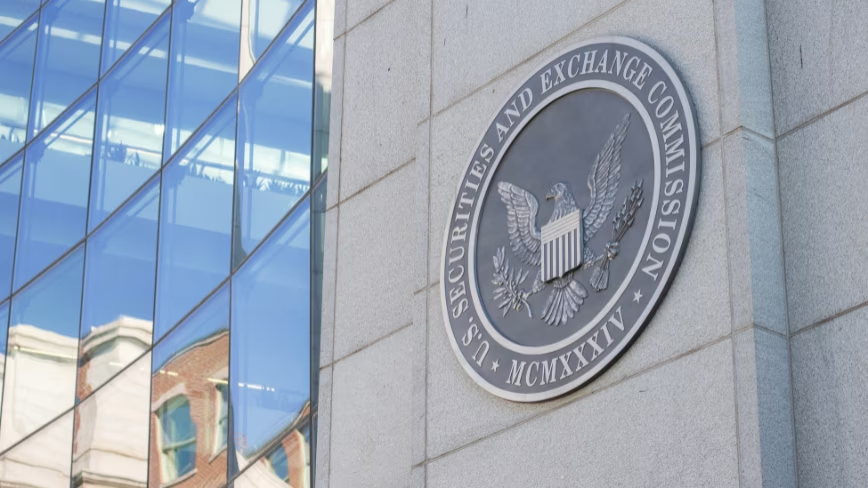
US Securities and Exchange Commission
 Credit: Tada Images / Shutterstock.com
The US Securities and Exchange Commission has settled fraud charges against private-fund adviser Adit Ventures Management LLC, its CEO Eric Munson, and three affiliated general partners, in a case that reads like a cautionary tale about the frenzy for pre-IPO shares in marquee names.
The regulator alleges that between April 2019 and December 2024 the defendants dressed up their funds with claims of stakes in companies everyone wanted a piece of, then helped themselves to client money along the way.
The bait, in other words, was access. Retail investors and small funds have spent years chasing a way into the private darlings that stay off public markets, and the appetite has been feverish enough to spawn its own cottage industry of workarounds, some of which never delivered.
Crypto platforms, for instance, promised SpaceX exposure through tokenised stock that never actually arrived.
Adit, according to the SEC, played to exactly that hunger. The firm and its general partners allegedly made false claims about owning pre-IPO shares in hot private companies, SpaceX and Klarna among them, precisely the sort of headline holdings that make a fund look plugged in.
It was a pitch tuned to a moment when everyone wanted the names and few could tell whether the shares behind them were real.
The rest of the conduct, as the regulator tells it, was rather more mundane and rather more damaging.
The defendants are accused of misappropriating advisory client assets, charging millions in undisclosed fees, and taking unauthorised, favourably termed unsecured loans from the very funds they managed, the kind of self-dealing that quietly drains a fund from the inside.
There was also, the SEC says, a neat trick with the shares themselves. The defendants allegedly bought pre-IPO stock and then sold it on to their own client funds at inflated prices, pocketing the spread, while separately overcharging millions in unauthorised “acquisition fees” that clients had never agreed to.
Perhaps the boldest move involved the clients’ own assets. The regulator alleges the defendants improperly pledged client holdings as collateral for a $10m line of credit, then used that credit for their personal obligations, effectively borrowing against other people’s money to cover their own.
Adit Ventures Management is also accused of failing to register as an investment adviser at all.
“Investment advisers are entrusted with acting in their clients’ best interests,” said Corey A. Schuster, chief of the SEC Enforcement Division’s Asset Management Unit.
“Here, the defendants allegedly engaged in repeated fraudulent acts to benefit or enrich themselves.”
Under the settlement, the defendants agree to a permanent injunction against further securities-law violations, along with disgorgement, prejudgment interest, and a civil penalty, though the amounts are still to be set by the court.
Munson accepts a three-year associational bar, with the option to apply to return, a comparatively soft landing given the allegations.
What makes the case resonate is less the individual firm than the conditions that produced it.
The gold rush into private shares has been genuine and enormous, which is why the eventual SpaceX float was projected to mint some 4,000 new millionaires, from engineers to cafeteria staff, and why its mere prospect set investors scrambling for any sliver of exposure they could find.
That scramble went global. When SpaceX did come to market, retail demand was so intense that Japanese retail investors alone absorbed $2.2bn of a record $75bn raise, a measure of just how far the hunger reached and how much room it left for anyone willing to sell a story.
Adit, in the SEC’s telling, was willing. The uncomfortable lesson is that a market this eager for the right names is also a market that struggles to check whether the shares are there at all, which is precisely the gap where this sort of fraud takes root.
The private-markets boom has minted real fortunes, yet it has quietly acquired a grifting problem to match, and regulators are only now beginning to catch up.
Get the TNW newsletter
Get the most important tech news in your inbox each week.
Also tagged with


