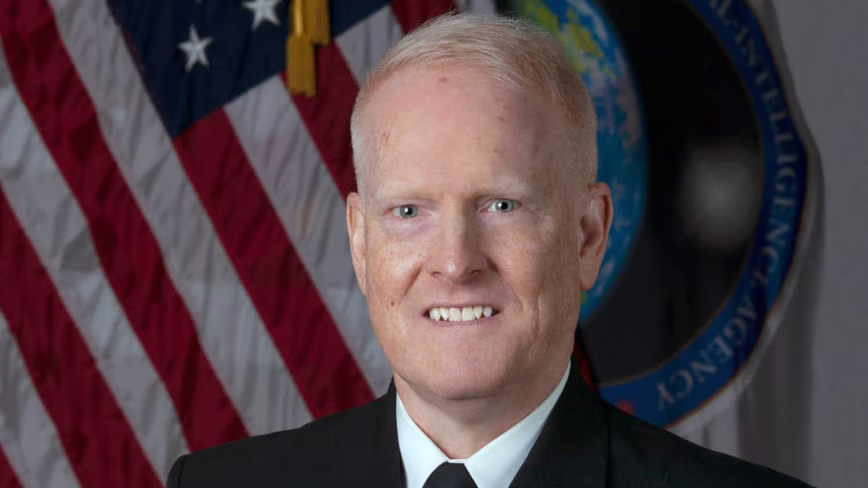
Official portrait of Vice Admiral Frank D. Whitworth III in US Navy dress uniform.
 Credit: National Geospatial-Intelligence Agency
Satellogic has appointed Frank D. “Trey” Whitworth as president, giving the day-to-day running of a commercial Earth-imaging company to the man who directed America’s spy-satellite intelligence agency until 10 months ago.
The appointment was announced today by the company. Whitworth, a retired US Navy vice admiral, directed the National Geospatial-Intelligence Agency from June 2022 to November 2025, an organisation of roughly 16,000 people.
He has been advising Satellogic since March and takes the role with immediate effect, reporting to chief executive Emiliano Kargieman. His remit is broad and unusually operational for a figure hired mainly for a contact book.
Satellogic says he will run internal operations, tie mission delivery to sales and marketing, and set strategy for the defence and intelligence product line. That is the commercial core of the business rather than an advisory perch beside it.
The career behind him is 36 years of military intelligence. Before the NGA, he was intelligence director for the Joint Staff, US Africa Command and Joint Special Operations Command, and deputy director for computer network operations at the NSA.
Also, he also helped expand the Pentagon’s Maven programme, the machine-vision effort Google abandoned after staff objections and which Palantir subsequently took over.
Maven is the closest thing the US military has to a working template for turning satellite imagery into targeting-grade information automatically, which is precisely the product category Whitworth has been hired to build.
Satellogic itself is a smaller player than the résumé implies. Founded in 2010 by Argentine engineers, it operates 18 imaging satellites and went public in 2022 through a SPAC merger, with former US Treasury secretary Steven Mnuchin as chairman.
Its next act is Merlin, a constellation beginning with eight satellites intended to deliver daily global coverage, with the first due to launch in October. The named customer categories are military and intelligence agencies alongside commercial buyers in shipping and logistics.
“Persistent Global Intelligence is no longer a future concept, it’s an operational necessity for the missions and organizations I’ve spent my career serving,” said Whitworth.
Kargieman said in the same release that Whitworth’s view of where the industry is heading made him “uniquely suited to help us scale”.
The capitalised phrase is Satellogic’s own framing rather than an industry term, and it describes the thing every operator in this market is now selling: not pictures, but a continuous feed.
The strategic logic is not hard to read. Satellogic is competing for government work against operators with larger fleets and longer contracting histories, and the constraint on a company that size is rarely the imagery.
It is knowing how an agency writes a requirement, what it will accept as evidence of performance, and which budget line a new capability can be funded from.
Whitworth spent three and a half years on the buying side of exactly that question, and the NGA is the single most important customer in the market he is now selling into.
That market has consolidated around defence money. Planet Labs, the sector’s largest commercial operator, reached its first profitable year on a $900mn backlog built substantially on defence contracts, and European operators have spent years struggling to find buyers outside government.
Commercial Earth observation was pitched a decade ago as a business selling insight to agriculture, insurance and finance. It has largely become a business selling surveillance to states.
Which is the context for the hire, and for the ten-month gap. Traffic between US intelligence agencies and the companies that supply them is routine, and Whitworth is not an unusual case.
It is still worth naming plainly: the official who set the requirements for what America’s imaging satellites collect is now responsible for selling collection to whoever succeeds him.
That arrangement is legal, it is common, and it is the reason the commercial Earth observation industry looks less like a technology sector every year and more like a defence contractor with better branding.
Get the TNW newsletter
Get the most important tech news in your inbox each week.


