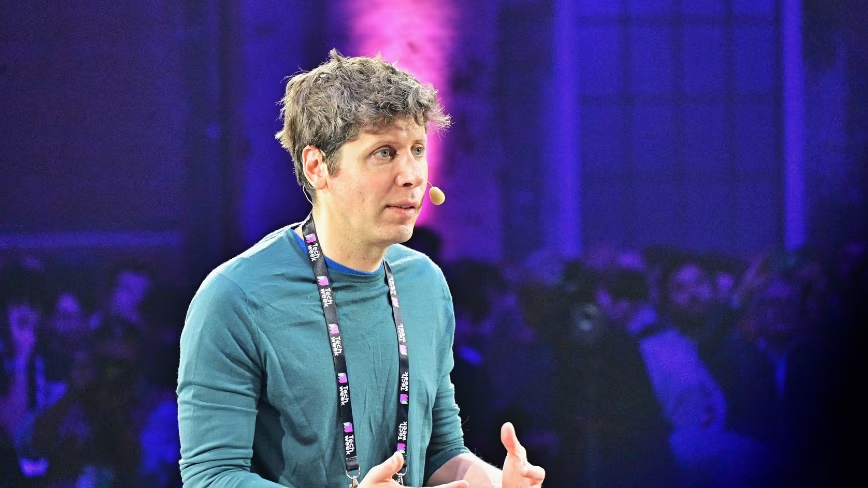
OpenAI chief executive Sam Altman speaks at Italian Tech Week 2024 in Turin
 Credit: Antonello Marangi / Shutterstock
Sam Altman says the industry has been too ambitious on AI timelines. He counts himself among the people who got it wrong.
The OpenAI chief executive said so to the podcaster David Senra, in an episode released on Sunday.
He was answering a question about someone else’s prediction.
The claim he was pushing back on
Senra had put to him a line from Tobi Lütke, the Shopify chief executive. Lütke told the same podcast that 2026 would be the year every business was up for grabs.
Someone was going to build the AI-native version of Shopify, Lütke said, and it was going to be him. He rebuilds it himself at night to find out what he would do starting from scratch.
Altman was not convinced. “I’m not sure if 2026 will be the year that every business feels up for grabs. I might disagree with him a little bit there.”
Many software businesses are up for grabs, he said. Not every business.
What he got wrong
Altman expected disruption to arrive quickly after GPT-4 landed in 2023. It did not.
“The economy just has so much inertia. People keep doing the same things they’re doing. They keep buying from the same company.”
He called that a positive. It will make the transition go “smoother and slower”, he said, and he is grateful for it.
“But I think it means we’ve all been too ambitious on timelines.”
He reached for Blockbuster, which he drove past on the way to school. People kept going there after Netflix started posting out DVDs.
Changing behaviour is “much harder than the tech nerds realize”, he said. Gizmodo reported that line on Monday.
AI has not had its iPhone moment
Altman compared the current phase to smartphones before Apple arrived. He had a Palm Treo around 2003.
Most of what the iPhone needed already existed, he said. What was missing was the product idea.
“We have all of the technological pieces, but we have not had the iPhone moment of completely changing how someone interfaces with technology.”
He put the blame in one place. “I think this is mostly a product failure.”
He still does his own email
Senra asked whether Altman catches himself resisting his own products. He said he had been waiting for the question.
He has used computers the same way for 20 years, he said, and now has Codex. He should not be pasting between messaging apps or scrolling his inbox looking for the least painful message to open.
“And yet there’s something in my mind that is encoded that doing this kind of stuff is what it means to work.”
He would never say he likes working that way, and would mean it. “But by revealed preference, I have a better way to do it now.”
People are “straddling these two worlds”, he said, unsure which to use when.
The two risks he names
Altman set out two worries that he says are slightly in tension.
The first is loss of control, where AI becomes powerful in a way nobody can guarantee holding. The second is power becoming too centralised in one company, model or person.
Both are anti-human positions, he said. “The right approach is to say we want people deeply in control of the future.”
The pitch he calls terrible
From the second risk, Altman built what he twice called a caricature.
Some people in the field effectively offer a cure for all disease and cheap goods, he said. The price is autonomy and influence over the future, in the name of safety, and alongside rampant inequality.
“There will be people that have access to huge amounts of wealth and power and other people just get a pretty good everything. And this is like a terrible sales pitch.”
Then he performed it. “Dear peasants, we will bequeath upon you these gifts of a cure for cancer and material wealth and great entertainment. And you stop complaining and we’ll make all the decisions about the future.”
Why he thinks people make it
Senra asked why anyone would sell it that way. Altman said fear and power.
Some people are so alarmed by the scale of the risks that they want to trade a lot of liberty for safety, he said.
Then he went further. That reasoning “ends up kind of like a way to justify a lot of power seeking behavior”, he said.
Who he was talking about
Altman named nobody. Business Insider and SiliconANGLE both read the remarks as aimed at Dario Amodei. The Anthropic chief executive has argued for a bigger government role in AI.
Amodei wrote on X last week that marketing will not repair the industry’s standing. Saying AI will cure cancer is a cliché that most people find deceptive, he wrote, and the thing that will work is actually curing cancer.
He added that the most accurate criticism of AI companies, Anthropic included, is that they have not yet delivered on their promises.
He made a version of that pitch himself
The New World went back through the archive.
“Maybe with 10 gigawatts of compute, AI can figure out how to cure cancer,” Altman wrote last summer, in his own blog post. Or, he added, customised tutoring for every student on Earth.
What OpenAI killed to focus
Altman said the hardest lesson in business is killing good ideas to protect the great ones, and that he is bad at it.
OpenAI shut Sora last year because it used a lot of compute and mattered less than Codex. It shut its Atlas browser because the talent was needed elsewhere, though he still calls it the best browser there was.
ChatGPT and Codex have now been merged. Altman wants OpenAI to be a platform rather than a product company, with one interface and one API, and says it should not try to compete with its own customers.
Most of his own effort goes into research and compute, which he called probably the most expensive infrastructure project in history.
It gets harder from here
Altman argued OpenAI has made more safety progress than critics expected, and that shipping to real users is why.
He does not think that gets easier. The smartest people in the world are about as smart as the smartest models, he said, and that is about to flip.
OpenAI will have to decide when to delay development, he said. It is already rewriting its safety rules and has slowed a model called Astra.
What he expects next
“We are about to see the greatest boom in people starting smaller businesses that we have ever seen.”
The field has not talked about that enough, he said, including OpenAI, and has not built enough products to accelerate it.
He also expects some businesses to become harder to compete with precisely because they have nothing to do with AI. People will want authentic, non-technological experiences, he said, and will care more about things like sports teams.
OpenAI filed confidentially for an IPO in June. Its chief financial officer told staff last week it would go public in 2027, or sooner.
What he did not say
Altman did not say how far out the timelines actually are, or which of OpenAI’s own forecasts he now considers wrong.
He did not name anyone making the pitch he mocked. Nor did he address the version of it in his own blog post.
Get the TNW newsletter
Get the most important tech news in your inbox each week.
Also tagged with


