 Credit: Salesforce
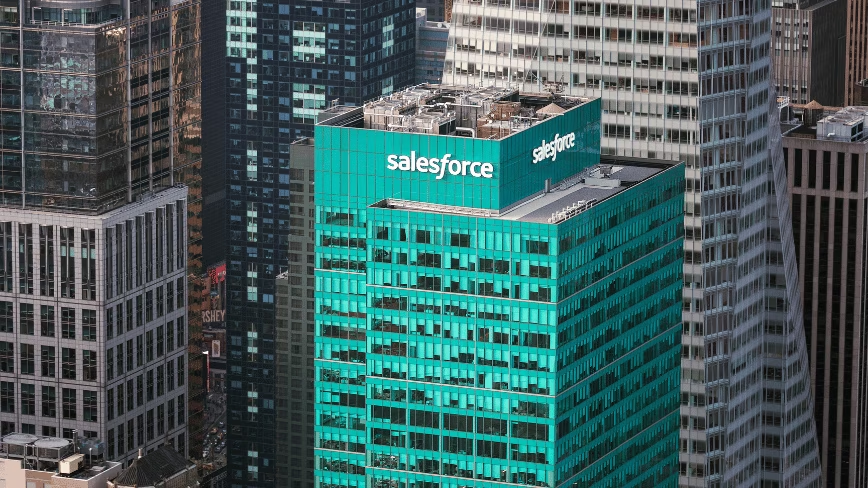
Salesforce is taking the word “Agentforce” out of the names of some of its biggest products, a week before its Dreamforce customer conference. Kevin McLaughlin and Laura Bratton reported the change for The Information, citing two people with direct knowledge of the matter.
The reversal undoes a rebrand that is less than a year old. Salesforce added “Agentforce” to the names of about two dozen products last October, The Information reported. Chief executive Marc Benioff had gone further in public, suggesting the company might one day take the name itself.
What changed on the website
The clearest example is the company’s flagship sales product. It was Sales Cloud, became Agentforce Sales last autumn, and is Sales Cloud again. The Information checked the older names against the Internet Archive and found the site reverted this week.
TNW checked the live pages on Monday. Salesforce’s sales page now presents the product as Sales Cloud, with Agentforce Sales appearing further down as a capability rather than the product name. The platform page is headed Salesforce Platform, and the phrase Headless 360 does not appear on it.
The agents have not gone anywhere in the copy. The sales page still runs the line “Sellers focus on winning. Agents handle the grind.” The platform page opens with “Build your Agentic Enterprise on a trusted, open, and unified platform.” The pitch is intact. The product names around it are the old ones.
Headless 360 Platform is the other renaming The Information reported. Salesforce unveiled Headless 360 in April as a set of tools for building and customising applications and agents. It lets customers plug in external AI agents, from Anthropic and others, to reach their data inside Salesforce applications. That product is now called Salesforce Platform again.
One name survives. Agentforce 360, the product itself, keeps it, according to The Information.
What Salesforce has not said
Salesforce has not explained the change. The Information said spokespeople did not respond to its requests for comment, and it reported that what prompted the decision is unclear.
The timing is the part that stands out. Dreamforce opens next week, and a naming change made days beforehand will be read at the conference whether or not anyone on stage mentions it.
Salesforce has also not said whether the change reaches contracts, invoices and support pages, or only the marketing site. For a customer mid-renewal, that is the practical question.
The numbers behind the name
Agentforce itself is growing. After what The Information called a sluggish start, its annual revenue, the value of contracts over the next 12 months, grew more than 240% year on year to more than $1.5bn in Salesforce’s July quarter. That is the measure Salesforce uses for the product line, and it counts the next 12 months of signed contracts rather than revenue already booked.
That is the tension in this story. The product line is selling, and the company is still pulling its name off the products people already knew by another one. Salesforce has not linked the two.
A year of Agentforce
Salesforce launched Agentforce in late 2024 and made it the centre of its sales and marketing. TNW wrote in May that the company was selling the AI future harder than it was delivering it. In August it cut 133 jobs in Washington and California in an AI restructuring.
The agent strategy has also leaned on other people’s models. In August, Salesforce put Anthropic’s Claude at the heart of a partnership its own staff nicknamed Claudeforce. Headless 360, the product now renamed, was built for the same idea: customers bringing outside agents to Salesforce data.
It has bought its way in too. Salesforce completed its acquisition of Fin, the customer service AI company formerly known as Intercom, on Thursday, and is in talks over a $2bn deal for Listen Labs, The Information reported last week. The Fin deal was announced in June at $3.6bn.
Why the naming matters
Salesforce spent a year teaching customers, partners and its own sellers a new vocabulary. Sales Cloud became Agentforce Sales, and about two dozen other products moved with it. Those names are now back where they started, without a public explanation.
Salesforce is not alone in trying the agent label on its existing catalogue. Nor is it alone in stepping back from a rebrand: Google renamed NotebookLM to Gemini Notebook in July, folding a known product into a bigger brand rather than out of one.
What Salesforce does at Dreamforce next week will say more than the website does. For now the facts are narrow: some products have their old names back, the company has not said why, and Agentforce revenue is growing while the word comes off the box.
Get the TNW newsletter
Get the most important tech news in your inbox each week.


