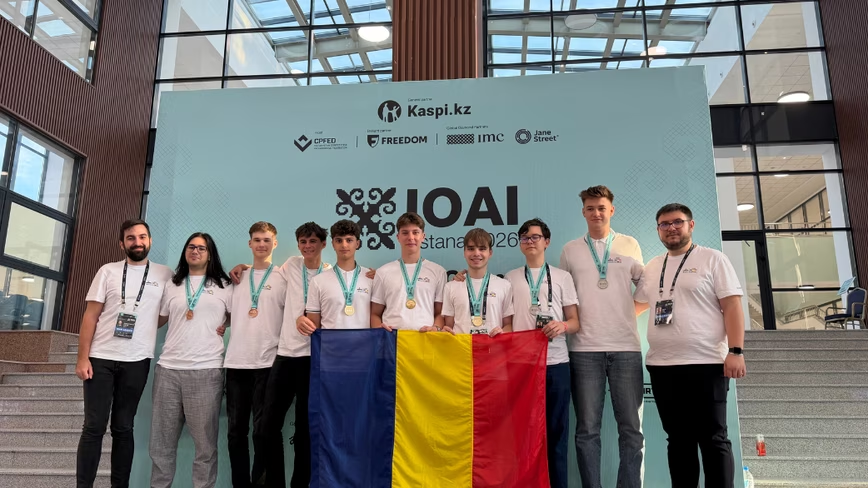
IOAI Romanian team

Romania has just produced one of its finest showings yet in competitive artificial intelligence, and the most telling thing about it is how little the state had to do with it.
At the 2026 International AI Olympiad in Kazakhstan, all eight of the country’s students came home with medals, three of them gold, even as national AI policy drifts.
That gap matters, because Romania builds this talent on remarkably thin foundations. The country spends among the least on research and development in the whole EU, well under 1% of GDP against a bloc average above 2%, and the European Commission’s latest assessment flags a low level of basic digital skills and persistent trouble holding on to the ICT graduates it trains in large numbers.
The state’s “own AI ambitions”, meanwhile, keep stalling. Romania has a National AI Strategy on paper for 2024 to 2027, yet its flagship government “AI adviser,” ION, was quietly shelved after the government that launched it moved on, and the country risks losing a proposed AI mega-factory worth up to €8bn, backed by names like TSMC and Foxconn, because political turmoil has left investors with no stable government to negotiate with.
Set against all that, the students’ result looks less like a windfall and more like defiance. Around 500 competitors from 108 countries and territories gathered in Astana, and Romania not only medalled across the board but finished fourth overall, outscoring the United States, the United Kingdom, India, Singapore, Japan, South Korea, France and Germany, nations that command a vastly larger share of the world’s AI money.
Thury-Burileanu Alexandru, Petrean Roland and David Georgescu, the last from the C.D. Loga National College in Timișoara, each finished among the very best of a demanding two-day competition, taking the gold.
Stoica Mihnea-Teodor and Dobre Darius-Adrian took silver, while Nistor Iulian, Bence-Muk Daniel-Antoniu and Pop Matei-Tudor rounded out the haul with bronze, a clean sweep in which no team member left empty-handed.
The test itself was no gentle quiz, as across two days of six-hour sessions and three problems apiece, students had to build and refine working AI systems on the fly, tackling tasks that ranged from ordering audio sequences to predicting a robot’s next action and spotting where AI-generated text began.
Behind the result sits a familiar Romanian strength. Coordinated by Mihai Nan, a professor at the Politehnica University of Bucharest, the team drew on a deep national tradition in mathematics and computer science, the same pipeline that has long made the country a quiet force in informatics olympiads.
What makes the win resonate, though, is what Romania did it without. Mihai Nan was candid that the team competes with far less computing power than the leading nations, so its edge comes from dedicated teachers and a well-worn olympiad system rather than from raw hardware.
That distinction lands squarely on one of the defining anxieties of European AI. The continent worries constantly about its dependence on foreign compute, and analysts warn that renting chips through cloud providers only reinforces the illusion of European sovereignty rather than resolving it.
Yet talent is the one resource Europe is not short of. Studies have found that the continent actually has more AI talent than the United States, and results like Romania’s are a vivid reminder that the raw human material is already here.
The harder question is whether Europe can keep it, as the continent is racing to shore up its AI sovereignty, and holding on to brilliant young engineers, rather than watching them decamp to better-funded labs abroad, is as much a part of that fight as any chip subsidy.
For Romania, the medals are both a point of pride and a pointed challenge to its leaders. The talent is plainly there, nurtured on a shoestring; the task now is to give these students reasons, and resources, to build the next generation of AI at home rather than somewhere else.
Get the TNW newsletter
Get the most important tech news in your inbox each week.


