TL;DR
Icertis veterans raised $7.55M in seed funding for Rivvun AI, which builds autonomous agents to recover enterprise spend and revenue that disappears between contract obligations and financial settlement. The $2T headline figure is a company projection, not an independently verified total.
Rivvun AI, a Seattle-based startup founded by former senior executives at contract management platform Icertis, has raised $7.55 million in an oversubscribed seed round co-led by Sitara Capital and 3one4 Capital. The company is building what it calls an autonomous AI execution layer that sits between enterprise systems and recovers money lost in the gap between commercial obligations and financial settlement.
The founding team spent a decade at Icertis, which manages contract lifecycles for some of the world’s largest commercial portfolios and has approached $350 million in annual recurring revenue. CEO Anand Veerkar and co-founder Niranjan Umarane say they saw the same pattern across every industry: terms were precisely structured, but financial execution against them was not.
The $2 trillion claim
Rivvun cites McKinsey research finding that enterprise procurement functions lose up to one-third of planned savings during execution, with an additional 3 to 4% of total external spend lost to transaction inefficiency and non-compliance. The company extrapolates this to more than $2 trillion across Fortune 2000 revenues.
That figure is a company projection based on applying McKinsey’s percentages to aggregate revenue, not an independently verified total. The McKinsey research itself is about procurement savings leakage, not a measurement of the full gap Rivvun claims to address. The underlying problem, that money owed under negotiated agreements goes uncollected because no system enforces outcomes, is real and well-documented. The $2 trillion headline should be treated as directional, not precise.
How it works
Rivvun connects to existing ERP, CRM, and procurement systems without replacing them. Its agents interpret commercial obligations, identify what has not settled as agreed, and initiate recovery at the transaction level.
Two agent families power the platform. Spend Assurance on the buy side recovers supplier rebates, pricing commitments, and procurement obligations that have gone unenforced. Margin Defence on the sell side recovers customer settlement variances, trade term discrepancies, and revenue that left the P&L without authorisation.
Vertical-first design
Rivvun deploys with industry-specific agent logic rather than a horizontal approach. Chargeback mechanics in pharma, which involve GPO compliance and government pricing obligations, are structurally different from settlement gaps in banking or trade term failures in consumer goods.
The company says it launches across pharma, healthcare, banking, CPG/retail, and industrial verticals. Whether vertical-specific agents can deliver accurate recovery at the transaction level across all five sectors simultaneously from a seed-stage company is an open question.
The team
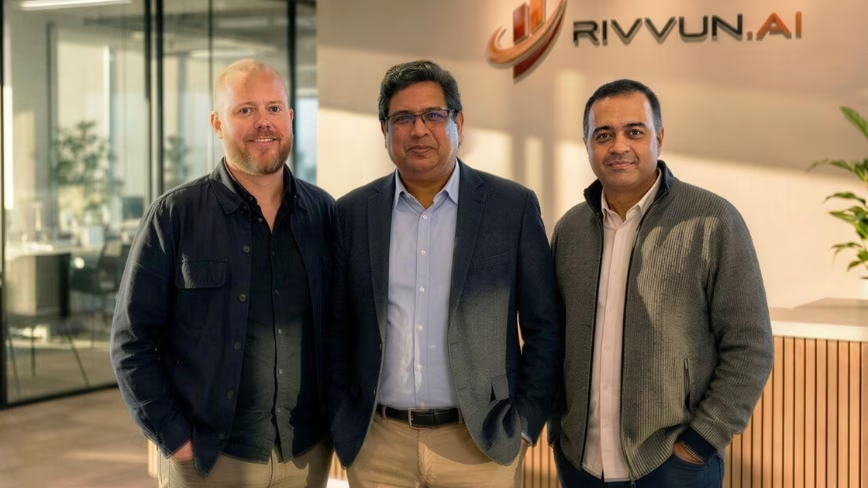
Veerkar and Umarane are joined by serial entrepreneur Patrick Linton, who brings experience scaling global operations for enterprise software companies. 3one4 Capital manages $800 million in committed capital and called the founding team “one of the strongest founder-market fits we’ve seen in the vertical AI category.”
“The enterprise has spent years being told AI will transform how it operates,” Veerkar said. “What it needed was AI that creates direct, measurable impact on the P&L.” That framing, tying AI value to recovered dollars rather than productivity narratives, is deliberate. It is also the exact claim that will be easiest to verify or disprove once the platform is deployed.


 Credit: Rivvun AI