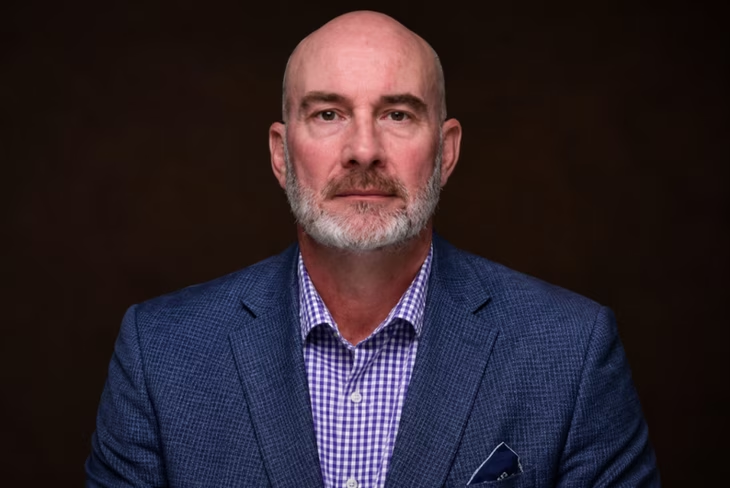
Tim Crockett, co-founder of DGBI-USA
 Credit: Tim Crockett
Threats against corporate leaders are becoming harder for businesses to treat as an isolated security issue. Reuters reported that 42% of security chiefs surveyed across multiple industries had seen a significant increase in threats of violence against company executives over the previous two years. The figure rose to 66% among U.S.-based security chiefs at technology companies, suggesting that concerns may be particularly pronounced within the tech sector.
For Tim Crockett, co-founder of DGBI-USA, which works across intelligence, investigations and security risk management, those figures raise a broader question for technology leaders. The immediate concern is executive safety. The longer-term concern is whether distrust around technology, work and institutions could make hostility toward visible business leaders harder to assess.
Crockett sees distrust as one of the forces shaping the current risk environment. “There is a growing sense of uncertainty around what people can trust,” he explains. “When audiences are constantly exposed to competing claims, conflicting narratives and increasingly convincing AI-generated content, it becomes harder to distinguish credible information from misinformation. That erosion of trust can influence how people view institutions, companies and the leaders associated with them.”
That concern becomes more complicated as AI changes both what people see and what they expect from work. The 2025 World Security Report found that 73% of chief security officers said their companies had been targeted by a misinformation or disinformation campaign. Meanwhile, a 2026 Pew Research Center survey found that 71% of U.S. adults believed AI would lead to fewer jobs over the next 20 years, up from 64% in 2024.
Those expectations do not establish what AI will ultimately do to employment. They do show that workforce uncertainty is widespread. The World Economic Forum’s Future of Jobs Report 2025 found that 41% of employers expected to reduce staff where AI could replicate roles, while 77% planned to reskill or upskill employees to work more effectively alongside AI.
For Crockett, the security relevance lies less in predicting an exact number of lost jobs than in recognizing how uncertainty may affect perceptions of companies and their leaders. “We’re going to see a dip, and I think it’s that dip that’s going to create the issues,” he observes. His concern is that people who already feel economically insecure may increasingly associate that insecurity with the companies leading technological change.
Recent developments inside the technology sector show why trust can also become an internal issue. A 2026 Reuters investigation reported that Meta scaled back an AI-led workforce restructuring after employee resistance, concerns about productivity and operational disruption. The episode does not establish a link between workforce frustration and violence. Crockett’s concern is narrower. He believes AI-driven disruption can add to a wider environment of uncertainty around jobs, institutions and corporate leadership.
From his perspective, that distinction is important for security teams. Criticism, protest, or employee dissatisfaction should not automatically be treated as signs of violent intent. Crockett is more concerned about situations in which anger appears to escalate into threats or other concerning behavior. “What happens now is that it can quickly escalate to threats of violence,” he says.
Crockett is particularly concerned about desensitization. He believes repeated exposure to threats and highly publicized violence can gradually affect what people perceive as normal. “I think people are starting to become desensitized to the use of violence,” he says. “That filter or barrier is being eroded.”
For technology companies, the practical implications may extend beyond conventional executive protection. Reuters reported that companies are responding to rising threats through measures such as stronger security procedures, executive risk assessments, and online threat monitoring. Crockett believes those steps may also need to account for workplace concerns, online narratives, and organizational changes that can shape the broader security environment.
“The objective is not to treat every critic or grievance as a threat,” Crockett explains. “The concern is when pressures such as AI disruption, job uncertainty, and declining trust begin to overlap and make the wider risk environment harder to assess.”
Crockett’s warning is ultimately about preparedness rather than prediction. Rising threats today do not prove that violence against technology executives will continue to increase. They do suggest that leadership teams have reason to watch the conditions surrounding those threats more closely as technological and workforce change accelerates.
Get the TNW newsletter
Get the most important tech news in your inbox each week.


