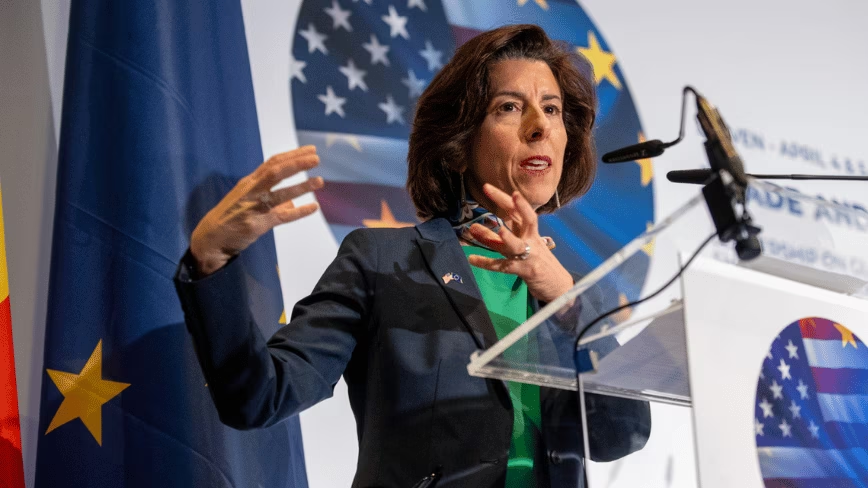
U.S. Secretary of Commerce Gina Raimondo, Executive Vice-President of the European Commission Margrethe Vestager, and the Prime Minister of Belgium Alexander De Croo, speak at a reception on the first day of the TTC in Leuven, Belgium, April 4, 2024. (Official USEU photo by Andrew Rogers)

OpenAI, Anthropic, Amazon and Microsoft are bankrolling a new nonprofit to retrain American workers for the AI economy. RAISE US, led by Gina Raimondo, has already raised more than $500m.
The biggest names in AI agree on at least one thing. The technology they are building could upend the American job market, and almost nobody is ready. So they are writing cheques. Gina Raimondo, the former US commerce secretary, and Eric Holcomb, the former governor of Indiana, have launched RAISE US. The nonpartisan nonprofit will work with governors and employers to help workers through the disruption.
The group has secured more than $500m so far. The target is $1bn in multi-year commitments. It launches with more than two dozen of America’s largest companies and philanthropies behind it. Raimondo will serve as chief executive.
Its anchor backers are striking. OpenAI, Anthropic, Microsoft and Amazon are fierce rivals, racing to build the most powerful models. All four have signed on. So have Bank of America, IBM, Mastercard, AMD, Eli Lilly and the Rockefeller Foundation, among others.
“America has a technology strategy for leading the global AI competition. It does not yet have a people strategy, and we cannot lead without one,” Raimondo said. “If we build the best AI systems in the world and leave millions of Americans behind, we won’t have won anything. We’ll have automated our own decline.”
Why the money is moving now
The launch lands at an anxious moment. Estimates of how many jobs AI will displace range wildly. They run from half of all entry-level white-collar roles to a few thousand here and there. Layoffs remain low for now. But worker sentiment toward AI has been worsening, and some firms have already blamed the technology for deep cuts.
That nervousness is shared by the very companies funding RAISE US. The same labs preparing to go public at trillion-dollar valuations are now helping pay to soften the blow. Two of the new backers, IBM and Workday, have themselves cited AI in recent job cuts.
Public mood is part of the story too. Anger over AI has grown louder. It runs from data-centre power bills to the steady drumbeat of layoff headlines. Washington has done little. Congress has not addressed the disruption, and the White House has played down the risk of widespread job losses.
Into that vacuum steps a privately funded coalition. “This is an independent effort,” Raimondo said. “It’s the first one I know of where competitors in the tech industry have put aside their competition to say, ‘We’re going to write big checks and, in the service of our country, do what we can to figure out this transition.’”
How RAISE US plans to work
The strategy runs through state capitals. RAISE US will start with governors in Utah, Arkansas, Maryland and Connecticut, a deliberately bipartisan mix. States control community colleges, credentialing and business incentives. Those levers decide whether employers retrain workers or let them go. That makes states the natural place to test ideas.
The bulk of the budget will fund pilot programmes. A lean team of about 15 staff and consultants will oversee them. In Arkansas, the group is backing an AI-powered career navigation platform called Arkansas LAUNCH. In Maryland, it will expand a “service year” for recent high school graduates into fields with shortages, such as health care. It will also stand up an accelerator to help displaced workers start businesses.
Other ideas borrow from the social safety net. RAISE US wants to pilot “wage insurance” for workers who take a lower-paying job rather than dropping out of the labour force. It also wants to test short-time compensation to keep people employed through a transition.
The group wants to keep workers in the jobs they already have, too. It plans to offer technical help to companies that would rather retrain staff than replace them. Microsoft says it has found a model that works. It cross-trains its junior lawyers across the business and equips them with AI skills, so they can be moved as roles change.
“You can think of doing that with almost any job we have,” said Brad Smith, vice chair and president at Microsoft. “It creates an opportunity to transfer people from jobs that are being eliminated to jobs that are being created.”
A crowded and skeptical field
RAISE US enters a busy lane. Governments and companies have floated a wave of fixes. The corporate giants now in workforce programmes have learned that retraining is hard, and historically not very successful. Raimondo herself called past efforts “ineffective.”
That history invites doubt about a corporate-funded group steering policy. The structure tries to answer it. RAISE US also runs a policy lab, funded by philanthropies rather than companies. The aim is to keep its recommendations at arm’s length from its sponsors.
The wider debate is sharper still. Senator Bernie Sanders has suggested seizing half the stock value of top AI firms for a public fund. OpenAI itself has floated robot taxes and a national wealth fund. RAISE US is more modest. Its board includes Liz Shuler, president of the AFL-CIO, a signal it wants labour at the table.
Notably, the group is not sold on universal basic income, the Silicon Valley favourite. Its leaders argue that work offers more than a wage. They would rather build pathways into new jobs than simply send out cheques.
The unanswered question
The deeper uncertainty is whether AI will create jobs as fast as it destroys them. Even backers concede they cannot be sure. The companies bankrolling RAISE US are themselves split on the threat. Some bosses warn of upheaval. Others, including Sam Altman, argue an AI jobs apocalypse is unlikely.
Raimondo frames the effort as insurance against the worst version of the transition. She points to the Committee for Economic Development, formed by big businesses in 1942 to ease soldiers back into the economy after the war. The parallel is pointed. It is a moment of upheaval met by employers acting before the government did.
“I think this technology will lead to more productive people, new jobs and new industries, and I want to get there,” Raimondo said. “But I also worry about the transition, and a window where people could get hurt.”
The ambition is real, and so is the money. The funders themselves struggle to predict this shift. Whether $500m and a handful of state pilots can blunt it is the question RAISE US now has to answer.
Get the TNW newsletter
Get the most important tech news in your inbox each week.
Also tagged with


