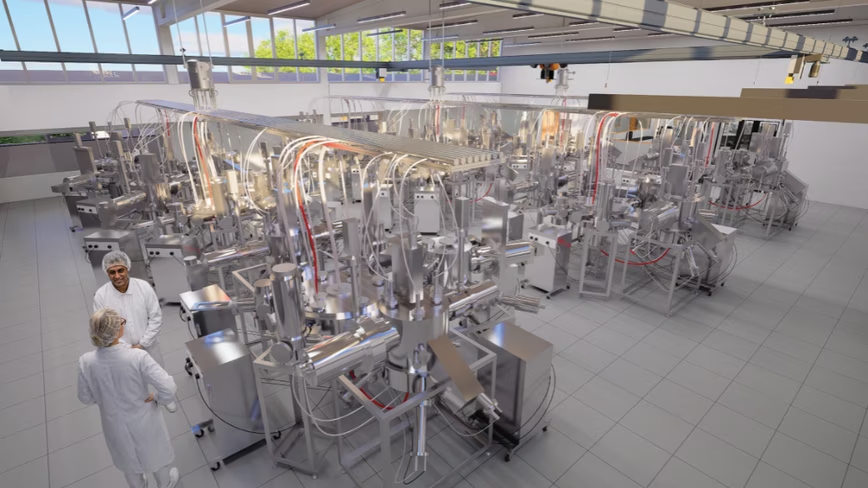
Visualisation of the Quantum Foundry Copenhagen chip fabrication facility
 Credit: Novo Nordisk Foundation
Europe is getting a factory for quantum chips rather than another quantum computer. Quantum Foundry Copenhagen, owned by the Novo Nordisk Foundation, is building a 5,300-square-metre facility in the Danish capital that is due to open in 2027 and will offer wafer fabrication to quantum companies around the world.
The investment is about $62M, according to Bloomberg. That is modest compared with the billions being spent on AI data centres, but it is aimed at a part of the quantum industry that Europe currently has limited access to.
The facility will cover nanofabrication of quantum materials, characterisation, testing, chip assembly, packaging and ultra-high-vacuum manufacturing. Those are the industrial processes underneath a quantum computer, and they are an area where Europe has struggled to build enough capacity outside research institutions.
Peter Krogstrup, the company’s CEO, has set out the ambition clearly:
“Our vision is to become a world-leading quantum chip manufacturer, supplying Europe with advanced, next-generation quantum computing processors and enabling quantum companies to scale production. We aim to build state-of-the-art quantum production lines and support a sustainable deep-tech industry that can help shape the future of quantum technology.”
The money is not coming from a government or a venture fund. The Novo Nordisk Foundation is the charitable owner of the company behind Ozempic and Europe’s wealthiest foundation, and it has now committed more than DKK 2.9bn, around €390m, to quantum technologies.
That funding has gone into research as well as manufacturing. The foundation runs a quantum computing programme at Copenhagen’s Niels Bohr Institute that aims to build Denmark’s first fault-tolerant quantum computer by 2034. The foundry is intended to connect that research with a manufacturing capability.
Mads Krogsgaard Thomsen, the foundation’s CEO, described the purpose in similar terms.
“At the Novo Nordisk Foundation, we believe quantum technologies will be one of the most defining scientific and technological fields of this century. That is why we have made a significant long-term commitment to building a world-class quantum ecosystem in Denmark and Europe. “
Lene Oddershede, the foundation’s chief scientific officer, made the strategic argument more directly, saying that building the capacity “marks an important step towards positioning Europe centrally in the global quantum ecosystem”.
The European Commission was represented at the launch, which gives an indication of how the project is being framed. “Strengthening European capacity to develop and manufacture quantum chips is essential for competitiveness and technological sovereignty,” said Henna Virkkunen, executive vice-president of the European Commission.
The timing fits with a broader policy shift. The EU’s Quantum Europe Strategy and the Quantum Act, now moving through Brussels, both put more emphasis on commercialisation and manufacturing, rather than the research funding where most European public investment has gone so far.
Denmark has been building its position deliberately. The country has its own strategy for turning quantum research into an industry, and it brought in Microsoft to build what was billed as the world’s most powerful quantum computer alongside its national investment fund.
Elsewhere in Europe, much of the spending has focused on quantum applications and individual companies rather than manufacturing infrastructure. France has committed €500m to quantum computing, while Finland has built a hardware ecosystem around IQM, but neither has an open commercial foundry of this kind.
A foundry could change what smaller quantum companies are able to build. A startup with a new qubit design currently has to develop its own fabrication capabilities or negotiate access to a university cleanroom, and neither option is particularly well suited to scaling a commercial product.
The comparison being made is with the semiconductor industry. TSMC helped turn chip design into a business that companies could enter without owning a factory by separating design from manufacturing. A commercial quantum foundry is attempting something similar, although the technology is still at a much earlier stage.
Getting there will not be simple. There is no dominant qubit architecture, so a foundry may eventually need to support superconducting, spin and topological approaches, each requiring different manufacturing processes.
Europe’s problem has not been a lack of quantum research. The continent produces strong research and has built leading companies, but commercialisation has often happened elsewhere, a pattern that has made Europe’s path to a competitive quantum industry difficult.
Owning more of the manufacturing step is one way to change that. A quantum company that depends on a European foundry has a reason to keep part of its production ecosystem close to Europe in a way that a research lab publishing papers does not.
Get the TNW newsletter
Get the most important tech news in your inbox each week.


