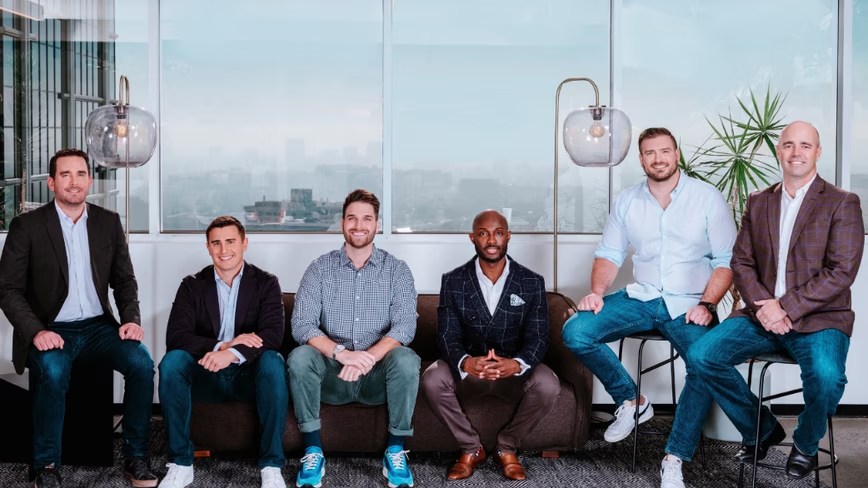
Prevalent AI team group photo
Prevalent AI, a London company that folds hundreds of scattered enterprise data sources into a single queryable graph, has raised $22m from Integrity Growth Partners.
It is the first primary capital the business has taken in nine years of trading, which in the current market counts as an eccentricity.
The company was founded in 2017 by Paul Stokes, its chief executive, and Arun Raj, its chief operating officer, alongside a group with British intelligence heritage. Sir Iain Lobban, Director of GCHQ from 2008 to 2014, is among them.
So is Andrew France, a former Deputy Director for Cyber Defence Operations at the agency who joined Darktrace as chief executive in January 2014, the year after that company was spun out of Mike Lynch’s Invoke Capital.
Prevalent says it has been profitable since its first customer and has never taken growth capital. The one prior change on the cap table came in July 2021, when Istari, the cybersecurity platform backed by Singapore’s Temasek, became a significant minority shareholder through a secondary transaction.
Annual recurring revenue has more than doubled over the past 12 months, according to the company, which did not disclose the underlying figure. Neither valuation nor the size of IGP’s stake was released.
The platform continuously cleans and connects those data sources into what Prevalent calls a sovereign knowledge graph, held inside the customer’s own infrastructure rather than a shared cloud.
Sovereignty is doing real commercial work in that sentence, and it is a word the UK market is currently paying for. The argument is that people and AI agents alike need to know what exists across an organisation, how it connects, and where the gaps sit, before either can act on any of it.
Prevalent started in security because that is where fragmentation does damage fastest, and sells to global banks, telecoms operators, insurers, and critical national infrastructure operators.
“Large enterprises do not have a shortage of tools or data. They have a shortage of context,” Stokes said. “Security teams are being asked to make decisions across thousands of systems, controls, identities, and data sources that were never designed to work together.”
The market numbers behind the pitch are Gartner’s. Worldwide end-user spending on information security is forecast to reach $240bn in 2026, up 12.5% on the year.
Separately, the firm expects more than 40% of agentic AI projects to be cancelled by the end of 2027, blaming escalating costs, unclear business value, and inadequate risk controls.
Prevalent’s case is that those are one problem wearing two hats, a reading shared by the wave of startups now raising to secure and ground AI agents rather than build them.
On results, the company cites a global insurer that cut the time to produce executive security reports by 95%, and an international banking group that improved incident detection by more than 80%. Neither customer is named, and neither figure has been independently verified.
The money goes on a formal go-to-market organisation spanning sales, marketing, customer success, and partnerships, a deeper push into the US, and an extension of the knowledge graph past security into wider risk and enterprise functions including financial crime analysis and compliance.
Stuart Barnard has joined as chief financial officer and Mike East as senior vice president of global sales. The American push cuts against the recent traffic, with US data-security firms such as Rubrik moving in the other direction and making London their European base.
For Integrity Growth Partners, a Santa Monica firm that closed an oversubscribed $220m fund in December, the cheque is a tenth of the vehicle.
Ryan Anderson, its managing partner and co-founder, said the team had built “genuinely differentiated, AI-native technology” while keeping “remarkable capital discipline”, which is the polite private-equity way of saying it had not burned anyone’s money yet.
Get the TNW newsletter
Get the most important tech news in your inbox each week.


