TL;DR
Polish PM Donald Tusk announced a “sovereignty test” for significant government technology purchases and annual IT independence reports, warning that Poland’s dependency on foreign digital infrastructure demands urgent policy action.
The prime minister told the European Financial Congress that Poland’s reliance on foreign technology requires “serious economic, institutional, and organisational decisions,” adding annual IT independence reports to the new procurement rules
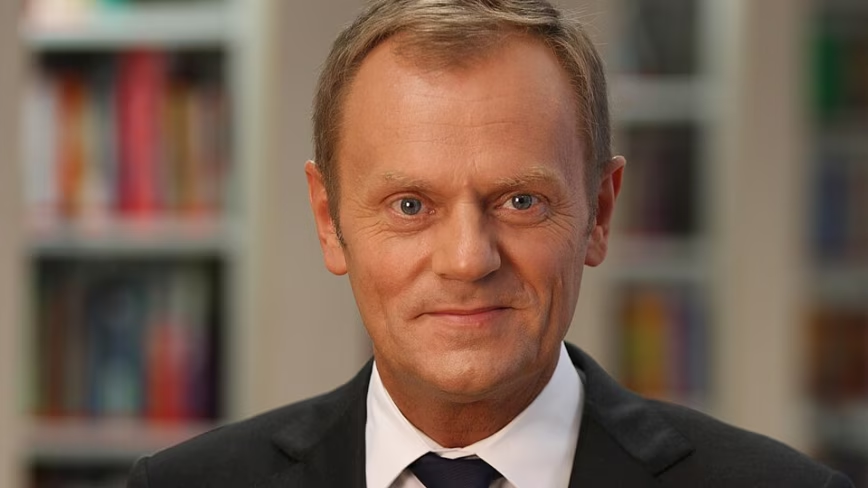
 Credit: Platforma Obywatelska RP
Polish PM Donald Tusk announced a “sovereignty test” for significant government technology purchases and annual IT independence reports, warning that Poland’s dependency on foreign digital infrastructure demands urgent policy action.TL;DR
Polish Prime Minister Donald Tusk has announced that Poland will introduce a “sovereignty test” for significant government purchases of technology solutions, warning that the country’s dependency on foreign digital infrastructure has reached a scale that demands a policy response. Speaking at the European Financial Congress in Sopot on Tuesday, Tusk said Poland will also publish annual reports documenting its progress toward IT independence, creating a public accountability mechanism for a priority he described as existential.
“At this point, the scale of this dependency, and I’m referring here to the relationship between the state and the digital sphere, has reached such proportions that it must prompt serious economic, institutional, and organisational decisions,” Tusk said. The statement places Poland among a growing number of EU member states that are translating tech sovereignty rhetoric into concrete procurement policy.
The details of the test have not been fully disclosed, but the framing suggests Poland will evaluate whether major government technology contracts create strategic dependencies on foreign providers, particularly in AI infrastructure, cloud computing, and telecommunications. Europe’s approach to technology governance has historically focused on regulation rather than procurement, but the AI era is forcing governments to consider who owns the infrastructure their citizens and institutions rely on, not just how it is regulated.
Poland has already taken steps in this direction. Earlier this year, the government banned Chinese-made cars from entering military facilities, citing infrastructure security concerns. The country is also increasing the share of domestic companies in public procurements, a policy that parallels similar moves across the EU as member states grapple with dependency on American cloud providers and Chinese hardware.
Tusk’s announcement arrives as EU nations struggle to balance trade relationships with technology security. Germany and Spain are leading opposition to European Commission plans to ban Chinese technology suppliers from telecom networks as part of new cybersecurity rules. The intersection of trade policy and technology security is creating fractures within the EU, with larger economies that have deep commercial ties to China resisting restrictions that smaller or more security-focused members support.
The EU’s own AI infrastructure plans are stumbling, with the €20 billion gigafactory programme facing delays and funding gaps. That vacuum makes national-level action like Poland’s sovereignty test more likely: if the EU cannot deliver a coordinated infrastructure strategy, individual member states will build their own frameworks for managing technology dependency.
The AI dimension adds urgency that previous technology sovereignty debates lacked. Europe’s inability to access Anthropic’s Mythos cybersecurity model until this week demonstrated that regulatory power alone does not guarantee access to the most consequential AI capabilities. A government that depends on foreign AI systems for critical functions, from defence analysis to healthcare delivery, faces risks that procurement rules alone may not address. European efforts to build sovereign AI alternatives, such as BNP Paribas and Mistral’s cyber-focused model, are gaining political support precisely because of these dependency concerns.
Poland holds the rotating presidency of the Council of the EU in the first half of 2025 and has used the position to push digital sovereignty higher on the bloc’s agenda. Tusk’s Sopot speech signals that Poland intends to lead by example, implementing domestic procurement reforms while advocating for EU-wide standards. Whether other member states follow will depend on whether they view technology sovereignty as a security imperative or a barrier to accessing the best available tools, a tension the EU has not resolved.
Get the most important tech news in your inbox each week.


