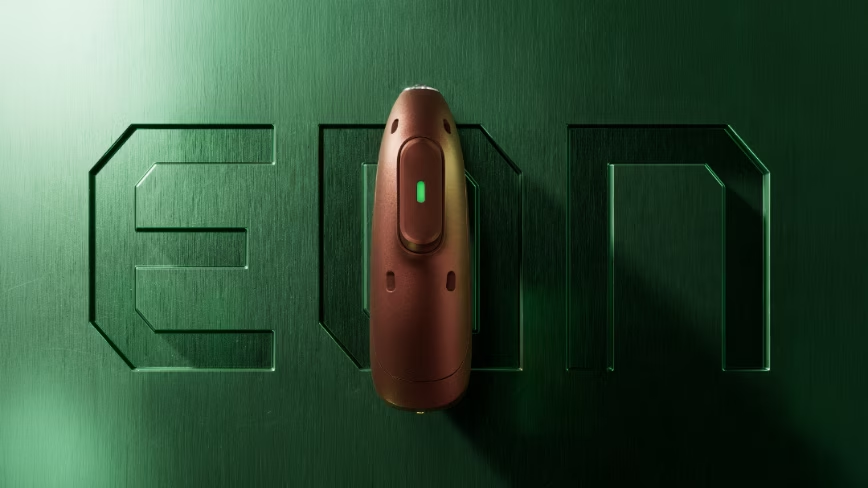
EON is Phonak’s 3rd generation of real-time AI
 Credit: Sonova
Phonak has launched EON, a hearing aid platform built around a newly developed processor the company calls HYPERSONIC, which it says runs two artificial intelligence systems in parallel while drawing 37% less power than the generation before it.
The Sonova-owned brand is pitching the release at the two problems that have defined the category for years, which are understanding speech in noise and making the devices worth what they cost.
The first of the two systems, Spheric Speech Clarity 3.0, uses a deep neural network to separate speech from background noise as it arrives. The second, AutoSense OS AI 8.0, classifies the surrounding sound environment and adjusts which features are running to suit it, so the wearer is not expected to switch programmes manually as they move between a restaurant and a street.
Running both at once is the part the chip is there to make possible. “With the HYPERSONIC chip, we have engineered a significant step forward in power efficiency without compromising real-time AI performance,” said Anders Rosengren, Sonova’s chief R&D officer.
The efficiency gain shows up in physical size and battery life. EON is 25% smaller and 20% lighter than the previous Sphere generation, according to Phonak, and runs for up to 38 hours on a charge, which is generous for a device that has to fit behind an ear and process audio continuously.
On performance, the company cites its own testing rather than third-party benchmarks. Phonak says wearers using Spheric Speech Clarity 3.0 are twice as likely to understand every word spoken from any direction compared with the same hearing aids configured identically but without the feature enabled.
Wind gets its own subsystem. WindBlock 2.0 reduces wind noise by up to 50 dB and can improve the signal-to-noise ratio by as much as 30 dB, which addresses one of the more consistent complaints from people who wear hearing aids outdoors.
The connectivity story is where EON is most clearly aimed at the wider consumer audio market. Phonak describes the platform as Made-For-All, meaning it pairs with essentially any Bluetooth device rather than requiring a particular phone, and it combines Bluetooth Classic with the company’s own Roger Direct wireless microphone protocol and with Auracast.
Auracast matters more than its billing suggests. The broadcast standard, part of the Bluetooth LE Audio specification, lets a venue transmit audio to an unlimited number of receivers at once, so a museum, theatre, or airport gate can send its audio straight into a wearer’s ears instead of through a loop system installed decades ago.
The practical value of that is easiest to see in the places where assistive listening has historically been worst served, such as a departure lounge announcement or a guided tour, since the wearer joins the broadcast directly rather than hunting for a receiver at a desk.
Phonak is shipping three configurations rather than one. Audéo EON Sphere and Audéo EON R both cover mild to profound hearing loss, while CROS EON R is built for unilateral loss, routing sound from the unaided side across to the better ear, and the range comes in eight colours.
“EON sets a new benchmark for intelligent hearing,” said Josipa Kern, global head of Phonak. “It brings together the capabilities that matter most in daily life: understanding speech, adapting automatically and staying connected with confidence.”
Licensed hearing care professionals in the United States could place orders from Monday, with Germany, France, the United Kingdom, Australia, and further markets following in September. Phonak has not published pricing, which is normal for a category sold through clinicians and shaped by national reimbursement schemes rather than list prices.
That distribution model is the quiet context for a launch like this one. Hearing aids remain a prescription-adjacent product fitted by professionals, even as consumer earbuds have moved into the same territory from the other direction, and the specification sheets on both sides are converging faster than the channels that sell them.
Get the TNW newsletter
Get the most important tech news in your inbox each week.


