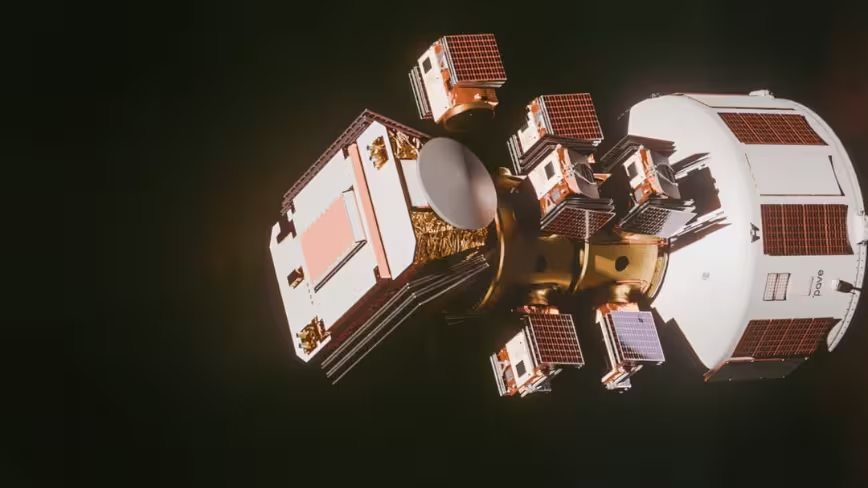
The Swiss startup, spun out of EPFL’s student rocketry programme that built Europe’s first student-made reusable rocket, has raised one of the largest seed rounds ever in European space. Visionaries Club and Creandum led; Lombard Odier, Atlantic Labs, and Sistafund also participated.
The satellite lifecycle has a structural inefficiency baked in. Launch vehicles deliver payloads to low Earth orbit because it is the cheapest and easiest destination to reach.
But the satellites that run global communications, navigation, and defence intelligence systems do their work in much higher orbits, geostationary, medium Earth orbit, sometimes even lunar.
Getting from the launch orbit to the working orbit is the problem of “last-mile logistics in space,” and today it is solved by onboard electric propulsion that burns slowly and precisely over six to twelve months.
PAVE Space, a startup founded in Renens, Switzerland in 2024, is building a fleet of orbital transfer vehicles designed to do that journey in under 24 hours.
PAVE has raised $40 million in seed funding, one of the largest seed rounds in European space history, led by Visionaries Club and Creandum, with participation from Lombard Odier Investment Managers, Atlantic Labs, Sistafund, b2venture, ACE Investment Partners, Ilavaska Vuillermoz Capital, and Pareto & Motier Ventures.
The capital will fund hardware development toward an in-orbit demonstration.
The company was co-founded by Julie Böhning, CEO, and Jérémy Marciacq, together with Simon Both, the same three engineers who started the Gruyère Space Program at EPFL in November 2018.
GSP was a student association that set itself an ambitious goal: to design and fly a reusable, vertically-landing liquid-propellant rocket on a student budget. By October 2024, their demonstrator, Colibri, a 2.45-metre bipropellant VTVL rocket, had completed 53 flights, including a 105-metre free flight, all on a budget of approximately CHF 250,000.
It was the first reusable VTVL rocket ever built and flown by a student team. When the programme concluded, the founders spun the technology and expertise out into PAVE Space.
The commercial rationale for fast orbital transfer is straightforward but growing in urgency. More than 12,000 active satellites are now in orbit, with thousands launched every year.
Operators whose assets are stuck in transit orbit for six months cannot serve customers, cannot generate revenue, and face compounding risks from debris and interference.
For defence customers, the timeline problem is more acute still: the ability to rapidly reposition a satellite into a new orbit in response to a threat is a capability that current electric propulsion cannot deliver.
PAVE’s OTVs use storable bipropellant propulsion rather than cryogenic fuels, which evaporate at room temperature and make long orbital loiters impractical.
The trade-off, somewhat lower specific impulse in exchange for indefinite shelf life and operational flexibility, is the defining technical choice behind the vehicle’s design.
The dual-use commercial and defence market is the clearest analogue in European space: launch providers such as Arianespace and RocketLab, and in-space services companies such as D-Orbit and Exotrail, have all found that European defence procurement accelerates when a credible domestic alternative to US or Chinese systems exists.
PAVE is making the same bet earlier, at the OTV layer.
Get the TNW newsletter
Get the most important tech news in your inbox each week.


