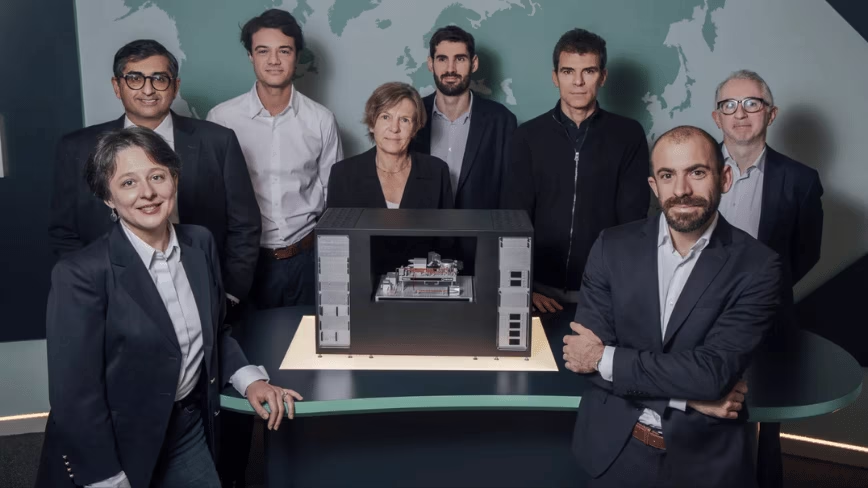
Members of the Pasqal leadership team with one of the company’s quantum computing units.
 Credit: Pasqal
France’s Pasqal is heading to Nasdaq at a $2bn valuation, roughly 100 times its revenue. Its own filings spell out two things. Quantum computing might never pay off. And Paris can veto who owns the company.
Pasqal, the French quantum-computing firm, is going public in the United States. It is merging with a blank-cheque company, Bleichroeder Acquisition Corp. II, in a deal that values it at $2bn before its cash. Sifted’s Daphné Leprince-Ringuet read the 300-plus pages of filings, and they are an unusually frank look at the economics of quantum.
Start with the multiple. Pasqal made €16.5m in revenue in 2025. A $2bn price tag is about 100 times sales. That sounds steep until you look at the neighbours.
Cheap, by quantum standards
Chief executive Wasiq Bokhari says Pasqal is, relatively speaking, a bargain. He told Leprince-Ringuet that its listed peers trade far higher. Quantinuum hit the public markets last month. It trades near a $20bn market cap, roughly 647 times its 2025 revenue. Against that, 100x looks almost restrained.
The comparison is telling. It shows how the market values quantum: not on what the machines earn today, but on what investors hope they will do later. The filings are blunt about the gamble. They warn that “commercial traction of quantum computing technology may never occur”, and that the machines may not deliver.
The French kill switch
The more unusual risk is political. Pasqal is a French company working on a critical technology. So it carries what the filings call “French state influence”. Any non-French or non-EU investor who wants a significant stake must get authorisation from the French Ministry of the Economy.
In other words, Paris keeps a hand on the register. That is a feature, not a bug, of Europe’s approach to strategic tech. It captures the continent’s central tension: it wants to build champions, and to control them. The same instinct drives France’s wider tech-sovereignty push.
For a company raising from global investors, that clause is a genuine complication. It is also why Pasqal listing in the US at all is notable.
Why list in America
Bokhari says the company chose the US for depth of capital. It is the same calculation that has pulled a run of European deep-tech names across the Atlantic. IQM became the first European quantum firm on a major US exchange. Others in frontier hardware and chip inspection have raised where the money is deepest.
The deal is a big one. Pasqal expects about $500m in gross proceeds. The combined company, to be called Pasqal Holding SA, aims to close on Nasdaq in the second half of this year. Both sides set it out in a joint Form F-4 filed with the SEC on 26 May, and amended a month later.
The pattern is awkward for Europe.
It builds its most advanced companies at home, then watches the markets value them abroad. Pasqal’s filings show why. A $2bn quantum bet needs patient, plentiful capital, and a French veto on ownership is a hard sell. Whether the machines ever justify the number is, by the company’s own admission, still an open question.
Get the TNW newsletter
Get the most important tech news in your inbox each week.


