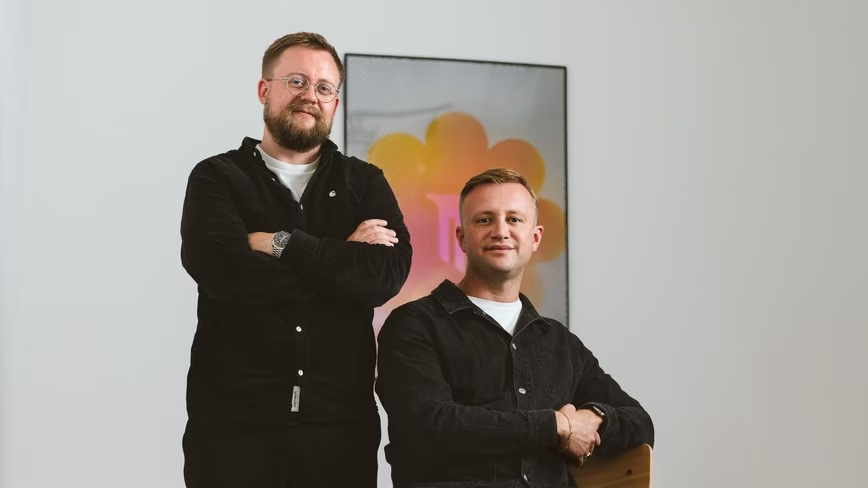
Pandektes co-founders Søren Brokær, left, and Casper Laursen, the company’s chief executive.
 Credit: Pandektes
Building a company like this requires relentlessness, belief and dedication. Every start-up will have low points, but we’ve always as founders had this die hard conviction that we could build a better and new way to do legal research, said Casper Laursen, CEO and co-founder of Pandektes.
The law is spread across millions of documents in many different places, and finding the right one takes lawyers a lot of time.
For decades, a handful of publishers have done that work for them, and in most European countries lawyers have had little choice but to pay for it.
In early 2023, Casper Laursen and Søren Brokær set out to change that with Pandektes, a tool that gathers these documents, organizes them, and helps lawyers quickly find what they need.
Even though many of the lawyers they pitched to warned them off, and neither founder had ever practiced law, they still pursued the idea.
There was general scepticism about the technology’s capabilities and possibilities in early 2023, they told us.
Three and a half years later, Pandektes has more than 500 customers and has just raised €13.5M. Munich-based Alstin Capital led the Series A, joined by PROfounders, Scale Capital and existing investors.
The raised capital will help the Copenhagen-based company expand from Denmark, Germany and Switzerland into more of Europe and North America.
“It’s a special sort of challenge to build a company into a highly monopolized market, and also one we heard many lawyers early on ‘warning’ us about,” Casper Laursen and Søren Brokær told us in an exclusive interview.
There were good reasons for the lawyers to be cautious, as in most European countries, it has long been the case that a single provider is the standard means of accessing the law, whether it is LexisNexis, Westlaw, Beck or Karnov.
Pandektes contends that this has made it costly to switch away from them, even as prices have continued to rise.
Coming from outside the profession made the early months harder still. Trust came more slowly than it would have for insiders, they said.
The technology was a hard sell too, because in early 2023 many lawyers were still unsure what large language models could really do.
From the outside, however, the founders could see something the industry had grown used to.
Most law is public, but gathering it from thousands of sources and keeping it reliable enough for court had always needed large editorial teams.
Laursen and Brøkær believed AI could take on much of that work and give lawyers a far stronger base to search from. Working out how to make it fit each area of law took countless conversations with practitioners.
For most companies, the first customer is the most special one. And their first customer arrived with a familiar problem.
Pandektes helped from day one, and the customer returned the favour with a steady stream of feedback. More than three years on, it still uses the platform.
“They’re still a customer with us to this day, more than 3 years later. We’re really proud of that. This organisation spent a lot of time researching procedural matters and had a heavy burden of knowledge sharing between seniors and juniors.”
“Pandektes added value there from day one, they provided a lot of feedback, and they’ve been happy users ever since,”Casper Laursen said to us.
Those first years, spent earning trust and building a body of data good enough to rely on, were the hardest.
Even so, Pandektes quickly brought an AI search product to market, and according to Laursen, the incumbents needed one to two years to respond.
“From that initial headstart we knew that we could keep outpacing them on product development and that we could eventually begin replacing them, which is what’s happening now,” Casper Laursen told us.
But after Pandektes raised €2.9M in seed funding in February 2025, just over 100 organisations were using the platform, according to Legal IT Insider.
The company reported that its revenue grew six times over the past year. About two out of three organisations that try the platform end up buying it, and many cancel their previous subscriptions.
Andreas Schenk, managing partner at Alstin Capital, put his firm’s interest down to that pent-up demand.
“We have rarely seen a market like legal research, where so many end-users would like to switch their core system but historically simply couldn’t,” he said.
When we asked about the hardest piece of law Pandektes had ever had to chase down, they could not name one, and that was exactly the problem.
“There isn’t one dramatic story, and that’s actually part of the point. Hard-to-find law isn’t the exception; it’s a structural problem,”Casper Laursen said.
So rather than hunting down documents one at a time, Pandektes continuously collects hard-to-reach sources, since they are often the ones that decide cases in court.
Some of the new money will open that collection to other developers through an API. Pandektes does not count legal AI workspaces, the tools firms use to draft and review documents, among its competitors.
When the conversation turned to people without any legal training, Laursen began with something already happening.
More and more people use general-purpose AI tools to understand their rights and stand up for themselves, and he welcomes it.
Yet smaller courts and administrative bodies that receive the results have told him they fall short.
“You get more legal-looking documents, but the arguments can miss important legal sources or the methodology needed to apply them correctly.”
Better chatbots alone will not close that gap, in his view. What people need is the same law, and the same reliable sources, that professionals already work with.
“If we get that right, someone without legal training should be able to understand their rights far more effectively than they can today, without pretending that legal expertise won’t matter,” Casper Laursen said.
Get the TNW newsletter
Get the most important tech news in your inbox each week.


